


-
Book Overview & Buying
-
Table Of Contents

Building Python Microservices with FastAPI
By :


Building Python Microservices with FastAPI
By:
Overview of this book
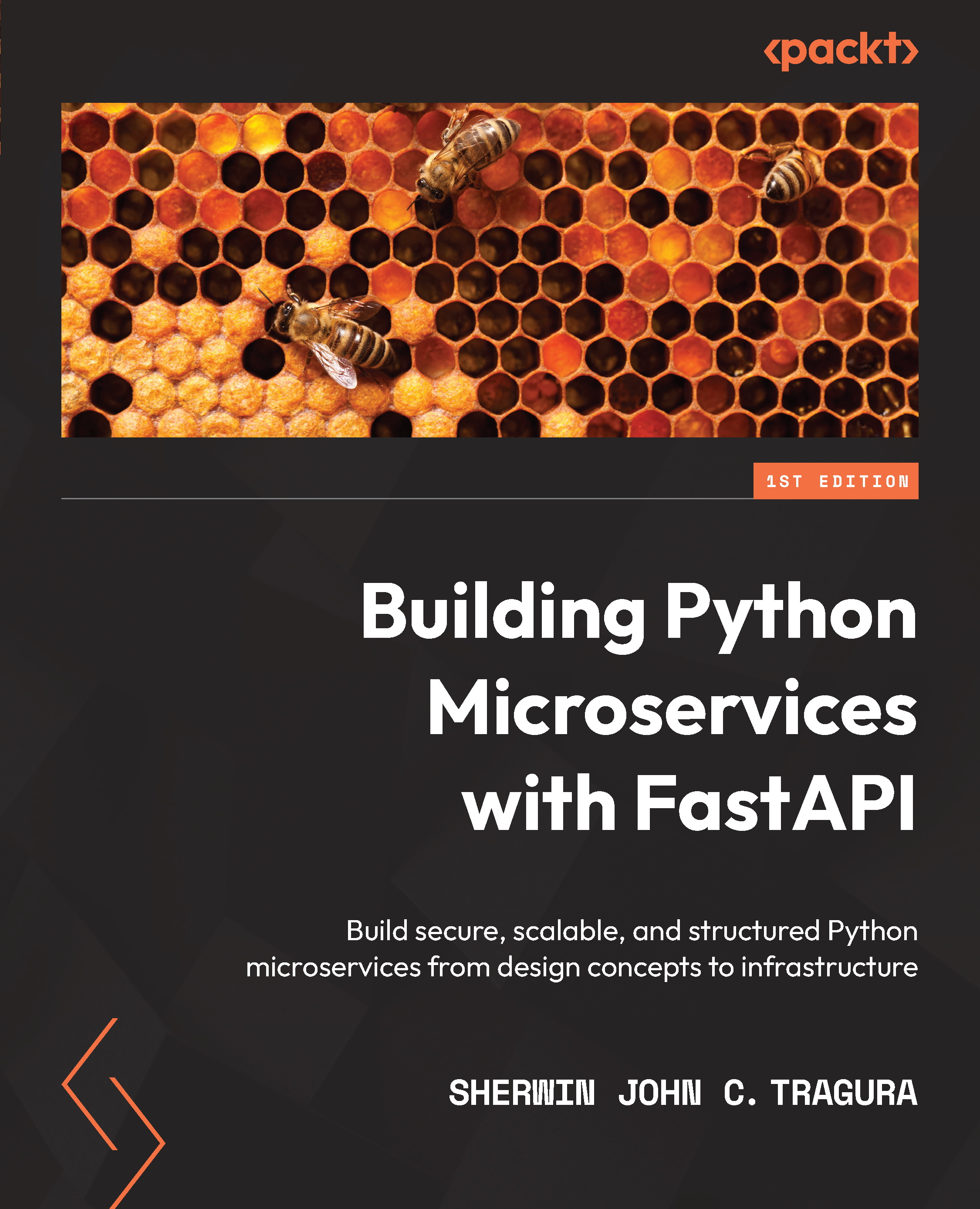
FastAPI is an Asynchronous Server Gateway Interface (ASGI)-based framework that can help build modern, manageable, and fast microservices. Because of its asynchronous core platform, this ASGI-based framework provides the best option when it comes to performance, reliability, and scalability over the WSGI-based Django and Flask. When working with Python, Flask, and Django microservices, you’ll be able to put your knowledge to work with this practical guide to building seamlessly manageable and fast microservices.
You’ll begin by understanding the background of FastAPI and learning how to install, configure, and use FastAPI to decompose business units. You’ll explore a unique and asynchronous REST API framework that can provide a better option when it comes to building microservices. After that, this book will guide you on how to apply and translate microservices design patterns in building various microservices applications and RESTful APIs using the FastAPI framework.
By the end of this microservices book, you’ll be able to understand, build, deploy, test, and experiment with microservices and their components using the FastAPI framework.
Table of Contents (17 chapters)
Preface


Part 1: Application-Related Architectural Concepts for FastAPI microservice development
 Free Chapter
Chapter 1: Setting Up FastAPI for Starters
Chapter 2: Exploring the Core Features
Chapter 3: Investigating Dependency Injection
Chapter 4: Building the Microservice Application
Part 2: Data-Centric and Communication-Focused Microservices Concerns and Issues
Chapter 5: Connecting to a Relational Database
Chapter 6: Using a Non-Relational Database
Chapter 7: Securing the REST APIs
Chapter 8: Creating Coroutines, Events, and Message-Driven Transactions
Part 3: Infrastructure-Related Issues, Numerical and Symbolic Computations, and Testing Microservices
Chapter 9: Utilizing Other Advanced Features
Chapter 10: Solving Numerical, Symbolic, and Graphical Problems
Chapter 11: Adding Other Microservice Features

Index
Other Books You May Enjoy



