Sign In Start Free Trial
Account

Add to playlist

Create a Playlist

Modal Close icon
You need to login to use this feature.
  • Book Overview & Buying Building Python Microservices with FastAPI
  • Table Of Contents Toc
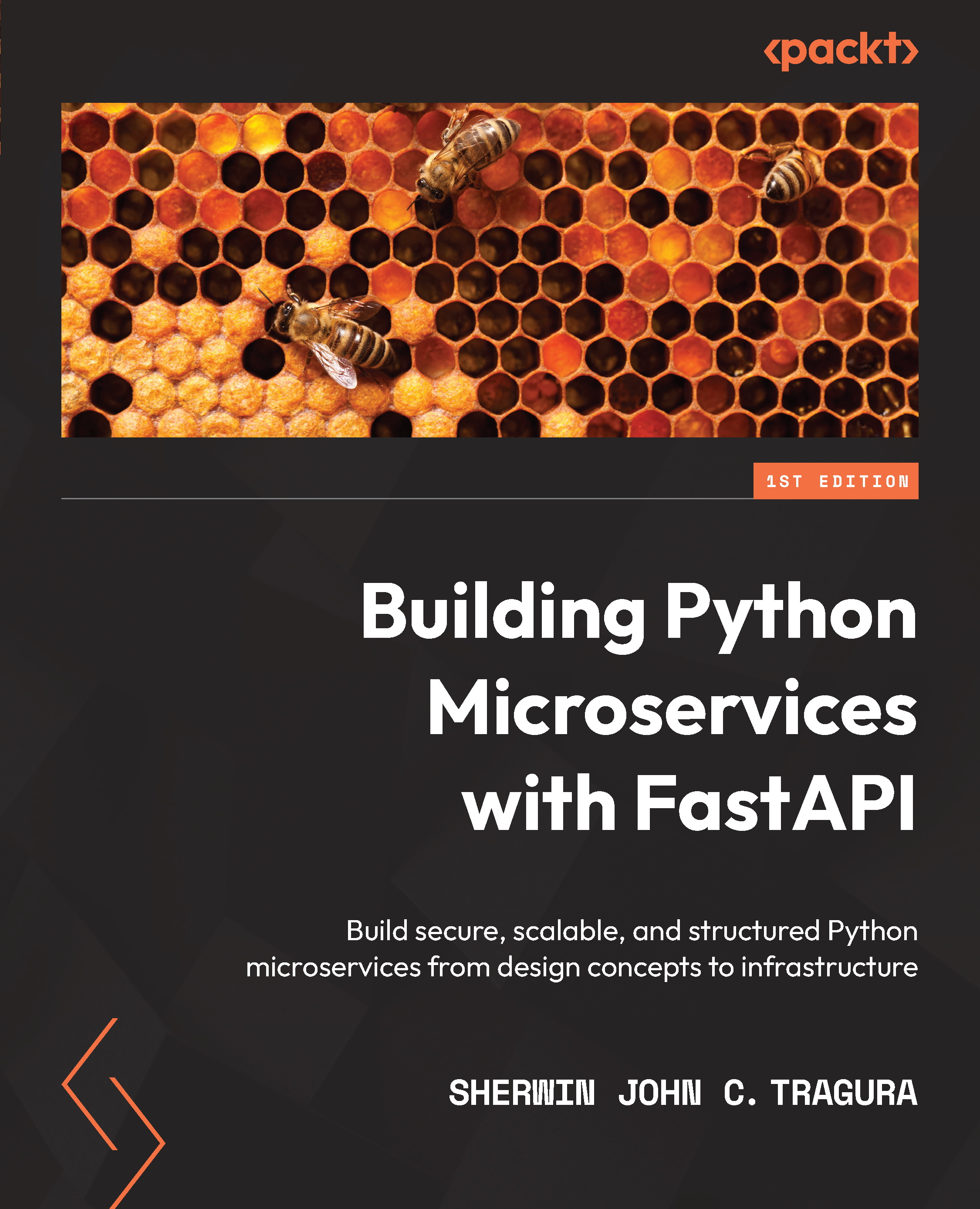
Building Python Microservices with FastAPI

Building Python Microservices with FastAPI

By : Sherwin John C. Tragura
4 (8)
close
close
Building Python Microservices with FastAPI

Building Python Microservices with FastAPI

4 (8)
By: Sherwin John C. Tragura

Overview of this book

FastAPI is an Asynchronous Server Gateway Interface (ASGI)-based framework that can help build modern, manageable, and fast microservices. Because of its asynchronous core platform, this ASGI-based framework provides the best option when it comes to performance, reliability, and scalability over the WSGI-based Django and Flask. When working with Python, Flask, and Django microservices, you’ll be able to put your knowledge to work with this practical guide to building seamlessly manageable and fast microservices. You’ll begin by understanding the background of FastAPI and learning how to install, configure, and use FastAPI to decompose business units. You’ll explore a unique and asynchronous REST API framework that can provide a better option when it comes to building microservices. After that, this book will guide you on how to apply and translate microservices design patterns in building various microservices applications and RESTful APIs using the FastAPI framework. By the end of this microservices book, you’ll be able to understand, build, deploy, test, and experiment with microservices and their components using the FastAPI framework.
Table of Contents (17 chapters)
close
close
1
Part 1: Application-Related Architectural Concepts for FastAPI microservice development
6
Part 2: Data-Centric and Communication-Focused Microservices Concerns and Issues
11
Part 3: Infrastructure-Related Issues, Numerical and Symbolic Computations, and Testing Microservices

Setting Up FastAPI for Starters

In any software development work, it is always important to first know the business requirement of the project and the appropriate framework, tools, and deployment platform to use before pursuing the task. Frameworks that are easy to understand and use, seamless during coding, and within standards are always picked because of the integrity they provide to solve problems without risking too much development time. And a promising Python framework called FastAPI, created by Sebastian Ramirez, provides experienced developers, experts, and enthusiasts the best option for building REST APIs and microservices.

But before proceeding to the core details of building microservices using FastAPI, it is best to first learn the building blocks of this framework, such as how it captures clients’ requests, how it builds the rules for each HTTP method, and how it manages HTTP responses. Learning the basic components is always essential to know the strengths and weaknesses of the framework and to what extent we can apply FastAPI to solve different enterprise-grade and microservices-related problems.

Thus, in this chapter, we’re going to have a walkthrough of the basic features of FastAPI by covering the following main topics:

  • The setup of the development environment
  • Initialization and configuration of FastAPI
  • Design and implementation of the REST APIs
  • Managing user requests and server response
  • Handling form parameters
  • Handling cookies
Visually different images
CONTINUE READING
83
Tech Concepts
36
Programming languages
73
Tech Tools
Icon Unlimited access to the largest independent learning library in tech of over 8,000 expert-authored tech books and videos.
Icon Innovative learning tools, including AI book assistants, code context explainers, and text-to-speech.
Icon 50+ new titles added per month and exclusive early access to books as they are being written.
Building Python Microservices with FastAPI
notes
bookmark Notes and Bookmarks search Search in title playlist Add to playlist download Download options font-size Font size

Change the font size

margin-width Margin width

Change margin width

day-mode Day/Sepia/Night Modes

Change background colour

Close icon Search
Country selected

Close icon Your notes and bookmarks

Confirmation

Modal Close icon
claim successful

Buy this book with your credits?

Modal Close icon
Are you sure you want to buy this book with one of your credits?
Close
YES, BUY

Submit Your Feedback

Modal Close icon
Modal Close icon
Modal Close icon