Sign In Start Free Trial
Account

Add to playlist

Create a Playlist

Modal Close icon
You need to login to use this feature.
  • Book Overview & Buying Flask Framework Cookbook
  • Table Of Contents Toc
Flask Framework Cookbook

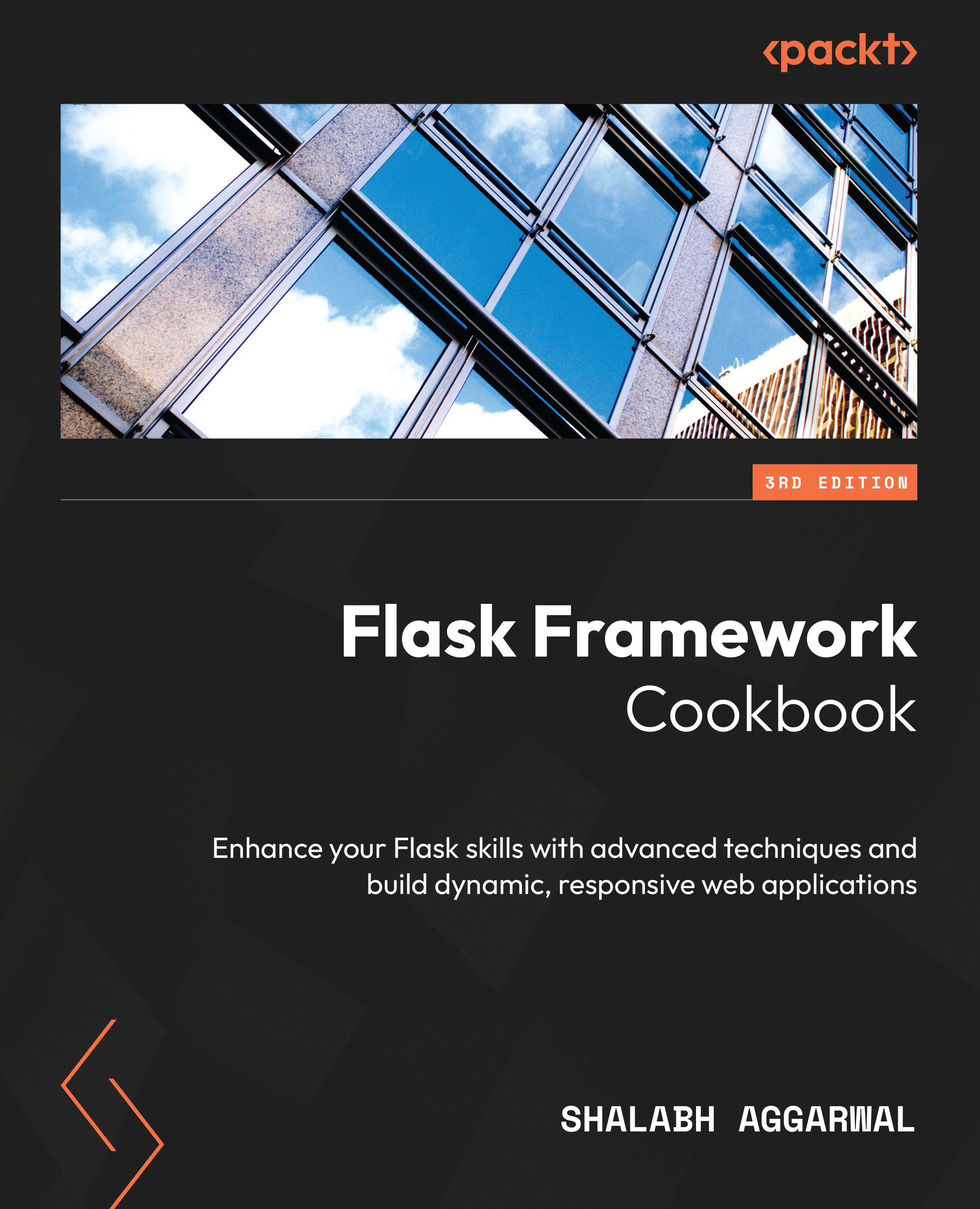
Flask Framework Cookbook - Third Edition

By : Shalabh Aggarwal
5 (10)
close
close
Flask Framework Cookbook

Flask Framework Cookbook

5 (10)
By: Shalabh Aggarwal

Overview of this book

Discover what makes Flask, the lightweight Python web framework, popular, as you delve into its modular design that enables the development of scalable web apps. With this practical guide, you'll explore modern solutions, recommended design patterns, and best practices for Flask web development. Updated to the latest version of Flask and Python, this third edition of the Flask Framework Cookbook moves away from the outdated libraries, updates content to incorporate new coding patterns, and introduces recipes for the latest tools. You'll explore different ways to integrate with GPT to build AI-ready Flask applications. The book starts with an exploration of Flask application configurations and then guides you through working with templates and understanding the ORM and view layers. You’ll also be able to write an admin interface and get to grips with testing using the factory pattern, debugging, and logging errors. Then you’ll discover different ways of using Flask to create, deploy, and manage microservices using AWS, GCP, and Kubernetes. Finally, you’ll gain insights into various deployment and post-deployment techniques for platforms such as Apache, Tornado, and Datadog. By the end of this book, you'll have acquired the knowledge necessary to write Flask applications that cater to a wide range of use cases in the best possible way and scale them using standard industry practices.
Table of Contents (20 chapters)
close
close
1
Part 1: Flask Fundamentals
6
Part 2: Flask Deep Dive
12
Part 3: Advanced Flask

Being deployment-specific with the instance folder

Flask provides yet another method for configuration, where we can efficiently manage deployment-specific parts. Instance folders allow us to segregate deployment-specific files from our version-controlled application. We know that configuration files can be separate for different deployment environments, such as development and production, but there are also many more files, such as database files, session files, cache files, and other runtime files. In this recipe, we will create an instance folder that will act like a holder container for such kinds of files. By design, the instance folder will not be a part of the version control system.

How to do it...

By default, the instance folder is picked up from the application automatically if we have a folder named instance in our application at the application level, as follows:

my_app/
    app.py
    instance/
        config.cfg

We can also explicitly define the absolute path of the instance folder by using the instance_path parameter on our application object, as follows:

app = Flask(
    __name__,
    instance_path='/absolute/path/to/instance/folder')

To load the configuration file from the instance folder, we can use the instance_relative_config parameter on the application object, as follows:

app = Flask(__name__, instance_relative_config=True)

This tells the application to load the configuration file from the instance folder. The following example shows how to configure this:

app = Flask(
    __name__, instance_path='path/to/instance/folder',
    instance_relative_config=True
)
app.config.from_pyfile('config.cfg', silent=True)

How it works...

In the preceding code, first, the instance folder is loaded from the given path; then, the configuration file is loaded from the config.cfg file in the given instance folder. Here, silent=True is optional and is used to suppress the error if config.cfg is not found in the instance folder. If silent=True is not given and the file is not found, then the application will fail, giving the following error:

IOError: [Errno 2] Unable to load configuration file (No such file or directory): '/absolute/path/to/config/file'

Information

It might seem that loading the configuration from the instance folder using instance_relative_config is redundant work and could be moved to one of the configuration methods itself. However, the beauty of this process lies in the fact that the instance folder concept is completely independent of configuration, and instance_relative_config just complements the configuration object.

CONTINUE READING
83
Tech Concepts
36
Programming languages
73
Tech Tools
Icon Unlimited access to the largest independent learning library in tech of over 8,000 expert-authored tech books and videos.
Icon Innovative learning tools, including AI book assistants, code context explainers, and text-to-speech.
Icon 50+ new titles added per month and exclusive early access to books as they are being written.
Flask Framework Cookbook
notes
bookmark Notes and Bookmarks search Search in title playlist Add to playlist download Download options font-size Font size

Change the font size

margin-width Margin width

Change margin width

day-mode Day/Sepia/Night Modes

Change background colour

Close icon Search
Country selected

Close icon Your notes and bookmarks

Confirmation

Modal Close icon
claim successful

Buy this book with your credits?

Modal Close icon
Are you sure you want to buy this book with one of your credits?
Close
YES, BUY

Submit Your Feedback

Modal Close icon
Modal Close icon
Modal Close icon