Sign In Start Free Trial
Account

Add to playlist

Create a Playlist

Modal Close icon
You need to login to use this feature.
  • Book Overview & Buying Angular for Enterprise Applications
  • Table Of Contents Toc
  • Feedback & Rating feedback
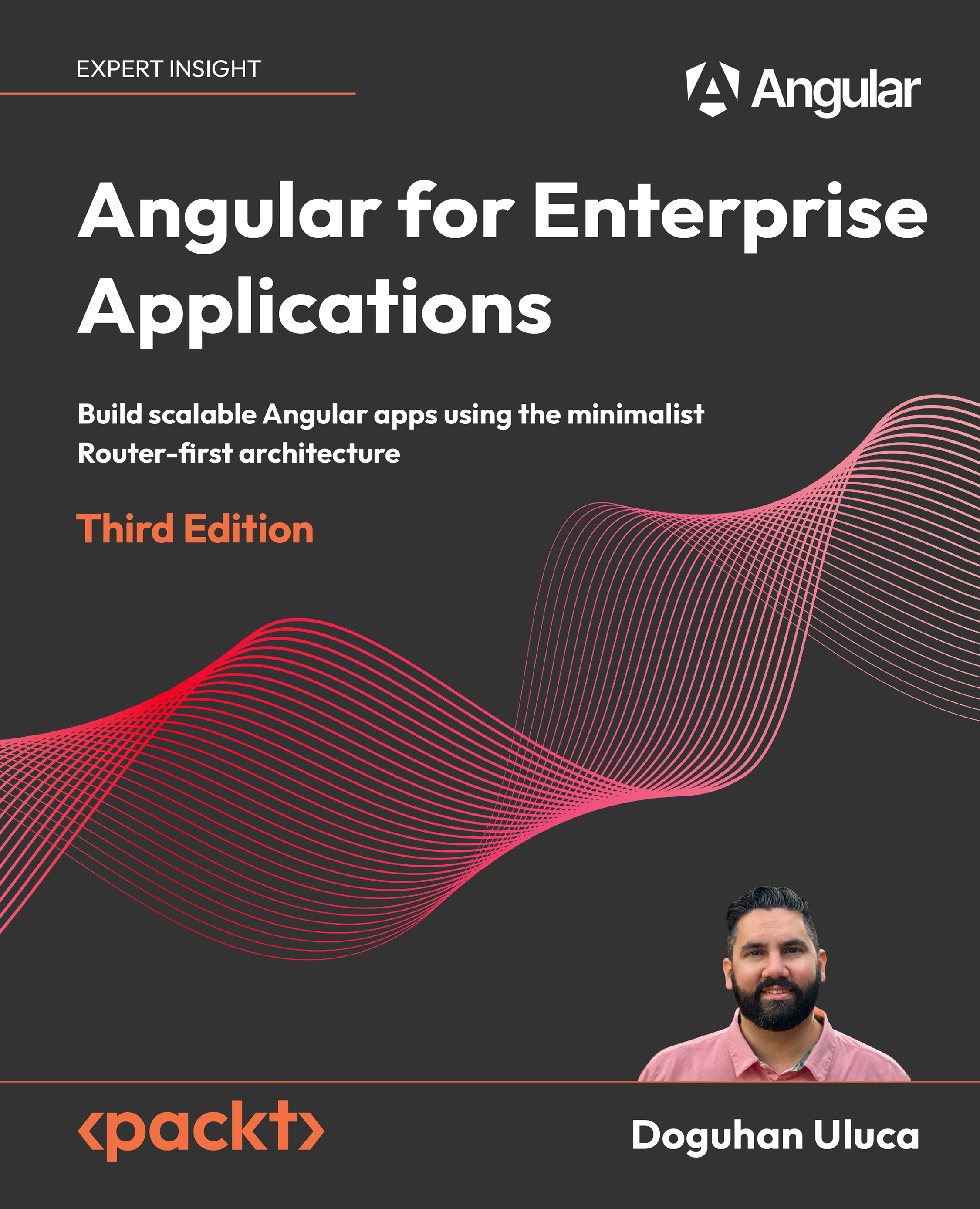
Angular for Enterprise Applications

Angular for Enterprise Applications - Third Edition

By : Doguhan Uluca
4.9 (7)
close
close
Angular for Enterprise Applications

Angular for Enterprise Applications

4.9 (7)
By: Doguhan Uluca

Overview of this book

If you’re looking to upskill and build sophisticated, minimalist web applications suited for enterprise use, Angular for Enterprise Applications is your guide to the next level of engineering mastery. In its third edition, this Angular book distils hard-earned lessons into a lucid roadmap for success. Adopting a pragmatic approach founded on a robust technical base, you'll utilize both JavaScript and TypeScript fundamentals. You'll also embrace agile engineering coding principles and learn to architect optimally sized enterprise solutions employing the freshest concepts in Angular. You’ll gradually build upon this foundation through insightful recipes, sample apps, and crystal-clear explanations. You’ll master authentication and authorization and achieve optimal performance through reactive programming and lazy loading, build complex yet flexible UIs with Router-first principles, and then integrate with backend systems using REST and GraphQL APIs. You’ll cover modern tools like RxAngular, Qwik, and Signals. You’ll construct master/detail views using data tables and NgRx for state management. You’ll explore DevOps using Docker and build CI/CD pipelines necessary for high-performance teams. By the end of this book, you’ll be proficient in leveraging Angular in enterprise and design robust systems that scale effortlessly.
Table of Contents (14 chapters)
close
close
11
Other Books You May Enjoy
12
Index

Angular’s Architecture and Concepts

Angular is a popular Single-Page Application (SPA) framework for building web applications. It is often preferred in enterprise application development because it is an opinionated, batteries-included framework that supports type-checking with TypeScript and concepts like Dependency Injection (DI) that allow for engineering scalable solutions by large teams. In contrast, React is a flexible and unopinionated library rather than a complete framework, requiring developers to pick their flavor from the community to build fully featured applications.

React is undoubtedly the more popular choice of the two. The numbers don’t lie. React’s easier learning curve and deceptively small and simple starting point have attracted the attention of many developers. The many “Angular vs React” articles you have undoubtedly encountered online add to the confusion. These articles are usually too shallow, often contain misleading information about Angular, and lack insights into the very bright future of Angular.

This chapter aims to give you a deeper understanding of why Angular exists, the variety of patterns and paradigms you can leverage to solve complex problems, and, later in the book, the pitfalls to avoid as you scale your solution. It’s important to take your time to read through this material because every journey begins with a choice. The real story of your choice today can only be written several years into a project when it’s too late and expensive to switch technologies.

This chapter covers the following topics:

  • Two Angulars
  • A brief history of web frameworks
  • Angular and the philosophies behind it
  • Component architecture
  • Reactive programming
  • Modular architecture
  • Standalone architecture
  • Angular Router
  • State management
  • React.js architecture
  • The future of Angular

Chapter 2, Forms, Observables, Signals, and Subjects, covers Angular fundamental concepts and building blocks. Chapter 3, Architecting an Enterprise App, covers technical, architectural, and tooling concerns for delivering large applications. With Chapter 4, Creating a Router-First Line-of-Business App, we dive into creating scalable Angular applications ready for the enterprise.

Each chapter introduces new concepts and progressively builds on best practices while covering optimal working methods with popular open-source tools. Along the way, tips and information boxes provide additional background and history, numbered steps, and bullet points that describe actions you need to take.

The code samples provided in this book have been developed using Angular 17. Since the second edition, significant changes occurred in the JavaScript and Angular ecosystems. The transition to Angular’s Ivy engine meant some third-party tools stopped working. ESLint has superseded TSLint. Karma and Jasmine have become outdated and superseded by Jest or the more modern Vitest. Significant headway was made in replacing commonjs modules with ES modules (ESM). The totality of these changes meant that much of the second edition’s supporting tools were beyond repair. As a lesson learned, the example projects now utilize minimal tooling to allow for the best possible DevEx with the least possible amount of npm packages installed. The core samples of the book, which intentionally avoided third-party libraries, were initially written for Angular 5 and have survived the test of time. This book adopts the Angular Evergreen motto and encourages incremental, proactive, and timely upgrades of your dependencies to maintain the health of your project and your team.

This book is supported by the companion site https://AngularForEnterprise.com. Visit the site for the latest news and updates.

The world of JavaScript, TypeScript, and Angular is constantly changing. To maintain consistency for my readers, I published a collection of open-source projects that support the content of the book:

A screenshot of a computer  Description automatically generated

Figure 1.1: Code developed in support of this book

The diagram above shows you the moving parts that make up the technical content supporting this book. Each component is detailed in the coming chapters. The code samples contain chapter-by-chapter snapshots and the final state of the code. The most up-to-date versions of the sample code for the book are on GitHub at the repositories linked below:

You may read more about updating Angular in the supplemental reading, Keeping Angular and Tools Evergreen, available at https://angularforenterprise.com/evergreen.

Now that you’re oriented with the book’s structure and supporting content, and before we dive into a prolonged history of the web, let’s first disambiguate the two major architectures of Angular and the underlying themes that motivated a dramatic rewrite of the framework in 2016.

Visually different images
CONTINUE READING
83
Tech Concepts
36
Programming languages
73
Tech Tools
Icon Unlimited access to the largest independent learning library in tech of over 8,000 expert-authored tech books and videos.
Icon Innovative learning tools, including AI book assistants, code context explainers, and text-to-speech.
Icon 50+ new titles added per month and exclusive early access to books as they are being written.
Angular for Enterprise Applications
notes
bookmark Notes and Bookmarks search Search in title playlist Add to playlist download Download options font-size Font size

Change the font size

margin-width Margin width

Change margin width

day-mode Day/Sepia/Night Modes

Change background colour

Close icon Search
Country selected

Close icon Your notes and bookmarks

Confirmation

Modal Close icon
claim successful

Buy this book with your credits?

Modal Close icon
Are you sure you want to buy this book with one of your credits?
Close
YES, BUY

Submit Your Feedback

Modal Close icon
Modal Close icon
Modal Close icon