Sign In Start Free Trial
Account

Add to playlist

Create a Playlist

Modal Close icon
You need to login to use this feature.
  • Book Overview & Buying Angular for Enterprise Applications
  • Table Of Contents Toc
  • Feedback & Rating feedback
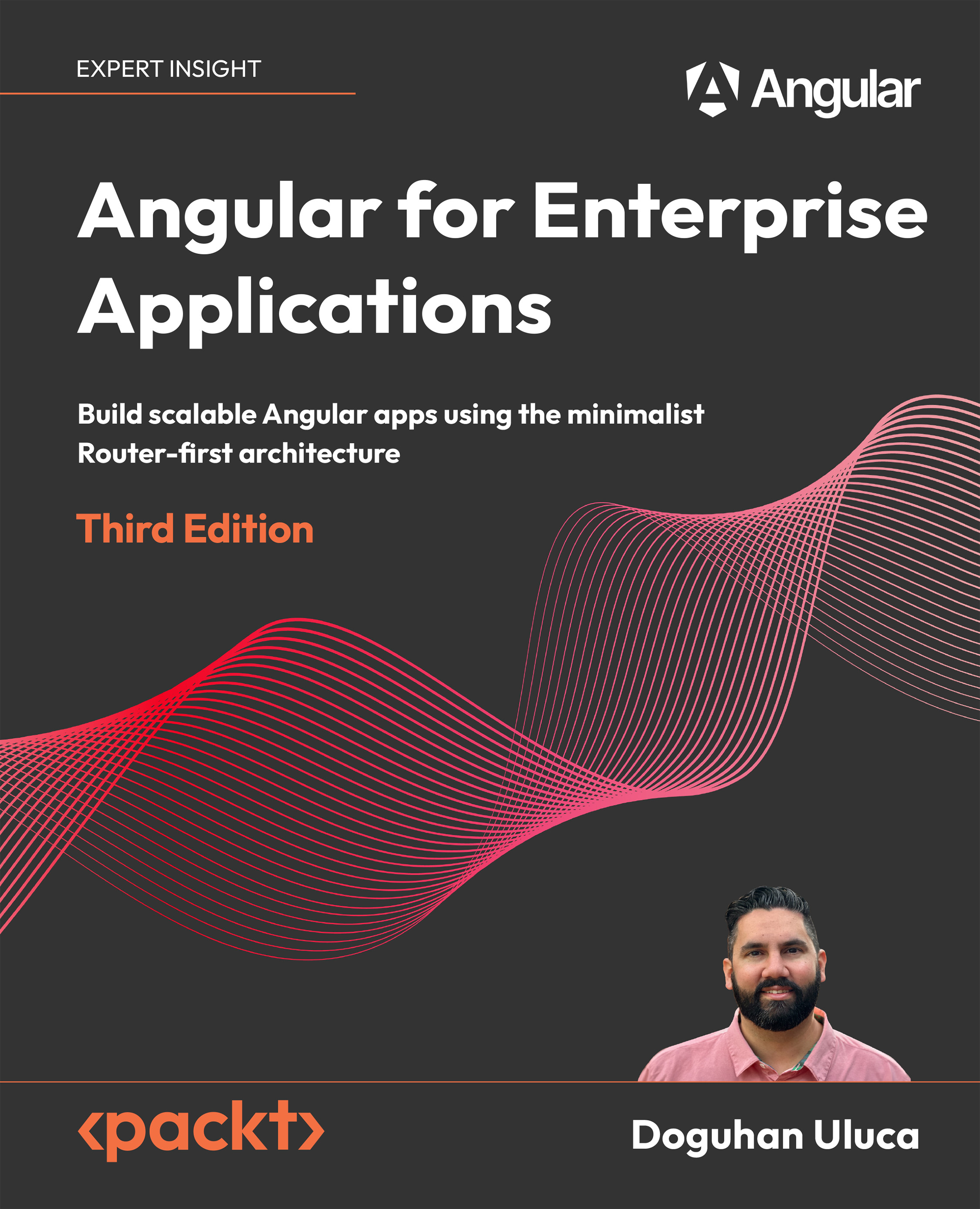
Angular for Enterprise Applications

Angular for Enterprise Applications - Third Edition

By : Doguhan Uluca
4.9 (7)
close
close
Angular for Enterprise Applications

Angular for Enterprise Applications

4.9 (7)
By: Doguhan Uluca

Overview of this book

If you’re looking to upskill and build sophisticated, minimalist web applications suited for enterprise use, Angular for Enterprise Applications is your guide to the next level of engineering mastery. In its third edition, this Angular book distils hard-earned lessons into a lucid roadmap for success. Adopting a pragmatic approach founded on a robust technical base, you'll utilize both JavaScript and TypeScript fundamentals. You'll also embrace agile engineering coding principles and learn to architect optimally sized enterprise solutions employing the freshest concepts in Angular. You’ll gradually build upon this foundation through insightful recipes, sample apps, and crystal-clear explanations. You’ll master authentication and authorization and achieve optimal performance through reactive programming and lazy loading, build complex yet flexible UIs with Router-first principles, and then integrate with backend systems using REST and GraphQL APIs. You’ll cover modern tools like RxAngular, Qwik, and Signals. You’ll construct master/detail views using data tables and NgRx for state management. You’ll explore DevOps using Docker and build CI/CD pipelines necessary for high-performance teams. By the end of this book, you’ll be proficient in leveraging Angular in enterprise and design robust systems that scale effortlessly.
Table of Contents (14 chapters)
close
close
11
Other Books You May Enjoy
12
Index

Two Angulars

In its original incarnation, Angular.js, aka 1.x, pioneered the SPA era, a technique that tricks the browser into thinking that a single index.html houses an interactive application containing many pages. Angular.js also popularized the concept of two-way binding in web development, which automatically updates the view to match the state of the ViewModel. To implement such a feature, Angular.js used Change Detection to keep track of Document Object Model (DOM) elements of the browser and the ViewModel state of the application.

Change Detection depends on a sophisticated rendering loop to detect user interactions and other events to determine if the application needs to react to changes. Whenever a rendering loop is involved, like in games, performance can be measured as a frame rate expressed in Frames per Second (FPS). A slow change detection process results in a low FPS count, translating into a choppy User Experience (UX). With the demand for more interactive and complicated web applications, it became clear that the internal architecture of Angular.js couldn’t be improved to maintain a consistent FPS output. However, UX and performance are only one side of the experience story. As an application grows more complicated better tooling is needed to support a great Developer Experience (DevEx) – sometimes called DevX or DX – which is key to developer wellbeing.

The Angular 2 rewrite, now simply referred to as Angular, aimed to solve both sides of the problem. Before frameworks and libraries like React, Angular, and Vue, we suffered from unmanaged complexity and JavaScript-framework-of-the-week syndrome. These frameworks succeeded with promises to fix all problems, bring about universally reusable web components, and make it easier to learn, develop, and scale web applications- at least for a while, some being better than others during different periods. The same problems that plagued early SPA are returning as the demand for ever more complicated web experiences increases, and the tooling to resolve these problems grows ever complex. To master Angular or any other modern framework, it is critical to learn about the past, present, and future of web development. The adolescent history of the web has taught us a couple of essential lessons. First, change is inevitable, and second, the developer’s happiness is a precious commodity that can make or break entire companies.

As you can see, Angular’s development has been deeply impacted by performance, UX, and DevEx concerns. But this wasn’t a unique problem that only impacted Angular. Let’s roll back the clock further and look at the last quarter century or so of web development history so that you can contextualize modern frameworks like Angular, React, and Vue.

Visually different images
CONTINUE READING
83
Tech Concepts
36
Programming languages
73
Tech Tools
Icon Unlimited access to the largest independent learning library in tech of over 8,000 expert-authored tech books and videos.
Icon Innovative learning tools, including AI book assistants, code context explainers, and text-to-speech.
Icon 50+ new titles added per month and exclusive early access to books as they are being written.
Angular for Enterprise Applications
notes
bookmark Notes and Bookmarks search Search in title playlist Add to playlist download Download options font-size Font size

Change the font size

margin-width Margin width

Change margin width

day-mode Day/Sepia/Night Modes

Change background colour

Close icon Search
Country selected

Close icon Your notes and bookmarks

Confirmation

Modal Close icon
claim successful

Buy this book with your credits?

Modal Close icon
Are you sure you want to buy this book with one of your credits?
Close
YES, BUY

Submit Your Feedback

Modal Close icon
Modal Close icon
Modal Close icon