


-
Book Overview & Buying
-
Table Of Contents

Rust Web Programming - Third Edition
By :


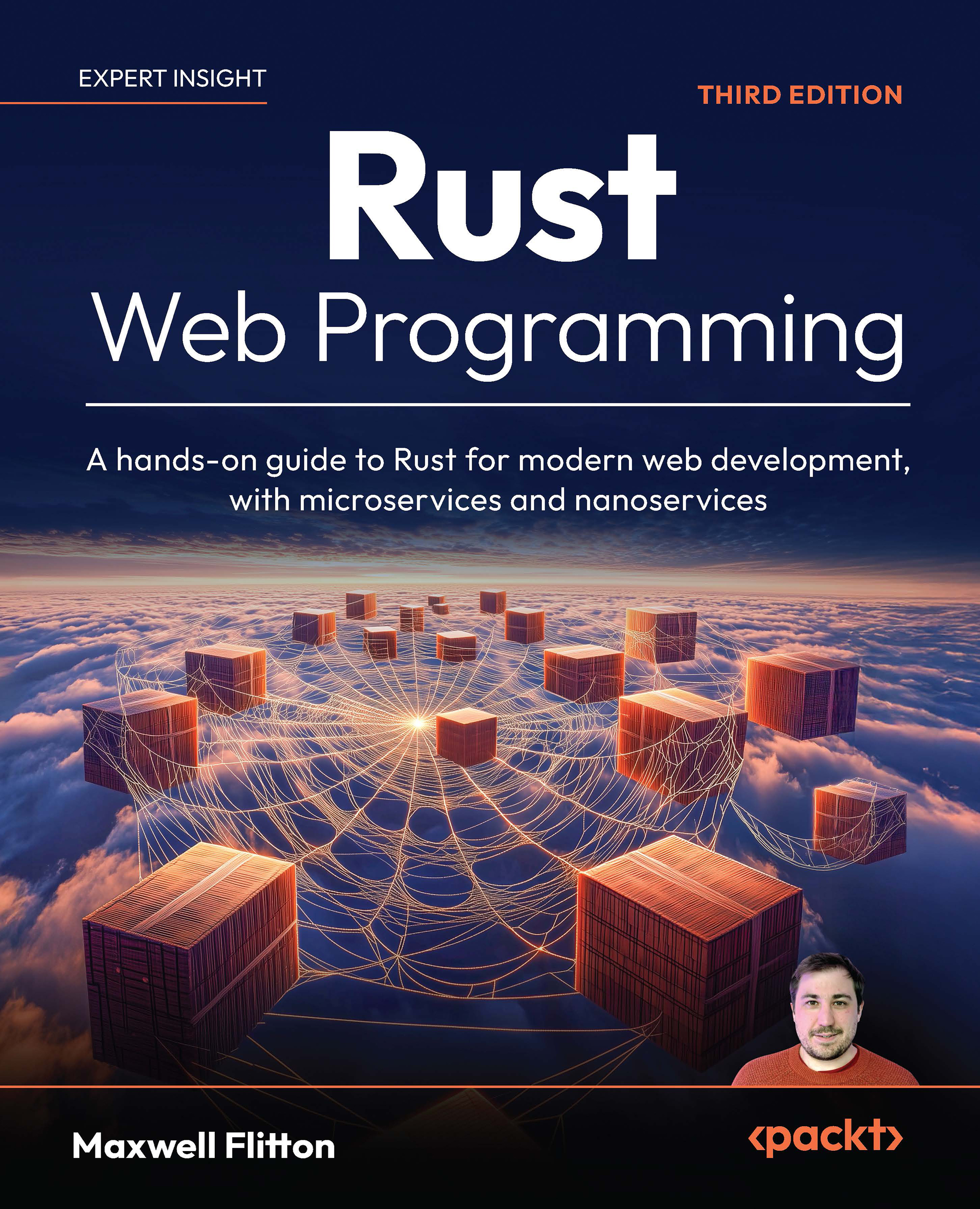
Rust Web Programming
By:
Overview of this book
Rust is no longer just for systems programming. This book will show you why this safe and performant language is a crucial up-and-coming option for developing web applications, and get you on your way to building fully functional Rust web apps. You don’t need any experience with Rust to get started, and this new edition also comes with a shallower learning curve.
You’ll get hands-on with emerging Rust web frameworks including Actix, Axum, Rocket, and Hyper. You’ll look at injecting Rust into the frontend with WebAssembly and HTTPS configuration with NGINX. Later, you’ll move on to more advanced async topics, exploring TCP and framing, and implementing async systems.
As you work through the book, you’ll build a to-do application with authentication using a microservice architecture that compiles into one Rust binary, including the embedding of a frontend JavaScript application in the same binary. The application will have end-to-end atomic testing and a deployment pipeline.
By the end of this book, you’ll fully understand the significance of Rust for web development. You’ll also have the confidence to build robust, functional, and scalable Rust web applications from scratch.
Table of Contents (24 chapters)
Preface


 Free Chapter
A Quick Introduction to Rust

Useful Rust Patterns for Web Programming
Designing Your Web Application in Rust
Async Rust
Handling HTTP Requests
Processing HTTP Requests
Displaying Content in the Browser
Injecting Rust in the Frontend with WebAssembly
Data Persistence with PostgreSQL
Managing User Sessions
Communicating Between Servers
Caching Auth Sessions
Observability Through Logging
Unit Testing
End-to-End Testing
Deploying Our Application on AWS
Configuring HTTPS with NGINX on AWS
Practicalities of Using Microservices and Nanoservices
Low-Level Networking
Distributed Computing
Unlock Your Exclusive Benefits
Other Books You May Enjoy
Index


