
Sign In Start Free Trial
Account

Add to playlist

Create a Playlist

Modal Close icon
You need to login to use this feature.
  • Book Overview & Buying Learning ArcGIS Pro 2
  • Table Of Contents Toc
Learning ArcGIS Pro 2

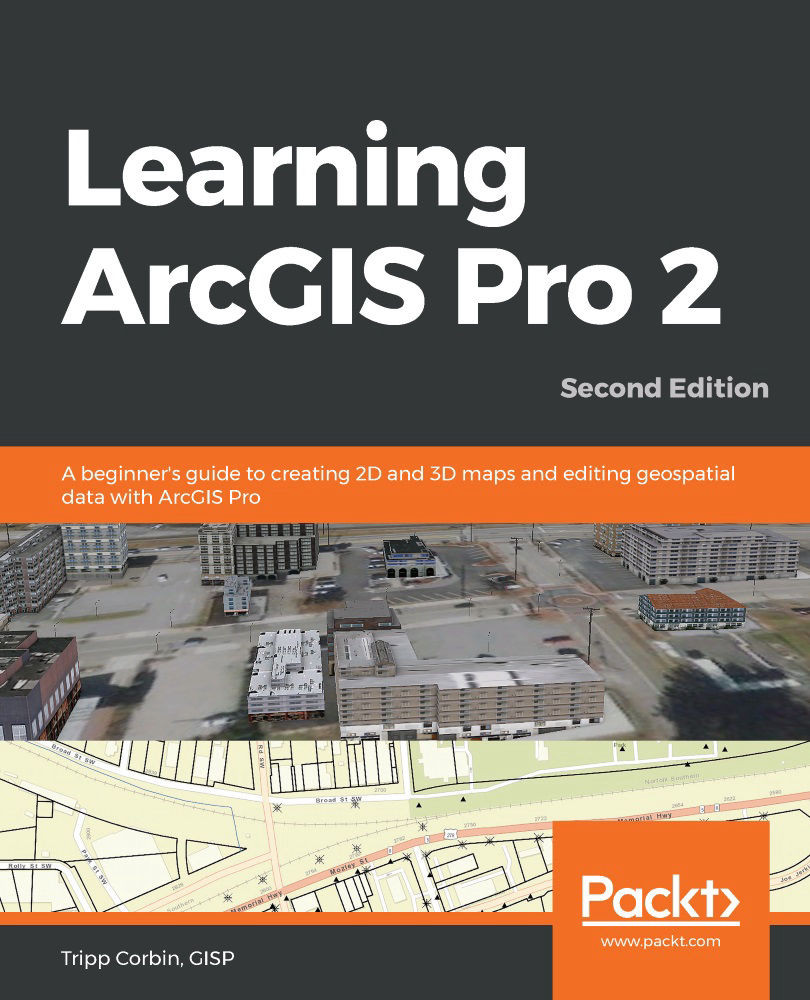
Learning ArcGIS Pro 2 - Second Edition

By : Tripp Corbin, GISP
4.8 (4)
close
close
Learning ArcGIS Pro 2

Learning ArcGIS Pro 2

4.8 (4)
By: Tripp Corbin, GISP

Overview of this book

Armed with powerful tools to visualize, maintain, and analyze data, ArcGIS Pro 2 is Esri's newest desktop geographic information system (GIS) application that uses the modern ribbon interface and a 64-bit processor to make using GIS faster and more efficient. This second edition of Learning ArcGIS Pro will show you how you can use this powerful desktop GIS application to create maps, perform spatial analysis, and maintain data. The book begins by showing you how to install ArcGIS and listing the software and hardware prerequisites. You’ll then understand the concept of named user licensing and learn how to navigate the new ribbon interface to leverage the power of ArcGIS Pro for managing geospatial data. Once you’ve got to grips with the new interface, you’ll build your first GIS project and understand how to use the different project resources available. The book shows you how to create 2D and 3D maps by adding layers and setting and managing the symbology and labeling. You’ll also discover how to use the analysis tool to visualize geospatial data. In later chapters, you’ll be introduced to Arcade, the new lightweight expression language for ArcGIS, and then advance to creating complex labels using Arcade expressions. Finally, you'll use Python scripts to automate and standardize tasks and models in ArcGIS Pro. By the end of this ArcGIS Pro book, you’ll have developed the core skills needed for using ArcGIS Pro 2.x competently.
Table of Contents (20 chapters)
close
close
1
Section 1: Introducing and Navigating ArcGIS Pro
4
Section 2: Visualizing, Maintaining, and Analyzing Data
13
Section 3: Sharing Data and Automating processes
18
GIS glossary
Introducing ArcGIS Pro

Esri's ArcGIS platform has become well-entrenched as the primary solution for GIS professionals seeking to implement a scalable integrated solution, which can start with a single user and grow to support multiple users across various platforms. With ArcGIS Desktop, ArcGIS Enterprise, ArcGIS Online, and ArcGIS Apps, Geographic Information System (GIS) professionals can design and implement a robust GIS solution that provides a wide range of functionality to meet the needs of a growing enterprise, which includes users of various skill levels, requirements, differing platforms, and data formats. However, Esri has not been content to rest on their laurels. They continue to push the GIS envelope.

In 2015, Esri released a new desktop GIS application named ArcGIS Pro. ArcGIS Pro has replaced ArcMap and ArcCatalog as the flagship desktop GIS application in Esri's solution stack. Those are not the only applications ArcGIS Pro has replaced. It has also replaced the ArcScene and ArcGlobe applications for 3D data viewing and analysis.

ArcGIS Pro is a completely new application from Esri. It is not just an update to their venerable ArcGIS Desktop platform. ArcGIS Pro has a modern ribbon interface that has become common in most current desktop applications. It is also designed from the ground up to take full advantage of modern hyperthreaded 64-bit architecture. This greatly improves its performance compared to the older applications it is replacing. In this chapter, we will begin to take a look at this new robust and smart interface.

ArcGIS Pro also introduces a new licensing model to Esri users. While it still supports the traditional Single Use and Concurrent Use license models of previous applications, at least for now, it defaults to the use of a subscription-based named user license model. This new license model requires you to manage your licenses through ArcGIS Online or ArcGIS Enterprise Portal. You will learn more about this later in the chapter.

ArcGIS Pro allows you to combine 2D and 3D content within a single application. In the past, you would need to utilize multiple applications, such as ArcMap, ArcScene, and ArcGlobe, to view 2D and 3D content. In this chapter, you will examine how you can view both 2D and 3D data within a single ArcGIS Pro project.

Here, the following topics will be covered:

  • Checking requirements for installing ArcGIS Pro
  • Downloading and installing ArcGIS Pro
  • Managing and assigning ArcGIS Pro licenses

Once you have completed this chapter, you will be able to successfully install ArcGIS Pro on your computer, know whether your computer is capable of running the application, assign yourself and other users licenses to use ArcGIS Pro, and open an ArcGIS Pro project.

CONTINUE READING
83
Tech Concepts
36
Programming languages
73
Tech Tools
Icon Unlimited access to the largest independent learning library in tech of over 8,000 expert-authored tech books and videos.
Icon Innovative learning tools, including AI book assistants, code context explainers, and text-to-speech.
Icon 50+ new titles added per month and exclusive early access to books as they are being written.
Learning ArcGIS Pro 2
notes
bookmark Notes and Bookmarks search Search in title playlist Add to playlist font-size Font size

Change the font size

margin-width Margin width

Change margin width

day-mode Day/Sepia/Night Modes

Change background colour

Close icon Search
Country selected

Close icon Your notes and bookmarks

Confirmation

Modal Close icon
claim successful

Buy this book with your credits?

Modal Close icon
Are you sure you want to buy this book with one of your credits?
Close
YES, BUY

Submit Your Feedback

Modal Close icon
Modal Close icon
Modal Close icon