-
Book Overview & Buying
-
Table Of Contents
Celtx: Open Source Screenwriting Beginner's Guide
By :
This book is about dreams: yours, mine, all sorts of creative people's dreams. Today's inexpensive yet powerful software, computers, cameras, and so forth create visual productions—whether they are movies, audio-visual, audio plays, stage presentations, and more—and now bring them within the reach of most of us.
Here's the secret for turning an amateurish mish mash into a sharp professional piece people will pay you money for—write it down. Script it. In that aspect, Celtx makes dreams come true.
Writing screenplays—especially the free part—is what first attracted me to Celtx a few years ago. However, Celtx is much more than just script writing software! Here are just a few of the many things you can create with Celtx automatically formatted to industry standards:
Some of these things will make you money, and some you will just do for fun. These and more we'll look at in the course of this book—how to do them, what to do with them (marketing tips), and all sorts of other good stuff. We'll have fun, all while becoming downright proficient with Celtx.
While this book emphasizes Celtx as script formatting software, the entire package adds production scheduling, story visualization tools, and more—all of which we'll see in action and use.
In the Overview section of the official Celtx website (http://celtx.com/overview.html), the Celtx developers describe this software package as "the world's first all-in-one media pre-production system.” We are told that Celtx:
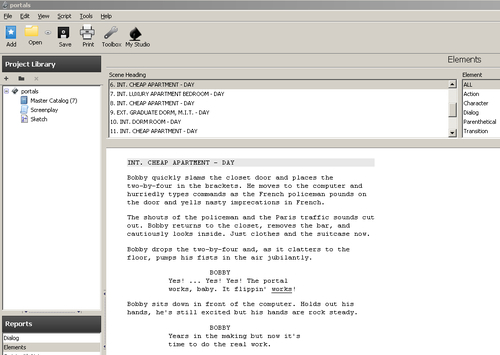
Celtx is powerful software yet simple to use. It can be used in writing the various types of scripts already mentioned, including everything independent film makers and media creators of all types need. This includes writing, planning, scheduling, and generating reports during the various stages of all sorts of productions. The following screenshot is an example of a Celtx report screen:

An important concept of Celtx's power is that it's a client-server application. This means only part of Celtx is in that download installed on your computer. The rest is out there in the cloud (the latest buzz term for servers on the Internet). Cloud computing (using remote servers to do part of the work) allows Celtx to have much more sophisticated features, in formatting and collaboration especially, than is normally found in a relatively small free piece of software. It's rather awesome actually and we'll see how it works throughout this book.
A major reason Celtx can be an open source program is that it is built on non-proprietary standards, such as HTML and XML (basic web mark-up languages) and uses other open source programs (specifically Mozilla's engine, the same used in the Firefox browser) for basic operations.
Celtx is really a web application. We have the advantage of big computers on the web doing stuff for us instead of having to depend on the much more limited resources of our local machine. This also means that improvements in script formats (as final formatting is done out on the web somewhere for you) are yours even if you haven't updated your local software. Yes, we'll discuss this more to better get our heads around it, but it's very much to your advantage.
In writing scripts, getting it in the industry standard format is critically important, especially if you're trying to sell scripts to producers or getting an agent interested in representing your work.
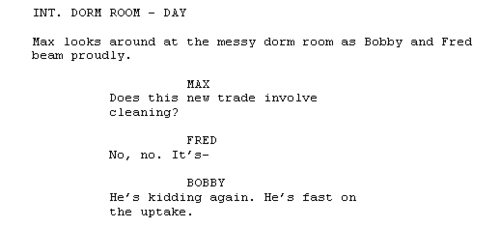
Celtx generates your finished scripts as a PDF file (automatically sending your script out on the web, converting it to PDF in the proper format for whichever type of project you are writing, and back to your computer very quickly indeed). We then have a nice finished product like the one shown in the following screenshot, which is a snippet from one of my own scripts:

Scene heading, action, character names, dialog—Celtx puts it all in exactly the right format for you!
The name Celtx, by the way is an acronym for Crew, Equipment, Location, Talent, and XML.
Celtx is supported by the Celtx community of volunteer developers and a Canadian company, Greyfirst Corp. in St. John's, Newfoundland.
The Celtx website says that more than 500,000 media creators in 160 countries use Celtx in 33 different languages. Independent filmmakers and studio professionals, and students in over 1,800 universities and film schools have adopted Celtx for teaching and class work submission.
Change the font size
Change margin width
Change background colour