Sign In Start Free Trial
Account

Add to playlist

Create a Playlist

Modal Close icon
You need to login to use this feature.
  • Book Overview & Buying Node Cookbook
  • Table Of Contents Toc
Node Cookbook

Node Cookbook

By : David Mark Clements
4 (9)
close
close
Node Cookbook

Node Cookbook

4 (9)
By: David Mark Clements

Overview of this book

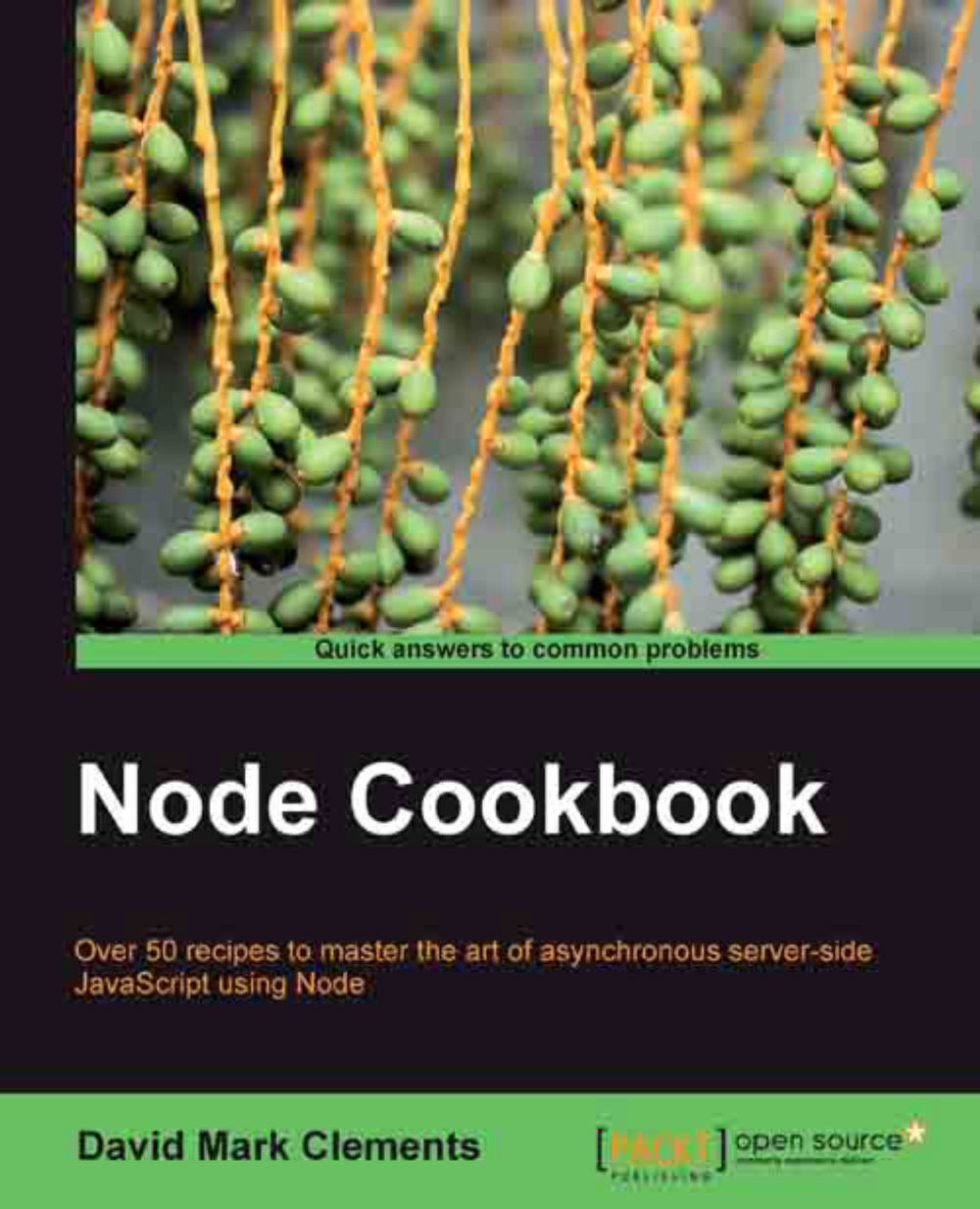
The principles of asynchronous event-driven programming are perfect for today's web, where efficient real-time applications and scalability are at the forefront. Server-side JavaScript has been here since the 90's but Node got it right. With a thriving community and interest from Internet giants, it could be the PHP of tomorrow. "Node Cookbook" shows you how to transfer your JavaScript skills to server side programming. With simple examples and supporting code, "Node Cookbook" talks you through various server side scenarios often saving you time, effort, and trouble by demonstrating best practices and showing you how to avoid security faux pas. Beginning with making your own web server, the practical recipes in this cookbook are designed to smoothly progress you to making full web applications, command line applications, and Node modules. Node Cookbook takes you through interfacing with various database backends such as MySQL, MongoDB and Redis, working with web sockets, and interfacing with network protocols, such as SMTP. Additionally, there are recipes on correctly performing heavy computations, security implementations, writing, your own Node modules and different ways to take your apps live.
Table of Contents (16 chapters)
close
close
Node Cookbook
Credits
About the Author
About the Reviewers
www.PacktPub.com
Preface

Writing a functional module mock-up


Now that we have our tests written (see previous recipe), we are ready to create our module (incidentally, from here on we'll be using the should version of our unit tests as opposed to assert).

In this recipe, we'll write our module in simple functional style to demonstrate proof of concept. In the next recipe, we'll refactor our code into a more common modular format centered on reusability and extendibility.

Getting ready

Let's open our main index.js and link it to the lib directory via module.exports.

module.exports = require('./lib');

This allows us to place the meat of our module code neatly inside the lib directory.

How to do it...

We'll open up lib/index.js and begin by requiring the fs module, which will be used to read an MP3 file, and setting up a bitrates map that cross references hex-represented values to bitrate values as defined by the MPEG-1 specification.

var fs = require('fs');
//half-byte (4bit) hex values to interpreted bitrates (bps)
/...
CONTINUE READING
83
Tech Concepts
36
Programming languages
73
Tech Tools
Icon Unlimited access to the largest independent learning library in tech of over 8,000 expert-authored tech books and videos.
Icon Innovative learning tools, including AI book assistants, code context explainers, and text-to-speech.
Icon 50+ new titles added per month and exclusive early access to books as they are being written.
Node Cookbook
notes
bookmark Notes and Bookmarks search Search in title playlist Add to playlist download Download options font-size Font size

Change the font size

margin-width Margin width

Change margin width

day-mode Day/Sepia/Night Modes

Change background colour

Close icon Search
Country selected

Close icon Your notes and bookmarks

Confirmation

Modal Close icon
claim successful

Buy this book with your credits?

Modal Close icon
Are you sure you want to buy this book with one of your credits?
Close
YES, BUY

Submit Your Feedback

Modal Close icon
Modal Close icon
Modal Close icon