NAT was a standard developed to deal with the depletion of IPv4 addresses. Since IPv4 addresses are 32-bit addresses, there are potentially 4.3 billion addresses available. But since IPv4 was initially divided into Class A networks (first octet = 1 to 126, 8-bit subnet, over 16 million nodes per network), Class B networks (first octet = 128 to 191, 16-bit subnet, 64K nodes per network) and Class C networks (first octet = 192 to 223, 24-bit subnet, 254 nodes per network), the situation was even worse. Class A and Class B networks were too large to be used efficiently even by large organizations, and many Class A networks were assigned to large corporations, thus further reducing the pool of available addresses. The next smallest size, Class C networks, was too small for many organizations. Many organizations ended up using multiple Class C networks, which created...
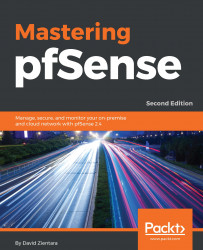
Mastering pfSense - Second Edition
By :
Mastering pfSense - Second Edition
By:
Overview of this book
pfSense has the same reliability and stability as even the most popular commercial firewall offerings on the market – but, like the very best open-source software, it doesn’t limit you.
You’re in control – you can exploit and customize pfSense around your security needs.
Mastering pfSense - Second Edition, covers features that have long been part of pfSense such as captive portal, VLANs, traffic shaping, VPNs, load balancing, Common Address Redundancy Protocol (CARP), multi-WAN, and routing. It also covers features that have been added with the release of 2.4, such as support for ZFS partitions and OpenVPN 2.4. This book takes into account the fact that, in order to support increased cryptographic loads, pfSense version 2.5 will require a CPU that supports AES-NI.
The second edition of this book places more of an emphasis on the practical side of utilizing pfSense than the previous edition, and, as a result, more examples are provided which show in step-by-step fashion how to implement many features.
Related Content you might be interested in
Current Title:
Mastering pfSense - Second Edition
Table of Contents (15 chapters)
Preface

 Free Chapter
Revisiting pfSense Basics

Advanced pfSense Configuration
VLANs
Using pfSense as a Firewall
Network Address Translation
Traffic Shaping
Virtual Private Networks
Redundancy and High Availability
Multiple WANs
Routing and Bridging
Extending pfSense with Packages
Diagnostics and Troubleshooting
Assessments
Another Book You May Enjoy
Customer Reviews