Sign In Start Free Trial
Account

Add to playlist

Create a Playlist

Modal Close icon
You need to login to use this feature.
  • Book Overview & Buying Mastering pfSense
  • Table Of Contents Toc
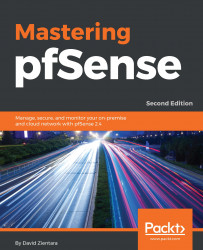
Mastering pfSense

Mastering pfSense - Second Edition

By : David Zientara
3.3 (4)
close
close
Mastering pfSense

Mastering pfSense

3.3 (4)
By: David Zientara

Overview of this book

pfSense has the same reliability and stability as even the most popular commercial firewall offerings on the market – but, like the very best open-source software, it doesn’t limit you. You’re in control – you can exploit and customize pfSense around your security needs. Mastering pfSense - Second Edition, covers features that have long been part of pfSense such as captive portal, VLANs, traffic shaping, VPNs, load balancing, Common Address Redundancy Protocol (CARP), multi-WAN, and routing. It also covers features that have been added with the release of 2.4, such as support for ZFS partitions and OpenVPN 2.4. This book takes into account the fact that, in order to support increased cryptographic loads, pfSense version 2.5 will require a CPU that supports AES-NI. The second edition of this book places more of an emphasis on the practical side of utilizing pfSense than the previous edition, and, as a result, more examples are provided which show in step-by-step fashion how to implement many features.
Table of Contents (15 chapters)
close
close

Multi-WAN configuration

Gateway load balancing is accomplished by setting up gateway groups, which consist of two or more WAN interfaces. Configuring gateway load balancing involves several steps:

  1. Adding and configuring additional WAN interfaces.
  2. Configuring DNS servers for each of the new WAN interfaces.
  3. Adding gateway groups which include the new interfaces.
  4. Adding firewall rules for each of the new gateway groups.

The first step, adding and configuring additional WAN interfaces, is a fairly simple process. When you initially set up pfSense, the WAN interface was automatically configured, but configuring additional WAN interfaces isn't much different from configuring any other interfaces. Refer to the following steps:

  1. Navigate to Interfaces | (assign), and on the Interface Assignments tab, there should be a tab showing all the existing interface assignments (which should...
CONTINUE READING
83
Tech Concepts
36
Programming languages
73
Tech Tools
Icon Unlimited access to the largest independent learning library in tech of over 8,000 expert-authored tech books and videos.
Icon Innovative learning tools, including AI book assistants, code context explainers, and text-to-speech.
Icon 50+ new titles added per month and exclusive early access to books as they are being written.
Mastering pfSense
notes
bookmark Notes and Bookmarks search Search in title playlist Add to playlist font-size Font size

Change the font size

margin-width Margin width

Change margin width

day-mode Day/Sepia/Night Modes

Change background colour

Close icon Search
Country selected

Close icon Your notes and bookmarks

Confirmation

Modal Close icon
claim successful

Buy this book with your credits?

Modal Close icon
Are you sure you want to buy this book with one of your credits?
Close
YES, BUY

Submit Your Feedback

Modal Close icon
Modal Close icon
Modal Close icon