
Sign In Start Free Trial
Account

Add to playlist

Create a Playlist

Modal Close icon
You need to login to use this feature.
  • Book Overview & Buying PowerShell Core for Linux Administrators Cookbook
  • Table Of Contents Toc
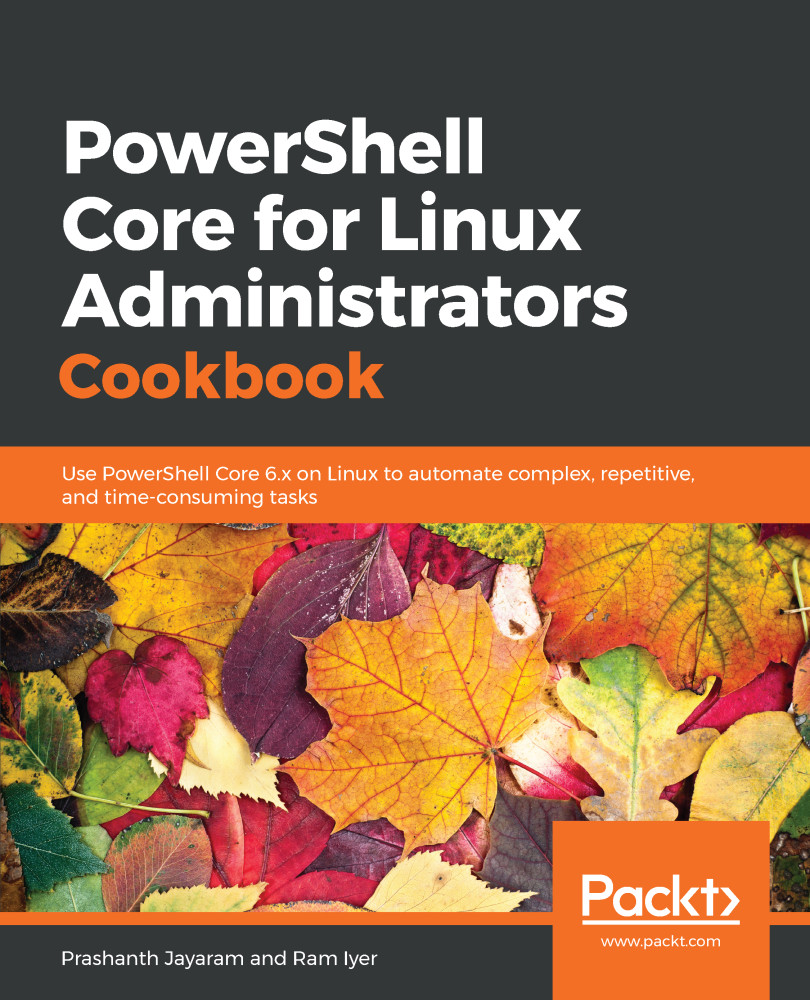
PowerShell Core for Linux Administrators Cookbook

PowerShell Core for Linux Administrators Cookbook

By : Prashanth Jayaram , Ram Iyer
close
close
PowerShell Core for Linux Administrators Cookbook

PowerShell Core for Linux Administrators Cookbook

By: Prashanth Jayaram , Ram Iyer

Overview of this book

PowerShell Core, the open source, cross-platform that is based on the open source, cross-platform .NET Core, is not a shell that came out by accident; it was intentionally created to be versatile and easy to learn at the same time. PowerShell Core enables automation on systems ranging from the Raspberry Pi to the cloud. PowerShell Core for Linux Administrators Cookbook uses simple, real-world examples that teach you how to use PowerShell to effectively administer your environment. As you make your way through the book, you will cover interesting recipes on how PowerShell Core can be used to quickly automate complex, repetitive, and time-consuming tasks. In the concluding chapters, you will learn how to develop scripts to automate tasks that involve systems and enterprise management. By the end of this book, you will have learned about the automation capabilities of PowerShell Core, including remote management using OpenSSH, cross-platform enterprise management, working with Docker containers, and managing SQL databases.
Table of Contents (19 chapters)
close
close

Introduction

Variables are important to programming since they act as containers of information that are stored during the program's execution. Although piping makes PowerShell highly versatile, they still cannot replace variables, because objects passed through the pipeline must be consumed immediately, and not all scripts work that way, given our varied requirements.

We are all aware of the various data types: int, double, string, char, array, and so on. Two other important types of variables in PowerShell are hashtables and objects. A hashtable is a dictionary table that's formed with key-value pairs. An object, as we have seen, could be as complex and as simple as it can get in PowerShell, that is, holding values of different kinds.

In PowerShell, objects can be stored in variables. For instance, check out the following command:

PS> $Processes = Get-Process

Using...

CONTINUE READING
83
Tech Concepts
36
Programming languages
73
Tech Tools
Icon Unlimited access to the largest independent learning library in tech of over 8,000 expert-authored tech books and videos.
Icon Innovative learning tools, including AI book assistants, code context explainers, and text-to-speech.
Icon 50+ new titles added per month and exclusive early access to books as they are being written.
PowerShell Core for Linux Administrators Cookbook
notes
bookmark Notes and Bookmarks search Search in title playlist Add to playlist download Download options font-size Font size

Change the font size

margin-width Margin width

Change margin width

day-mode Day/Sepia/Night Modes

Change background colour

Close icon Search
Country selected

Close icon Your notes and bookmarks

Confirmation

Modal Close icon
claim successful

Buy this book with your credits?

Modal Close icon
Are you sure you want to buy this book with one of your credits?
Close
YES, BUY

Submit Your Feedback

Modal Close icon
Modal Close icon
Modal Close icon