
Sign In Start Free Trial
Account

Add to playlist

Create a Playlist

Modal Close icon
You need to login to use this feature.
  • Book Overview & Buying Kubernetes - A Complete DevOps Cookbook
  • Table Of Contents Toc
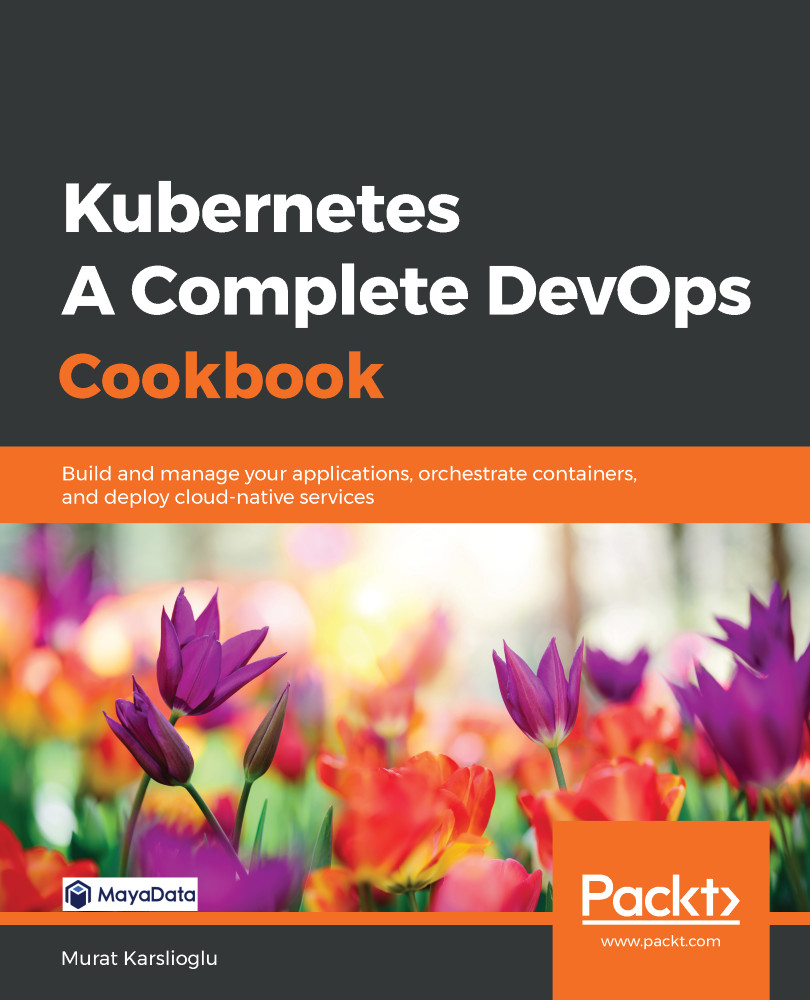
Kubernetes - A Complete DevOps Cookbook

Kubernetes - A Complete DevOps Cookbook

By : Karslioglu
4.5 (4)
close
close
Kubernetes - A Complete DevOps Cookbook

Kubernetes - A Complete DevOps Cookbook

4.5 (4)
By: Karslioglu

Overview of this book

Kubernetes is a popular open source orchestration platform for managing containers in a cluster environment. With this Kubernetes cookbook, you’ll learn how to implement Kubernetes using a recipe-based approach. The book will prepare you to create highly available Kubernetes clusters on multiple clouds such as Amazon Web Services (AWS), Google Cloud Platform (GCP), Azure, Alibaba, and on-premises data centers. Starting with recipes for installing and configuring Kubernetes instances, you’ll discover how to work with Kubernetes clients, services, and key metadata. You’ll then learn how to build continuous integration/continuous delivery (CI/CD) pipelines for your applications, and understand various methods to manage containers. As you advance, you’ll delve into Kubernetes' integration with Docker and Jenkins, and even perform a batch process and configure data volumes. You’ll get to grips with methods for scaling, security, monitoring, logging, and troubleshooting. Additionally, this book will take you through the latest updates in Kubernetes, including volume snapshots, creating high availability clusters with kops, running workload operators, new inclusions around kubectl and more. By the end of this book, you’ll have developed the skills required to implement Kubernetes in production and manage containers proficiently.
Table of Contents (12 chapters)
close
close

Building centralized logging in Kubernetes using the EFK stack

As described in the the Accessing Kubernetes logs locally section, basic logging can be used to detect configuration problems, but for cluster-level logging, an external backend is required to store and query logs. A cluster-level logging stack can help you quickly sort through and analyze the high volume of production log data that's produced by your application in the Kubernetes cluster. One of the most popular centralized logging solutions in the Kubernetes ecosystem is the Elasticsearch, Logstash, and Kibana (ELK) stack.

In the ELK stack, Logstash is used as the log collector. Logstash uses slightly more memory than Fluent Bit, which is a low-footprint version of Fluentd. Therefore, in this recipe, we will use the Elasticsearch, Fluent-bit, and Kibana (EFK) stack. If you have an application that has Logstash dependencies, you can always replace Fluentd/Fluent Bit with Logstash.

In this section, we will learn how...

Visually different images
CONTINUE READING
83
Tech Concepts
36
Programming languages
73
Tech Tools
Icon Unlimited access to the largest independent learning library in tech of over 8,000 expert-authored tech books and videos.
Icon Innovative learning tools, including AI book assistants, code context explainers, and text-to-speech.
Icon 50+ new titles added per month and exclusive early access to books as they are being written.
Kubernetes - A Complete DevOps Cookbook
notes
bookmark Notes and Bookmarks search Search in title playlist Add to playlist download Download options font-size Font size

Change the font size

margin-width Margin width

Change margin width

day-mode Day/Sepia/Night Modes

Change background colour

Close icon Search
Country selected

Close icon Your notes and bookmarks

Confirmation

Modal Close icon
claim successful

Buy this book with your credits?

Modal Close icon
Are you sure you want to buy this book with one of your credits?
Close
YES, BUY

Submit Your Feedback

Modal Close icon
Modal Close icon
Modal Close icon