Sign In Start Free Trial
Account

Add to playlist

Create a Playlist

Modal Close icon
You need to login to use this feature.
  • Book Overview & Buying Learn Helm
  • Table Of Contents Toc
  • Feedback & Rating feedback
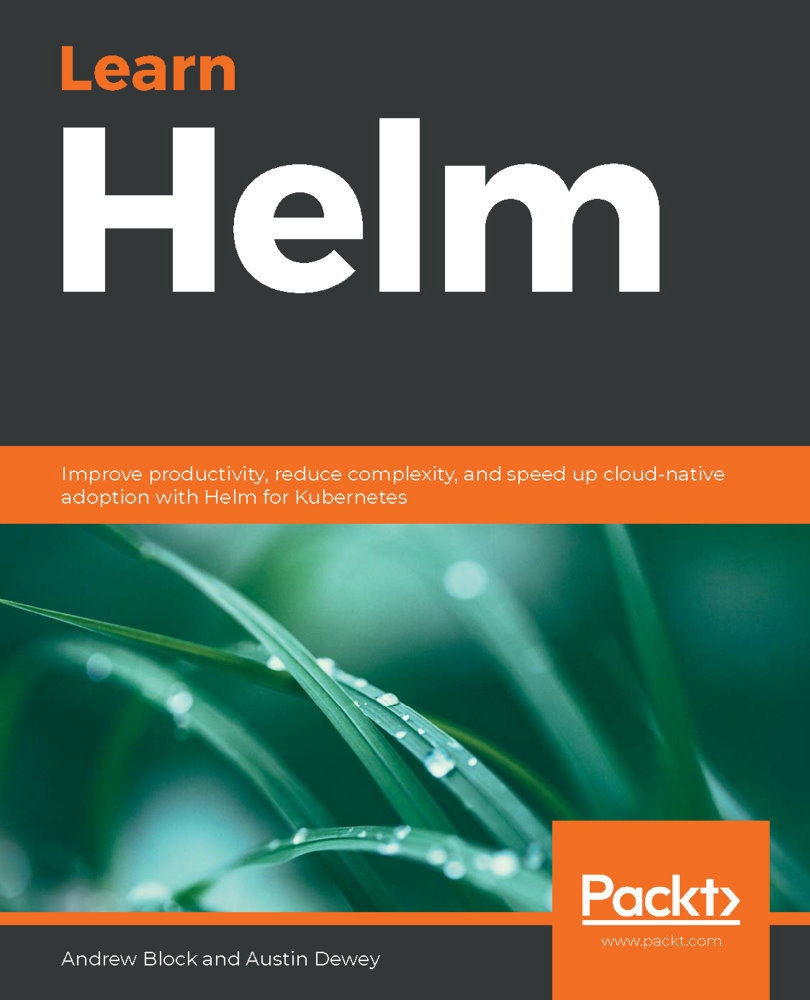
Learn Helm

Learn Helm

By : Andrew Block, Austin Dewey
3 (4)
close
close
Learn Helm

Learn Helm

3 (4)
By: Andrew Block, Austin Dewey

Overview of this book

Containerization is currently known to be one of the best ways to implement DevOps. While Docker introduced containers and changed the DevOps era, Google developed an extensive container orchestration system, Kubernetes, which is now considered the frontrunner in container orchestration. With the help of this book, you’ll explore the efficiency of managing applications running on Kubernetes using Helm. Starting with a short introduction to Helm and how it can benefit the entire container environment, you’ll then delve into the architectural aspects, in addition to learning about Helm charts and its use cases. You’ll understand how to write Helm charts in order to automate application deployment on Kubernetes. Focused on providing enterprise-ready patterns relating to Helm and automation, the book covers best practices for application development, delivery, and lifecycle management with Helm. By the end of this Kubernetes book, you will have learned how to leverage Helm to develop an enterprise pattern for application delivery.
Table of Contents (15 chapters)
close
close
1
Section 1: Introduction and Setup
5
Section 2: Helm Chart Development
9
Section 3: Adanced Deployment Patterns
14
Other Books You May Enjoy

Chapter 8: Using Helm with the Operator Framework

One of the advantages of using Helm is the ability to synchronize the local and the live states. With Helm, the local state is managed with values files that, when provided using the install or upgrade command, apply the values to synchronize the live state in a Kubernetes cluster. In previous chapters, this was performed by invoking these commands when a change to the application was desired.

Another way these changes can be synchronized is to create an application inside the cluster that checks periodically that the desired state matches the current configurations within an environment. If the state does not match, the application can automatically modify the environment to match the desired state. This application is referred to as a Kubernetes operator. In this chapter, we will create a Helm-based operator that helps ensure the locally defined state always matches the live state of the cluster. If it does not, the operator will...

Visually different images
CONTINUE READING
83
Tech Concepts
36
Programming languages
73
Tech Tools
Icon Unlimited access to the largest independent learning library in tech of over 8,000 expert-authored tech books and videos.
Icon Innovative learning tools, including AI book assistants, code context explainers, and text-to-speech.
Icon 50+ new titles added per month and exclusive early access to books as they are being written.
Learn Helm
notes
bookmark Notes and Bookmarks search Search in title playlist Add to playlist download Download options font-size Font size

Change the font size

margin-width Margin width

Change margin width

day-mode Day/Sepia/Night Modes

Change background colour

Close icon Search
Country selected

Close icon Your notes and bookmarks

Confirmation

Modal Close icon
claim successful

Buy this book with your credits?

Modal Close icon
Are you sure you want to buy this book with one of your credits?
Close
YES, BUY

Submit Your Feedback

Modal Close icon
Modal Close icon
Modal Close icon