Sign In Start Free Trial
Account

Add to playlist

Create a Playlist

Modal Close icon
You need to login to use this feature.
  • Book Overview & Buying Web Application Development with R Using Shiny Second Edition
  • Table Of Contents Toc
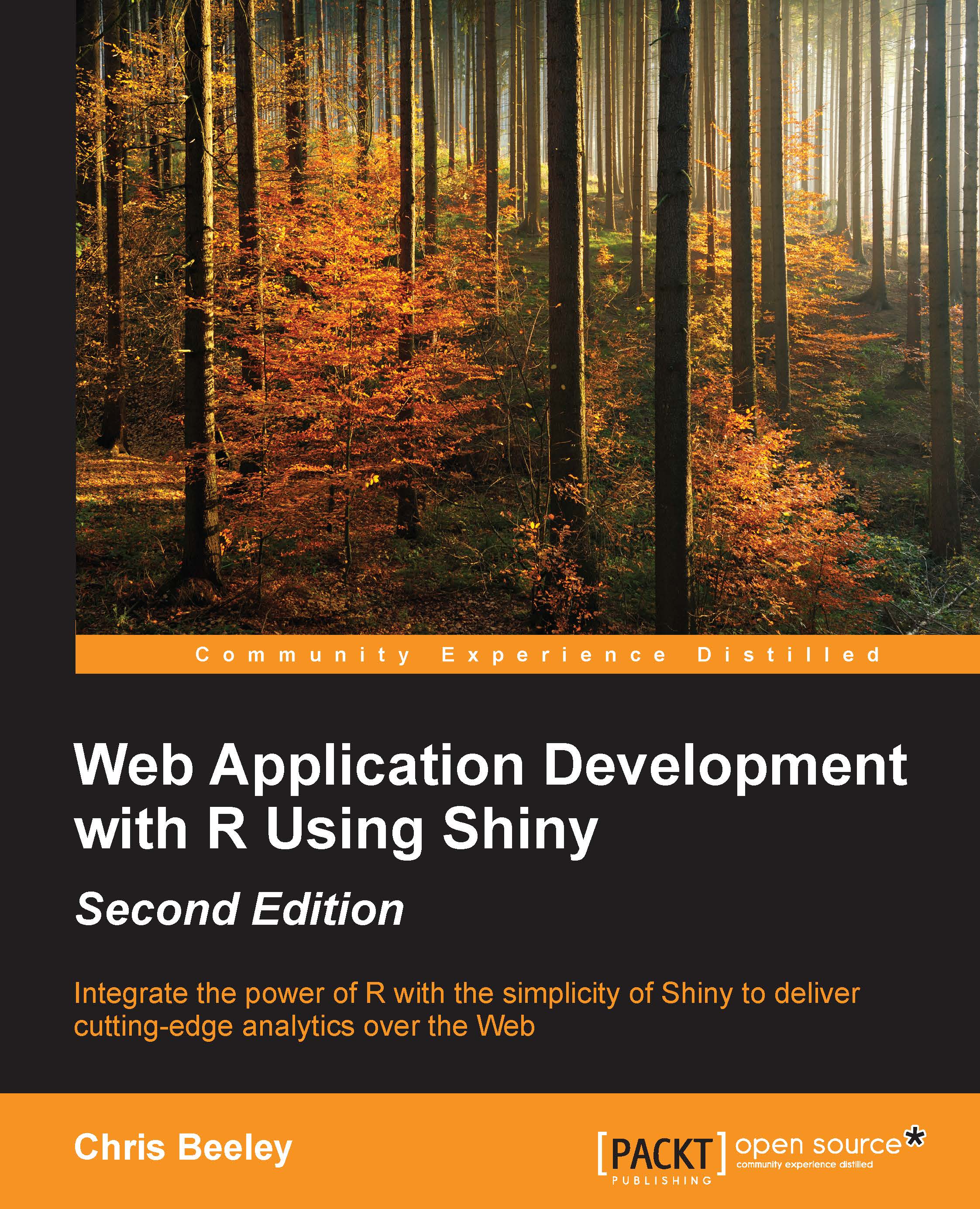
Web Application Development with R Using Shiny Second Edition

Web Application Development with R Using Shiny Second Edition - Second Edition

By : Chris Beeley
3.5 (10)
close
close
Web Application Development with R Using Shiny Second Edition

Web Application Development with R Using Shiny Second Edition

3.5 (10)
By: Chris Beeley

Overview of this book

R is a highly flexible and powerful tool for analyzing and visualizing data. Most of the applications built using various libraries with R are desktop-based. But what if you want to go on the web? Here comes Shiny to your rescue! Shiny allows you to create interactive web applications using the excellent analytical and graphical capabilities of R. This book will guide you through basic data management and analysis with R through your first Shiny application, and then show you how to integrate Shiny applications with your own web pages. Finally, you will learn how to finely control the inputs and outputs of your application, along with using other packages to build state-of-the-art applications, including dashboards.
Table of Contents (9 chapters)
close
close
8
Index

Info boxes


We have already seen how to use icons earlier in the chapter, but Shiny dashboard makes a nice feature of it by expanding and coloring them to draw attention to key pieces of information. An info box can be drawn statically as follows:

infoBox(width = 3, "Shiny version", "0.12",
  icon = icon("desktop"))

As you can see, the width can be set (using the 12 span rule from the standard bootstrap functions we saw earlier in the chapter) with title (Shiny version) and value (0.12, although you may often wish to pass a number). This function is placed within dashboardBody() in the ui.R file.

Although you may sometimes wish to hard-code info boxes in this way (to show version numbers of an application, as in this case), in the majority of cases, you are going to produce this content dynamically. In this case, you will as always need to do some preparation on server.R first. Here is the code for the first info box:

output$days <- renderInfoBox({
  infoBox(
    "Days", input$dateRange[2...
CONTINUE READING
83
Tech Concepts
36
Programming languages
73
Tech Tools
Icon Unlimited access to the largest independent learning library in tech of over 8,000 expert-authored tech books and videos.
Icon Innovative learning tools, including AI book assistants, code context explainers, and text-to-speech.
Icon 50+ new titles added per month and exclusive early access to books as they are being written.
Web Application Development with R Using Shiny Second Edition
notes
bookmark Notes and Bookmarks search Search in title playlist Add to playlist download Download options font-size Font size

Change the font size

margin-width Margin width

Change margin width

day-mode Day/Sepia/Night Modes

Change background colour

Close icon Search
Country selected

Close icon Your notes and bookmarks

Confirmation

Modal Close icon
claim successful

Buy this book with your credits?

Modal Close icon
Are you sure you want to buy this book with one of your credits?
Close
YES, BUY

Submit Your Feedback

Modal Close icon
Modal Close icon
Modal Close icon