Sign In Start Free Trial
Account

Add to playlist

Create a Playlist

Modal Close icon
You need to login to use this feature.
  • Book Overview & Buying Mastering Probabilistic Graphical Models with Python
  • Table Of Contents Toc
Mastering Probabilistic Graphical Models with Python

Mastering Probabilistic Graphical Models with Python

By : Ankur Ankan
3.3 (7)
close
close
Mastering Probabilistic Graphical Models with Python

Mastering Probabilistic Graphical Models with Python

3.3 (7)
By: Ankur Ankan

Overview of this book

Probabilistic Graphical Models is a technique in machine learning that uses the concepts of graph theory to compactly represent and optimally predict values in our data problems. In real world problems, it's often difficult to select the appropriate graphical model as well as the appropriate inference algorithm, which can make a huge difference in computation time and accuracy. Thus, it is crucial to know the working details of these algorithms. This book starts with the basics of probability theory and graph theory, then goes on to discuss various models and inference algorithms. All the different types of models are discussed along with code examples to create and modify them, and also to run different inference algorithms on them. There is a complete chapter devoted to the most widely used networks Naive Bayes Model and Hidden Markov Models (HMMs). These models have been thoroughly discussed using real-world examples.
Table of Contents (9 chapters)
close
close
8
Index

The propagation-based approximation algorithm


The propagation-based approximation algorithm is a more generalized version of the belief propagation algorithm and works on the same principle of passing messages. In the case of exact inference, we used to construct a clique tree and then passed messages between the clusters. However, in the case of the propagation-based approximation algorithms, we will be performing message passing on cluster graphs.

Let's take the simple example of a network:

Fig 4.1: A simple Markov network

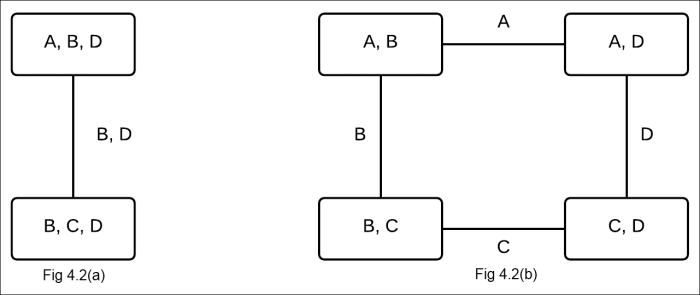
It is possible to construct multiple cluster graphs for this network. Let's take the example of the following two cluster graphs:

Fig 4.2: Cluster graphs for the network in Fig 4.1

Fig 4.2 shows two possible cluster graphs for the network in Fig 4.1. The cluster graph in Fig 4.2(a) is a clique tree and the clusters are (A, B, C) and (B, C, D). Whereas, the cluster graph in Fig 4.2(b) has four clusters (A, B), (B, C), (C, D), and (A, D). It also has loops:

Fig 4.3: Change of...

CONTINUE READING
83
Tech Concepts
36
Programming languages
73
Tech Tools
Icon Unlimited access to the largest independent learning library in tech of over 8,000 expert-authored tech books and videos.
Icon Innovative learning tools, including AI book assistants, code context explainers, and text-to-speech.
Icon 50+ new titles added per month and exclusive early access to books as they are being written.
Mastering Probabilistic Graphical Models with Python
notes
bookmark Notes and Bookmarks search Search in title playlist Add to playlist font-size Font size

Change the font size

margin-width Margin width

Change margin width

day-mode Day/Sepia/Night Modes

Change background colour

Close icon Search
Country selected

Close icon Your notes and bookmarks

Confirmation

Modal Close icon
claim successful

Buy this book with your credits?

Modal Close icon
Are you sure you want to buy this book with one of your credits?
Close
YES, BUY

Submit Your Feedback

Modal Close icon
Modal Close icon
Modal Close icon