Sign In Start Free Trial
Account

Add to playlist

Create a Playlist

Modal Close icon
You need to login to use this feature.
  • Book Overview & Buying Mathematica Data Analysis
  • Table Of Contents Toc
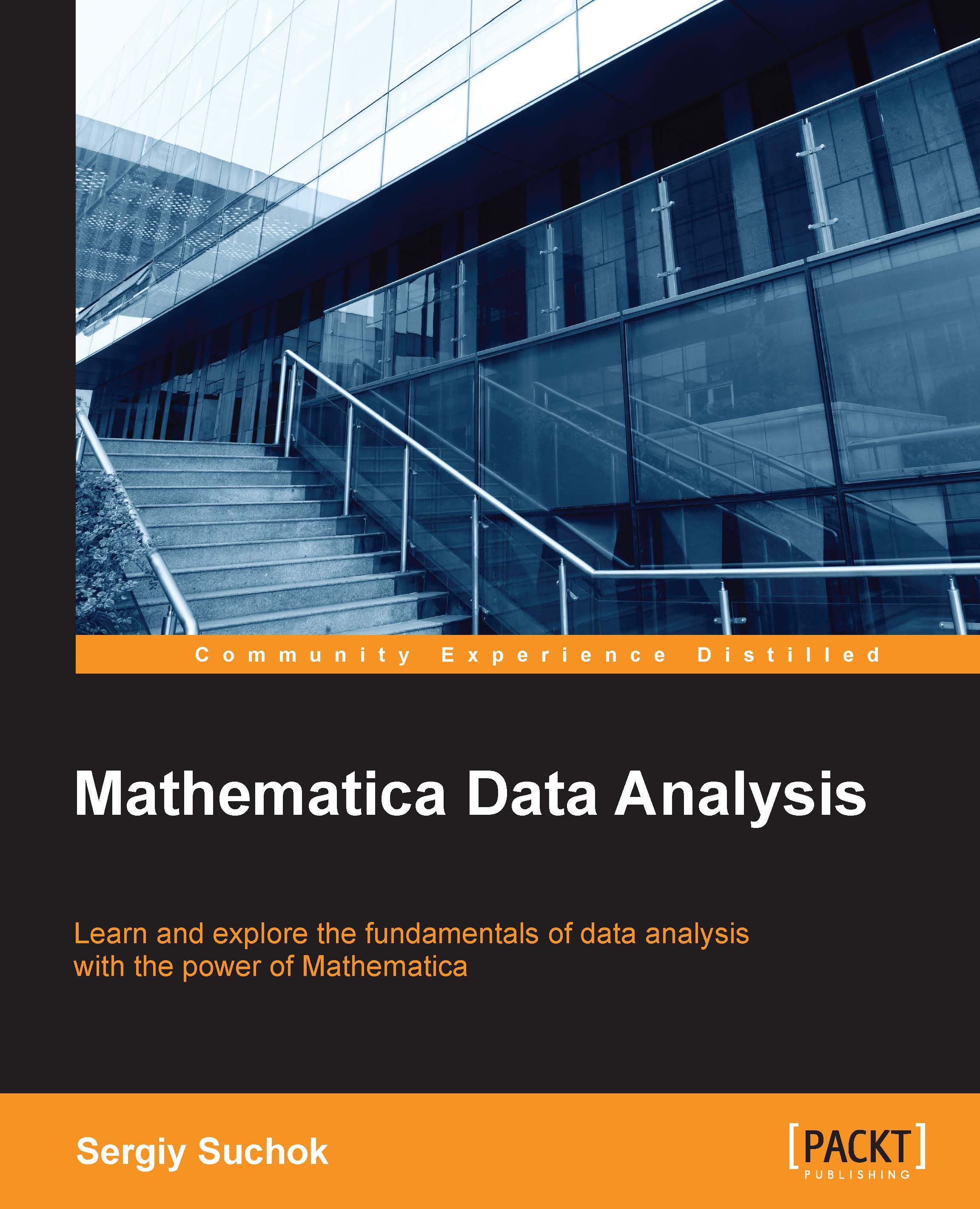
Mathematica Data Analysis

Mathematica Data Analysis

By : Sergiy Suchok
5 (1)
close
close
Mathematica Data Analysis

Mathematica Data Analysis

5 (1)
By: Sergiy Suchok

Overview of this book

There are many algorithms for data analysis and it’s not always possible to quickly choose the best one for each case. Implementation of the algorithms takes a lot of time. With the help of Mathematica, you can quickly get a result from the use of a particular method, because this system contains almost all the known algorithms for data analysis. If you are not a programmer but you need to analyze data, this book will show you the capabilities of Mathematica when just few strings of intelligible code help to solve huge tasks from statistical issues to pattern recognition. If you're a programmer, with the help of this book, you will learn how to use the library of algorithms implemented in Mathematica in your programs, as well as how to write algorithm testing procedure. With each chapter, you'll be more immersed in the special world of Mathematica. Along with intuitive queries for data processing, we will highlight the nuances and features of this system, allowing you to build effective analysis systems. With the help of this book, you will learn how to optimize the computations by combining your libraries with the Mathematica kernel.
Table of Contents (10 chapters)
close
close
9
Index

Interacting with Java

Having mastered the principles of Mathematica's interaction with external programs, it will be easy to understand the principles of writing Java programs in Mathematica.

First, you need to enable the JLink package. Here's an example Java program that will produce an expression computation using Mathematica's capabilities:

Interacting with Java

Similar to .NET, the following functions are used: JavaBlock for procedure construction in Java language and JavaNew to define a new object copy. The Moving slider event is declared with the help of the setHandler method.

After running the RealTimeAlgebraModal[] command, you will see the following window where you can change the parameter value and a power series in the expansion by moving the slider:

Interacting with Java

Let's look at a simple example of how to use the computing capabilities of Mathematica in a program written in Java:

import com.wolfram.jlink.*;

public class SampleProgram {

  public static void main(String[] argv) {

    KernelLink...
CONTINUE READING
83
Tech Concepts
36
Programming languages
73
Tech Tools
Icon Unlimited access to the largest independent learning library in tech of over 8,000 expert-authored tech books and videos.
Icon Innovative learning tools, including AI book assistants, code context explainers, and text-to-speech.
Icon 50+ new titles added per month and exclusive early access to books as they are being written.
Mathematica Data Analysis
notes
bookmark Notes and Bookmarks search Search in title playlist Add to playlist font-size Font size

Change the font size

margin-width Margin width

Change margin width

day-mode Day/Sepia/Night Modes

Change background colour

Close icon Search
Country selected

Close icon Your notes and bookmarks

Confirmation

Modal Close icon
claim successful

Buy this book with your credits?

Modal Close icon
Are you sure you want to buy this book with one of your credits?
Close
YES, BUY

Submit Your Feedback

Modal Close icon
Modal Close icon
Modal Close icon