Sign In Start Free Trial
Account

Add to playlist

Create a Playlist

Modal Close icon
You need to login to use this feature.
  • Book Overview & Buying Spark for Data Science
  • Table Of Contents Toc
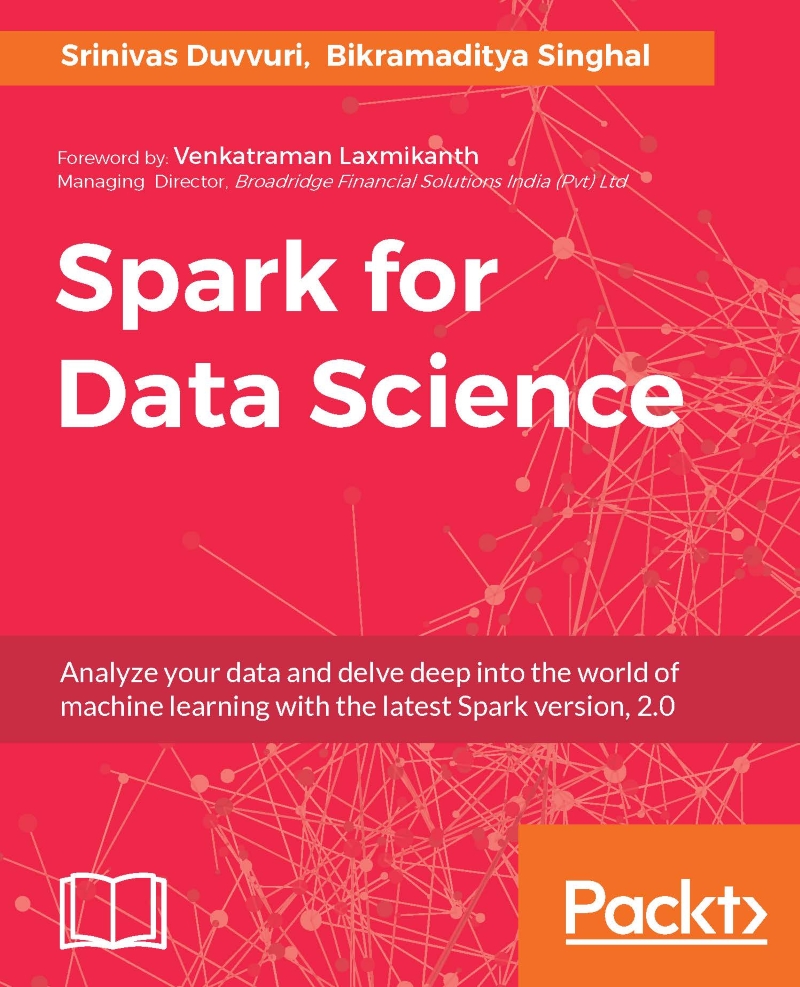
Spark for Data Science

Spark for Data Science

By : Srinivas Duvvuri, Bikramaditya Singhal
close
close
Spark for Data Science

Spark for Data Science

By: Srinivas Duvvuri, Bikramaditya Singhal

Overview of this book

This is the era of Big Data. The words ‘Big Data’ implies big innovation and enables a competitive advantage for businesses. Apache Spark was designed to perform Big Data analytics at scale, and so Spark is equipped with the necessary algorithms and supports multiple programming languages. Whether you are a technologist, a data scientist, or a beginner to Big Data analytics, this book will provide you with all the skills necessary to perform statistical data analysis, data visualization, predictive modeling, and build scalable data products or solutions using Python, Scala, and R. With ample case studies and real-world examples, Spark for Data Science will help you ensure the successful execution of your data science projects.
Table of Contents (12 chapters)
close
close

Big data overview

Much has already been spoken and written about what big data is, but there is no specific standard as such to clearly define it. It is actually a relative term to some extent. Whether small or big, your data can be leveraged only if you can analyze it properly. To make some sense out of your data, the right set of analysis techniques is needed and selecting the right tools and techniques is of utmost importance in data analytics. However, when the data itself becomes a part of the problem and the computational challenges need to be addressed prior to performing data analysis, it becomes a big data problem.

A revolution took place in the World Wide Web, also referred to as Web 2.0, which changed the way people used the Internet. Static web pages became interactive websites and started collecting more and more data. Technological advancements in cloud computing, social media, and mobile computing created an explosion of data. Every digital device started emitting data and many other sources started driving the data deluge. The dataflow from every nook and corner generated varieties of voluminous data, at speed! The formation of big data in this fashion was a natural phenomenon, because this is how the World Wide Web had evolved and no explicit efforts were involved in specifics. This is about the past! If you consider the change that is happening now, and is going to happen in future, the volume and speed of data generation is beyond what one can anticipate. I am propelled to make such a statement because every device is getting smarter these days, thanks to the Internet of Things (IoT).

The IT trend was such that the technological advancements also facilitated the data explosion. Data storage had experienced a paradigm shift with the advent of cheaper clusters of online storage pools and the availability of commodity hardware with bare minimal price. Storing data from disparate sources in its native form in a single data lake was rapidly gaining over carefully designed data marts and data warehouses. Usage patterns also shifted from rigid schema-driven, RDBMS-based approaches to schema-less, continuously available NoSQL data-store-driven solutions. As a result, the rate of data creation, whether structured, semi-structured, or unstructured, started accelerating like never before.

Organizations are very much convinced that not only can specific business questions be answered by leveraging big data; it also brings in opportunities to cover the uncovered possibilities in businesses and address the uncertainties associated with this. So, apart from the natural data influx, organizations started devising strategies to generate more and more data to maintain their competitive advantages and to be future ready. Here, an example would help to understand this better. Imagine sensors are installed on the machines of a manufacturing plant which are constantly emitting data, and hence the status of the machine parts, and a company is able to predict when the machine is going to fail. It lets the company prevent a failure or damage and avoid unplanned downtime, saving a lot of money.

CONTINUE READING
83
Tech Concepts
36
Programming languages
73
Tech Tools
Icon Unlimited access to the largest independent learning library in tech of over 8,000 expert-authored tech books and videos.
Icon Innovative learning tools, including AI book assistants, code context explainers, and text-to-speech.
Icon 50+ new titles added per month and exclusive early access to books as they are being written.
Spark for Data Science
notes
bookmark Notes and Bookmarks search Search in title playlist Add to playlist download Download options font-size Font size

Change the font size

margin-width Margin width

Change margin width

day-mode Day/Sepia/Night Modes

Change background colour

Close icon Search
Country selected

Close icon Your notes and bookmarks

Confirmation

Modal Close icon
claim successful

Buy this book with your credits?

Modal Close icon
Are you sure you want to buy this book with one of your credits?
Close
YES, BUY

Submit Your Feedback

Modal Close icon
Modal Close icon
Modal Close icon