Sign In Start Free Trial
Account

Add to playlist

Create a Playlist

Modal Close icon
You need to login to use this feature.
  • Book Overview & Buying Spark for Data Science
  • Table Of Contents Toc
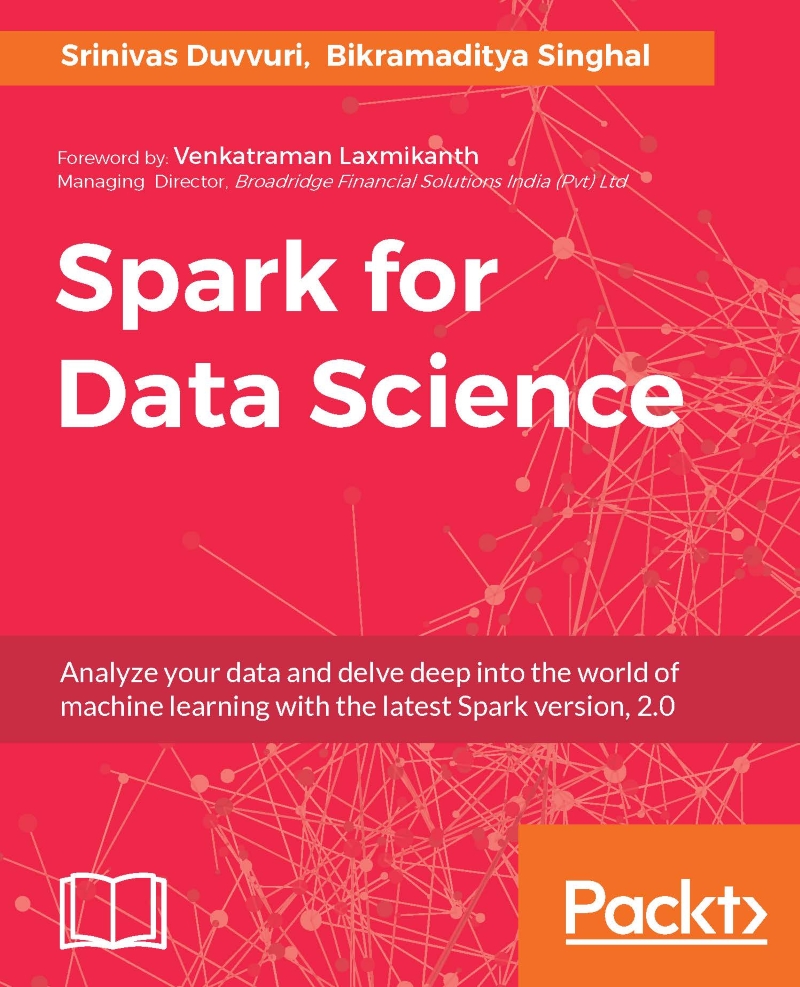
Spark for Data Science

Spark for Data Science

By : Srinivas Duvvuri, Bikramaditya Singhal
close
close
Spark for Data Science

Spark for Data Science

By: Srinivas Duvvuri, Bikramaditya Singhal

Overview of this book

This is the era of Big Data. The words ‘Big Data’ implies big innovation and enables a competitive advantage for businesses. Apache Spark was designed to perform Big Data analytics at scale, and so Spark is equipped with the necessary algorithms and supports multiple programming languages. Whether you are a technologist, a data scientist, or a beginner to Big Data analytics, this book will provide you with all the skills necessary to perform statistical data analysis, data visualization, predictive modeling, and build scalable data products or solutions using Python, Scala, and R. With ample case studies and real-world examples, Spark for Data Science will help you ensure the successful execution of your data science projects.
Table of Contents (12 chapters)
close
close

Spark for data analytics

Soon after the Spark project was successful in the AMP labs, it was made open source in 2010 and transferred to the Apache Software Foundation in 2013. It is currently being led by Databricks.

Spark offers many distinct advantages over other distributed computing platforms, such as:

  • A faster execution platform for both iterative machine learning and interactive data analysis
  • Single stack for batch processing, SQL queries, real-time stream processing, graph processing, and complex data analytics
  • Provides high-level API to develop a diverse range of distributed applications by hiding the complexities of distributed programming
  • Seamless support for various data sources such as RDBMS, HBase, Cassandra, Parquet, MongoDB, HDFS, Amazon S3, and so on

Spark for data analytics

The following is a pictorial representation of in-memory data sharing for iterative algorithms:

Spark for data analytics

Spark hides the complexities in writing the core MapReduce jobs and provides most of the functionalities through simple function calls. Because of its simplicity, it is able to cater to wider and bigger audience groups such as data scientists, data engineers, statisticians, and R/Python/Scala/Java developers.

The Spark architecture broadly consists of a data storage layer, management framework, and API. It is designed to work on top of an HDFS filesystem, and thereby leverages the existing ecosystem. Deployment could be as a standalone server or on distributed computing frameworks such as Apache Mesos or YARN. An API is provided for Scala, the language in which Spark is written, along with Java, R and Python.

CONTINUE READING
83
Tech Concepts
36
Programming languages
73
Tech Tools
Icon Unlimited access to the largest independent learning library in tech of over 8,000 expert-authored tech books and videos.
Icon Innovative learning tools, including AI book assistants, code context explainers, and text-to-speech.
Icon 50+ new titles added per month and exclusive early access to books as they are being written.
Spark for Data Science
notes
bookmark Notes and Bookmarks search Search in title playlist Add to playlist download Download options font-size Font size

Change the font size

margin-width Margin width

Change margin width

day-mode Day/Sepia/Night Modes

Change background colour

Close icon Search
Country selected

Close icon Your notes and bookmarks

Confirmation

Modal Close icon
claim successful

Buy this book with your credits?

Modal Close icon
Are you sure you want to buy this book with one of your credits?
Close
YES, BUY

Submit Your Feedback

Modal Close icon
Modal Close icon
Modal Close icon