Sign In Start Free Trial
Account

Add to playlist

Create a Playlist

Modal Close icon
You need to login to use this feature.
  • Book Overview & Buying Scientific Computing with Python 3
  • Table Of Contents Toc
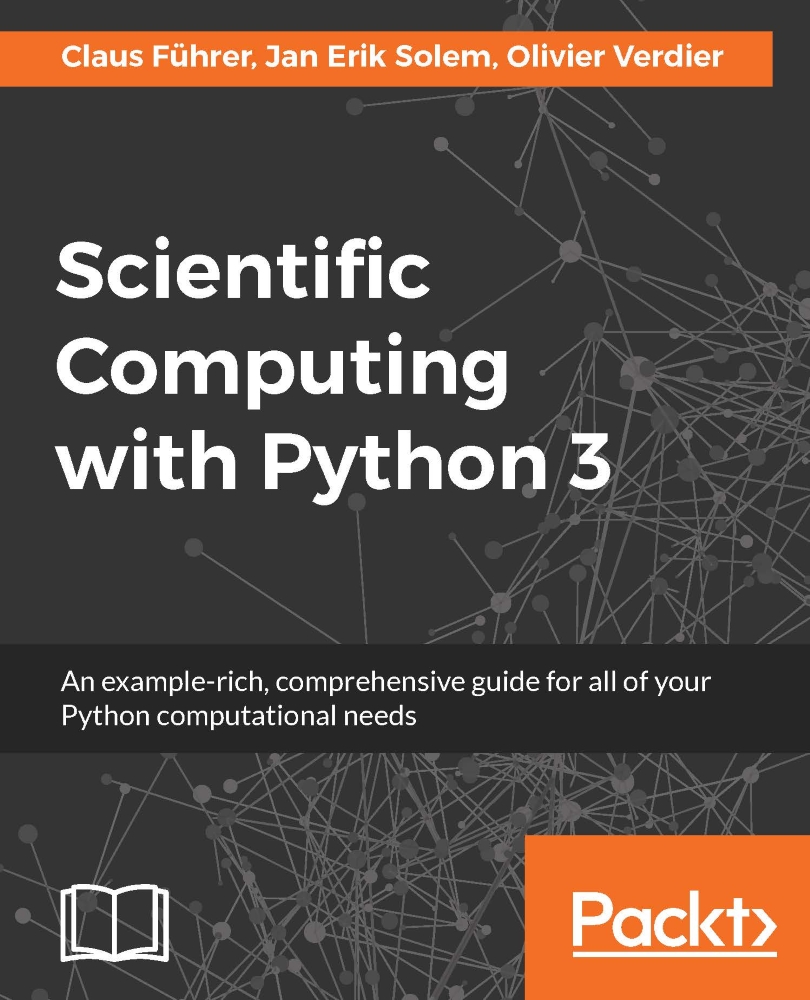
Scientific Computing with Python 3

Scientific Computing with Python 3

By : Claus Führer, Claus Fuhrer, Jan Erik Solem, Olivier Verdier
4 (2)
close
close
Scientific Computing with Python 3

Scientific Computing with Python 3

4 (2)
By: Claus Führer, Claus Fuhrer, Jan Erik Solem, Olivier Verdier

Overview of this book

Python can be used for more than just general-purpose programming. It is a free, open source language and environment that has tremendous potential for use within the domain of scientific computing. This book presents Python in tight connection with mathematical applications and demonstrates how to use various concepts in Python for computing purposes, including examples with the latest version of Python 3. Python is an effective tool to use when coupling scientific computing and mathematics and this book will teach you how to use it for linear algebra, arrays, plotting, iterating, functions, polynomials, and much more.
Table of Contents (17 chapters)
close
close
16
References

Array views and copies

In order to control precisely how memory is used, NumPy offers the concept of view of an array. Views are smaller arrays that share the same data as a larger array. This works just like a reference to one single object (refer to section Basic Types in Chapter 1, Getting Started).

Array views

The simplest example of a view is given by a slice of an array:

M = array([[1.,2.],[3.,4.]])
v = M[0,:] # first row of M

The preceding slice is a view of M. It shares the same data as M. Modifying v will modify M as well:

v[-1] = 0.
v # array([[1.,0.]])
M # array([[1.,0.],[3.,4.]]) # M is modified as well

It is possible to access the object that owns the data using the array attribute base:

v.base # array([[1.,0.],[3.,4.]])
v.base is M # True

If an array owns its data, the attribute base is none :

M.base # None

Slices as views

There are precise rules on which slices will return views and which ones will return copies. Only basic slices (mainly index expressions with :) return views...

CONTINUE READING
83
Tech Concepts
36
Programming languages
73
Tech Tools
Icon Unlimited access to the largest independent learning library in tech of over 8,000 expert-authored tech books and videos.
Icon Innovative learning tools, including AI book assistants, code context explainers, and text-to-speech.
Icon 50+ new titles added per month and exclusive early access to books as they are being written.
Scientific Computing with Python 3
notes
bookmark Notes and Bookmarks search Search in title playlist Add to playlist download Download options font-size Font size

Change the font size

margin-width Margin width

Change margin width

day-mode Day/Sepia/Night Modes

Change background colour

Close icon Search
Country selected

Close icon Your notes and bookmarks

Confirmation

Modal Close icon
claim successful

Buy this book with your credits?

Modal Close icon
Are you sure you want to buy this book with one of your credits?
Close
YES, BUY

Submit Your Feedback

Modal Close icon
Modal Close icon
Modal Close icon