Sign In Start Free Trial
Account

Add to playlist

Create a Playlist

Modal Close icon
You need to login to use this feature.
  • Book Overview & Buying Scientific Computing with Python 3
  • Table Of Contents Toc
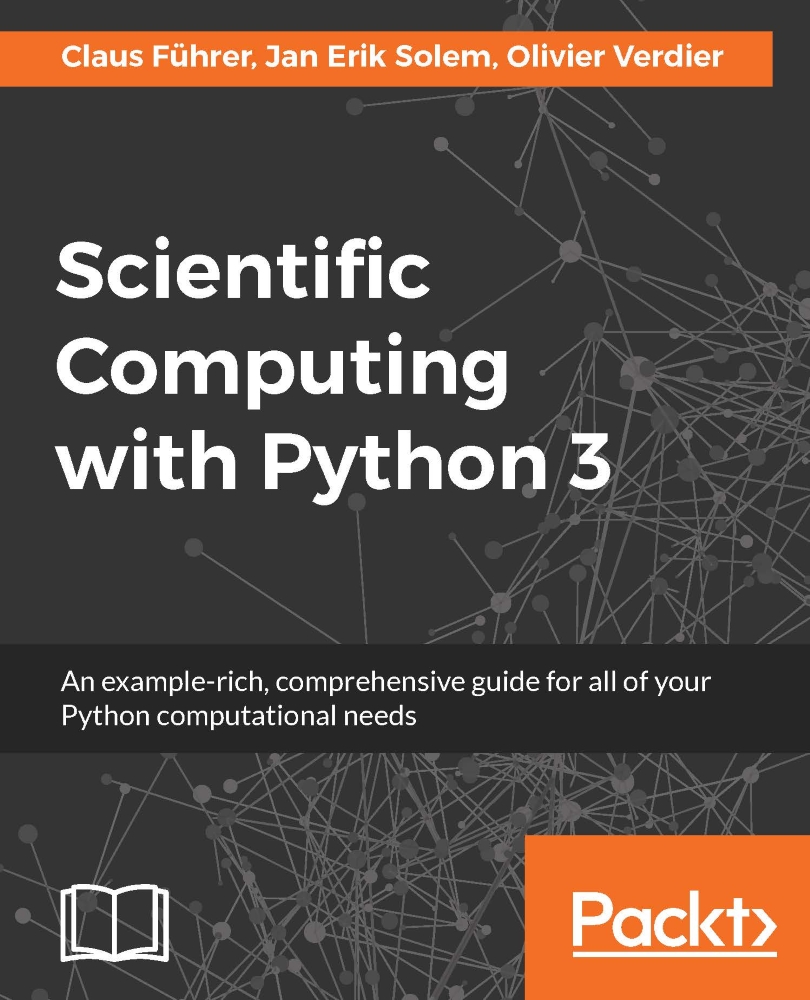
Scientific Computing with Python 3

Scientific Computing with Python 3

By : Claus Führer, Claus Fuhrer, Jan Erik Solem, Olivier Verdier
4 (2)
close
close
Scientific Computing with Python 3

Scientific Computing with Python 3

4 (2)
By: Claus Führer, Claus Fuhrer, Jan Erik Solem, Olivier Verdier

Overview of this book

Python can be used for more than just general-purpose programming. It is a free, open source language and environment that has tremendous potential for use within the domain of scientific computing. This book presents Python in tight connection with mathematical applications and demonstrates how to use various concepts in Python for computing purposes, including examples with the latest version of Python 3. Python is an effective tool to use when coupling scientific computing and mathematics and this book will teach you how to use it for linear algebra, arrays, plotting, iterating, functions, polynomials, and much more.
Table of Contents (17 chapters)
close
close
16
References

Exercises


Ex. 1 → Write a function that plots an ellipse given its center coordinates (x,y), the half axis a and b rotation angle θ.

Ex. 2 → Write a short program that takes a 2D array, e.g., the preceding Mandelbrot contour image, and iteratively replace each value by the average of its neighbors. Update a contour plot of the array in a figure window to animate the evolution of the contours. Explain the behavior.

Ex. 3 → Consider an N × N matrix or image with integer values. The mapping

is an example of a mapping of a toroidal square grid of points onto itself. This has the interesting property that it distorts the image by shearing and then moving the pieces outside the image back using the modulu function mod. Applied iteratively, this results in randomizing the image in a way that eventually returns the original. Implement the following sequence:

and save out the first N steps to files or plot them in a figure window.

As an example image, you can use the classic 512 × 512 Lena test...

CONTINUE READING
83
Tech Concepts
36
Programming languages
73
Tech Tools
Icon Unlimited access to the largest independent learning library in tech of over 8,000 expert-authored tech books and videos.
Icon Innovative learning tools, including AI book assistants, code context explainers, and text-to-speech.
Icon 50+ new titles added per month and exclusive early access to books as they are being written.
Scientific Computing with Python 3
notes
bookmark Notes and Bookmarks search Search in title playlist Add to playlist download Download options font-size Font size

Change the font size

margin-width Margin width

Change margin width

day-mode Day/Sepia/Night Modes

Change background colour

Close icon Search
Country selected

Close icon Your notes and bookmarks

Confirmation

Modal Close icon
claim successful

Buy this book with your credits?

Modal Close icon
Are you sure you want to buy this book with one of your credits?
Close
YES, BUY

Submit Your Feedback

Modal Close icon
Modal Close icon
Modal Close icon