Sign In Start Free Trial
Account

Add to playlist

Create a Playlist

Modal Close icon
You need to login to use this feature.
  • Book Overview & Buying Scientific Computing with Python 3
  • Table Of Contents Toc
Scientific Computing with Python 3

Scientific Computing with Python 3

By : Claus Führer, Claus Fuhrer, Olivier Verdier, Jan Erik Solem
4 (2)
close
close
Scientific Computing with Python 3

Scientific Computing with Python 3

4 (2)
By: Claus Führer, Claus Fuhrer, Olivier Verdier, Jan Erik Solem

Overview of this book

Python can be used for more than just general-purpose programming. It is a free, open source language and environment that has tremendous potential for use within the domain of scientific computing. This book presents Python in tight connection with mathematical applications and demonstrates how to use various concepts in Python for computing purposes, including examples with the latest version of Python 3. Python is an effective tool to use when coupling scientific computing and mathematics and this book will teach you how to use it for linear algebra, arrays, plotting, iterating, functions, polynomials, and much more.
Table of Contents (17 chapters)
close
close
16
References

Anonymous functions - the  lambda keyword


The keyword lambda is used in Python to define anonymous functions, that is; functions without a name and described by a single expression. You might just want to perform an operation on a function that can be expressed by a simple expression without naming this function and without defining this function by a lengthy def block.

Note

The name lambda originates from a special branch of calculus and mathematical logic, the -calculus.

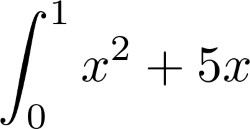
For instance, to compute the following expression, we may use SciPy’s function quad, which requires the function to be integrated as its first argument and the integration bounds as the next two arguments:

Here, the function to integrate is just a simple one-liner and we use the lambda keyword to define it:

import scipy.integrate as si
si.quad(lambda x: x ** 2 + 5, 0, 1)

The syntax is as follows:

lambda parameter_list: expression

The definition of the lambda function can only consist of a single expression and in particular...

CONTINUE READING
83
Tech Concepts
36
Programming languages
73
Tech Tools
Icon Unlimited access to the largest independent learning library in tech of over 8,000 expert-authored tech books and videos.
Icon Innovative learning tools, including AI book assistants, code context explainers, and text-to-speech.
Icon 50+ new titles added per month and exclusive early access to books as they are being written.
Scientific Computing with Python 3
notes
bookmark Notes and Bookmarks search Search in title playlist Add to playlist download Download options font-size Font size

Change the font size

margin-width Margin width

Change margin width

day-mode Day/Sepia/Night Modes

Change background colour

Close icon Search
Country selected

Close icon Your notes and bookmarks

Confirmation

Modal Close icon
claim successful

Buy this book with your credits?

Modal Close icon
Are you sure you want to buy this book with one of your credits?
Close
YES, BUY

Submit Your Feedback

Modal Close icon
Modal Close icon
Modal Close icon