
Sign In Start Free Trial
Account

Add to playlist

Create a Playlist

Modal Close icon
You need to login to use this feature.
  • Book Overview & Buying Healthcare Analytics Made Simple
  • Table Of Contents Toc
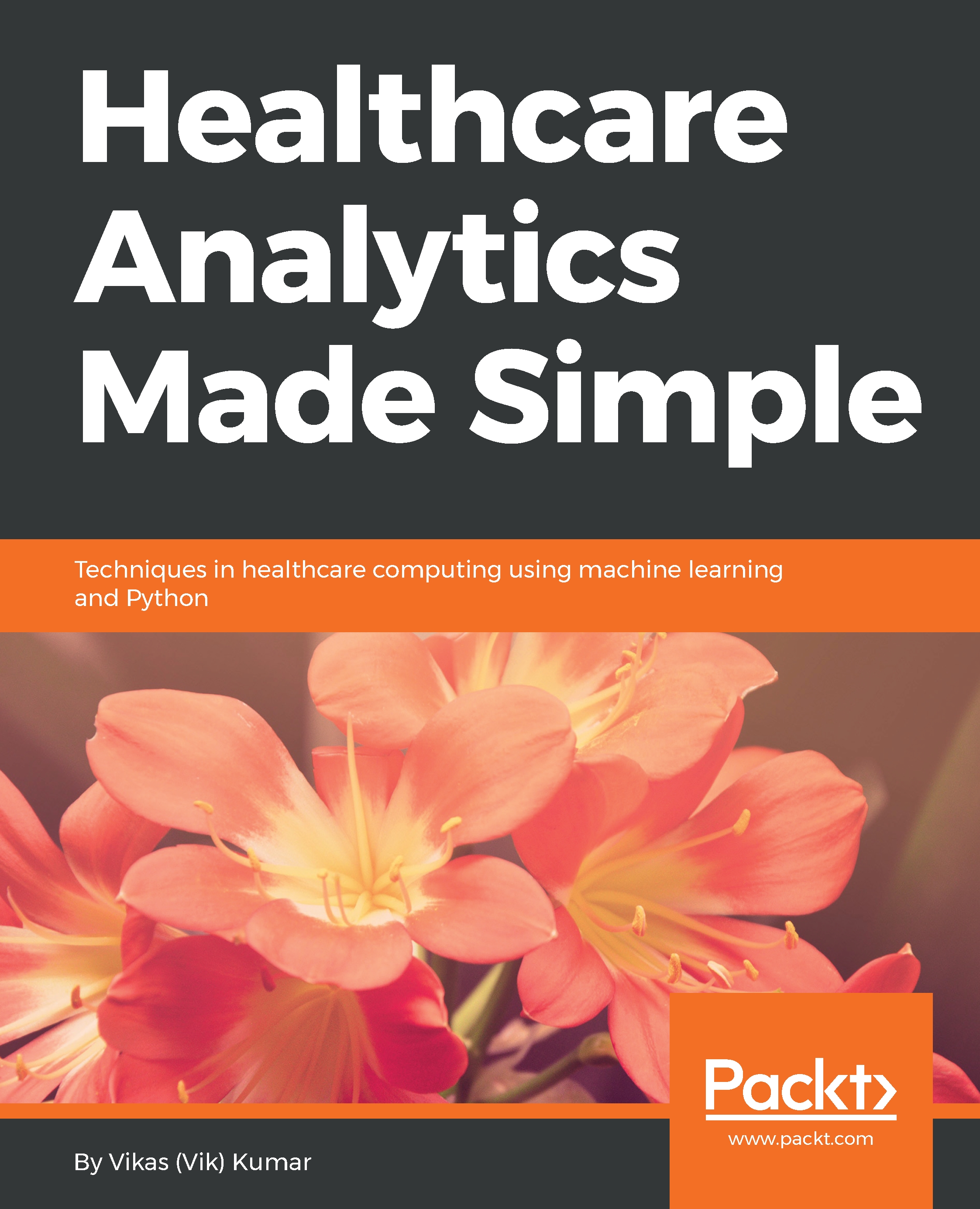
Healthcare Analytics Made Simple

Healthcare Analytics Made Simple

By : Kumar, Khader
4.4 (8)
close
close
Healthcare Analytics Made Simple

Healthcare Analytics Made Simple

4.4 (8)
By: Kumar, Khader

Overview of this book

In recent years, machine learning technologies and analytics have been widely utilized across the healthcare sector. Healthcare Analytics Made Simple bridges the gap between practising doctors and data scientists. It equips the data scientists’ work with healthcare data and allows them to gain better insight from this data in order to improve healthcare outcomes. This book is a complete overview of machine learning for healthcare analytics, briefly describing the current healthcare landscape, machine learning algorithms, and Python and SQL programming languages. The step-by-step instructions teach you how to obtain real healthcare data and perform descriptive, predictive, and prescriptive analytics using popular Python packages such as pandas and scikit-learn. The latest research results in disease detection and healthcare image analysis are reviewed. By the end of this book, you will understand how to use Python for healthcare data analysis, how to import, collect, clean, and refine data from electronic health record (EHR) surveys, and how to make predictive models with this data through real-world algorithms and code examples.
Table of Contents (11 chapters)
close
close

Computing Foundations – Introduction to Python

This chapter will provide an introduction to Python for analytics. It is meant mainly for novice programmers or developers who are not familiar with Python. By the end of the chapter, you will have a basic familiarity with the features of the Python base language, which is integral for healthcare analytics and machine learning. You will also understand how to get started using pandas and scikit-learn, two important Python libraries for analytics.

If you would like to follow along using the Jupyter Notebook, we encourage you to refer to the directions in Chapter 1, Introduction to Healthcare Analytics, to start a new Jupyter session. The notebook for this chapter is also available online at the book's official code repository.

Visually different images
CONTINUE READING
83
Tech Concepts
36
Programming languages
73
Tech Tools
Icon Unlimited access to the largest independent learning library in tech of over 8,000 expert-authored tech books and videos.
Icon Innovative learning tools, including AI book assistants, code context explainers, and text-to-speech.
Icon 50+ new titles added per month and exclusive early access to books as they are being written.
Healthcare Analytics Made Simple
notes
bookmark Notes and Bookmarks search Search in title playlist Add to playlist download Download options font-size Font size

Change the font size

margin-width Margin width

Change margin width

day-mode Day/Sepia/Night Modes

Change background colour

Close icon Search
Country selected

Close icon Your notes and bookmarks

Confirmation

Modal Close icon
claim successful

Buy this book with your credits?

Modal Close icon
Are you sure you want to buy this book with one of your credits?
Close
YES, BUY

Submit Your Feedback

Modal Close icon
Modal Close icon
Modal Close icon