Sign In Start Free Trial
Account

Add to playlist

Create a Playlist

Modal Close icon
You need to login to use this feature.
  • Book Overview & Buying TensorFlow 1.x Deep Learning Cookbook
  • Table Of Contents Toc
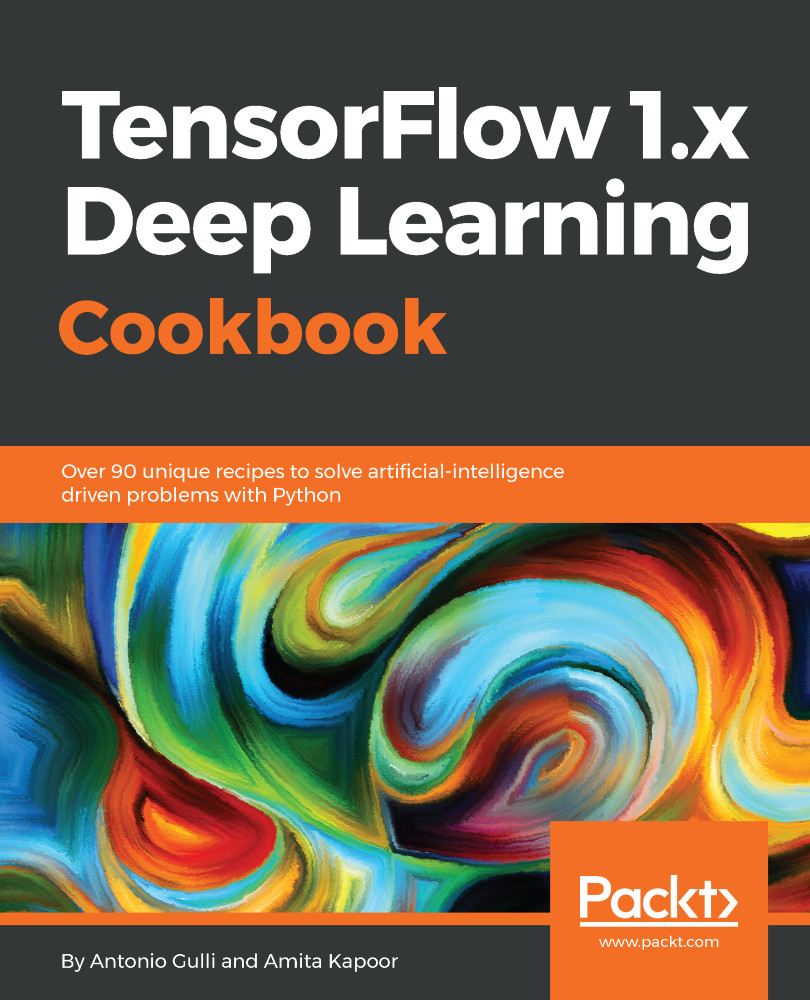
TensorFlow 1.x Deep Learning Cookbook

TensorFlow 1.x Deep Learning Cookbook

3.4 (16)
close
close
TensorFlow 1.x Deep Learning Cookbook

TensorFlow 1.x Deep Learning Cookbook

3.4 (16)

Overview of this book

Deep neural networks (DNNs) have achieved a lot of success in the field of computer vision, speech recognition, and natural language processing. This exciting recipe-based guide will take you from the realm of DNN theory to implementing them practically to solve real-life problems in the artificial intelligence domain. In this book, you will learn how to efficiently use TensorFlow, Google’s open source framework for deep learning. You will implement different deep learning networks, such as Convolutional Neural Networks (CNNs), Recurrent Neural Networks (RNNs), Deep Q-learning Networks (DQNs), and Generative Adversarial Networks (GANs), with easy-to-follow standalone recipes. You will learn how to use TensorFlow with Keras as the backend. You will learn how different DNNs perform on some popularly used datasets, such as MNIST, CIFAR-10, and Youtube8m. You will not only learn about the different mobile and embedded platforms supported by TensorFlow, but also how to set up cloud platforms for deep learning applications. You will also get a sneak peek at TPU architecture and how it will affect the future of DNNs. By using crisp, no-nonsense recipes, you will become an expert in implementing deep learning techniques in growing real-world applications and research areas such as reinforcement learning, GANs, and autoencoders.
Table of Contents (15 chapters)
close
close
14
TensorFlow Processing Units

Different Python packages required for DNN-based problems

TensorFlow takes care of most of the neural network implementation. However, this is not sufficient; for preprocessing tasks, serialization, and even plotting, we need some more Python packages.

How to do it...

Here are listed some of the common Python packages used:

  1. Numpy: This is the fundamental package for scientific computing with Python. It supports n-dimensional arrays and matrices. It also has a large collection of high-level mathematical functions. It is a necessary package required by TensorFlow and therefore, with pip install tensorflow, it is installed if not already present.
  2. Matplolib: This is the Python 2D plotting library. You can use it to create plots, histograms, bar charts, error charts, scatterplots, and power spectra with just a few lines of code. It can be installed using pip:
pip install matplotlib 
# or using Anaconda
conda install -c conda-forge matplotlib
  1. OS: This is included in the basic Python installation. It provides an easy and portable way of using operating system-dependent functionality like reading, writing, and changing files and directories.
  2. Pandas: This provides various data structures and data analysis tools. Using Pandas, you can read and write data between in-memory data structures and different formats. We can read from .csv and text files. It can be installed using either pip install or conda install.
  3. Seaborn: This is a specialized statistical data visualization tool built on Matplotlib.
  4. H5fs: H5fs is a filesystem for Linux (also other operating systems with FUSE implementation like macOS X) capable of operations on an HDFS (Hierarchical Data Format Filesystem).
  5. PythonMagick: It is the Python binding of the ImageMagick library. It is a library to display, convert, and edit raster image and vector image files. It supports more than 200 image file formats. It can be installed using source build available from ImageMagick. Certain .whl formats are also available for a convenient pip install (http://www.lfd.uci.edu/%7Egohlke/pythonlibs/#pythonmagick).

  1. TFlearn: TFlearn is a modular and transparent deep learning library built on top of TensorFlow. It provides a higher-level API to TensorFlow in order to facilitate and speed up experimentation. It currently supports most of the recent deep learning models, such as Convolutions, LSTM, BatchNorm, BiRNN, PReLU, Residual networks, and Generative networks. It works only for TensorFlow 1.0 or higher. To install, use pip install tflearn.
  2. Keras: Keras too is a high-level API for neural networks, which uses TensorFlow as its backend. It can run on top of Theano and CNTK as well. It is extremely user-friendly, adding layers to it is just a one-line job. It can be installed using pip install keras.

See also

CONTINUE READING
83
Tech Concepts
36
Programming languages
73
Tech Tools
Icon Unlimited access to the largest independent learning library in tech of over 8,000 expert-authored tech books and videos.
Icon Innovative learning tools, including AI book assistants, code context explainers, and text-to-speech.
Icon 50+ new titles added per month and exclusive early access to books as they are being written.
TensorFlow 1.x Deep Learning Cookbook
notes
bookmark Notes and Bookmarks search Search in title playlist Add to playlist download Download options font-size Font size

Change the font size

margin-width Margin width

Change margin width

day-mode Day/Sepia/Night Modes

Change background colour

Close icon Search
Country selected

Close icon Your notes and bookmarks

Confirmation

Modal Close icon
claim successful

Buy this book with your credits?

Modal Close icon
Are you sure you want to buy this book with one of your credits?
Close
YES, BUY

Submit Your Feedback

Modal Close icon
Modal Close icon
Modal Close icon