


In this chapter, you have learned about various unsupervised learning methods to identify the structures and patterns within the data using k-mean clustering, PCA, SVD and deep auto encoders. Also, the k-means clustering algorithm explained with iris data. Methods were shown on how to choose the optimal k-value based on various performance metrics. Handwritten data from scikit-learn was been utilized to compare the differences between linear methods like PCA and SVD with non-linear techniques and deep auto encoders. The differences between PCA and SVD were given in detail, so that the reader can understand SVD, which can be applied even on rectangular matrices where the number of users and number of products are not necessarily equal. At the end, through visualization, it has been proven that deep auto encoders are better at separating digits than linear unsupervised learning...
-
Book Overview & Buying
-
Table Of Contents

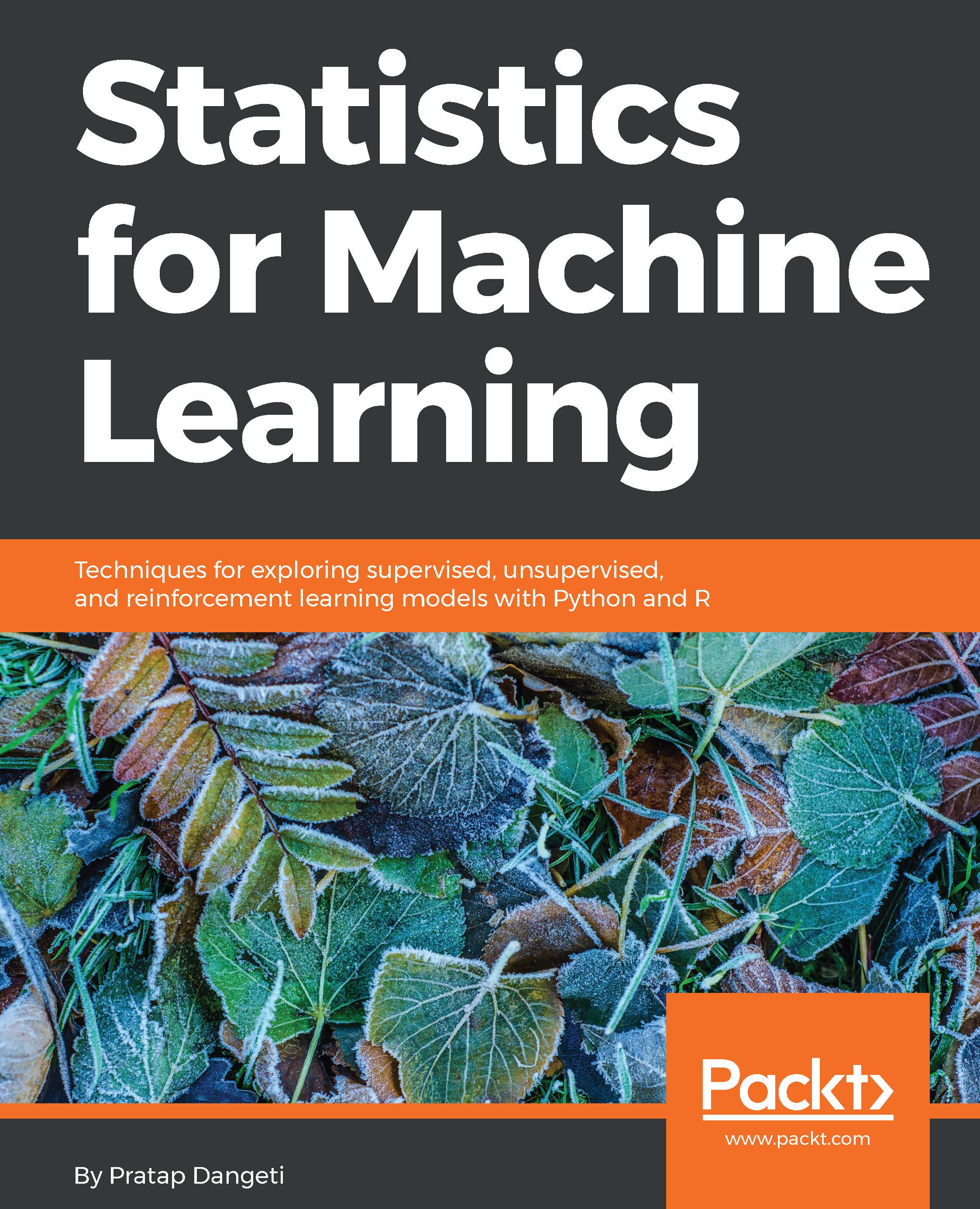
Statistics for Machine Learning
By :


Statistics for Machine Learning
By:
Overview of this book
Complex statistics in machine learning worry a lot of developers. Knowing statistics helps you build strong machine learning models that are optimized for a given problem statement.
This book will teach you all it takes to perform the complex statistical computations that are required for machine learning. You will gain information on the statistics behind supervised learning, unsupervised learning, reinforcement learning, and more. You will see real-world examples that discuss the statistical side of machine learning and familiarize yourself with it. You will come across programs for performing tasks such as modeling, parameter fitting, regression, classification, density collection, working with vectors, matrices, and more.
By the end of the book, you will have mastered the statistics required for machine learning and will be able to apply your new skills to any sort of industry problem.
Table of Contents (10 chapters)
Preface

 Free Chapter
Journey from Statistics to Machine Learning
Parallelism of Statistics and Machine Learning
Logistic Regression Versus Random Forest
Tree-Based Machine Learning Models
K-Nearest Neighbors and Naive Bayes
Support Vector Machines and Neural Networks
Recommendation Engines
Unsupervised Learning

Reinforcement Learning


