Sign In Start Free Trial
Account

Add to playlist

Create a Playlist

Modal Close icon
You need to login to use this feature.
  • Book Overview & Buying Statistics for Machine Learning
  • Table Of Contents Toc
  • Feedback & Rating feedback
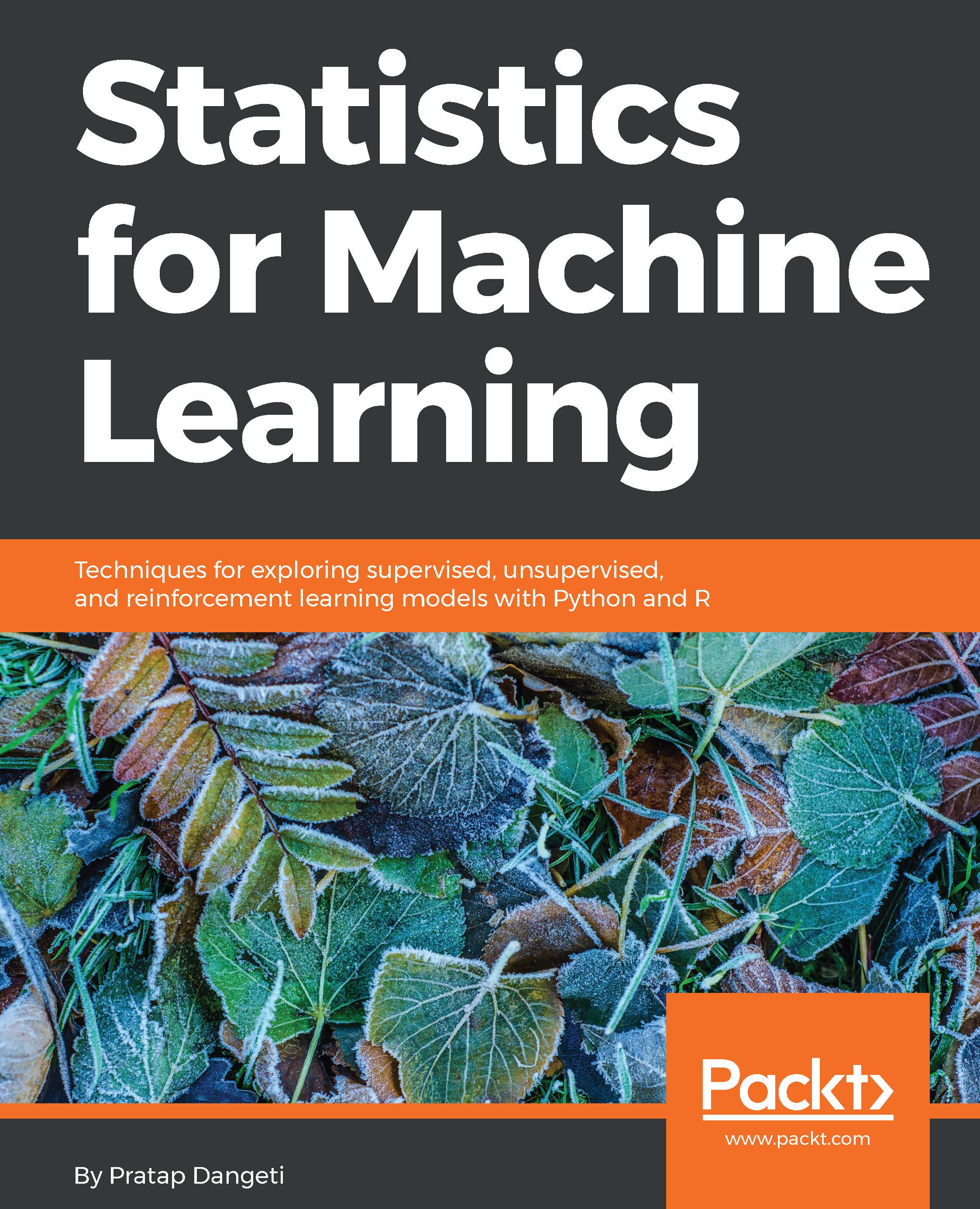
Statistics for Machine Learning

Statistics for Machine Learning

By : Pratap Dangeti
3.7 (6)
close
close
Statistics for Machine Learning

Statistics for Machine Learning

3.7 (6)
By: Pratap Dangeti

Overview of this book

Complex statistics in machine learning worry a lot of developers. Knowing statistics helps you build strong machine learning models that are optimized for a given problem statement. This book will teach you all it takes to perform the complex statistical computations that are required for machine learning. You will gain information on the statistics behind supervised learning, unsupervised learning, reinforcement learning, and more. You will see real-world examples that discuss the statistical side of machine learning and familiarize yourself with it. You will come across programs for performing tasks such as modeling, parameter fitting, regression, classification, density collection, working with vectors, matrices, and more. By the end of the book, you will have mastered the statistics required for machine learning and will be able to apply your new skills to any sort of industry problem.
Table of Contents (10 chapters)
close
close

Deep auto encoders applied on handwritten digits using Keras


Deep auto encoders are explained with same handwritten digits data to show the comparison of how this non-linear method differs to linear methods like PCA and SVD. Non-linear methods generally perform much better, but these methods are kind of black-box models and we cannot determine the explanation behind that. Keras software has been utilized to build the deep auto encoders here, as they work like Lego blocks, which makes it easy for users to play around with different architectures and parameters of the model for better understanding:

# Deep Auto Encoders 
>>> import matplotlib.pyplot as plt 
>>> from sklearn.preprocessing import StandardScaler 
>>> from sklearn.datasets import load_digits 
 
>>> digits = load_digits() 
>>> X = digits.data 
>>> y = digits.target 
 
>>> print (X.shape) 
>>> print (y.shape) 
>>> x_vars_stdscle = StandardScaler().fit_transform...
Visually different images
CONTINUE READING
83
Tech Concepts
36
Programming languages
73
Tech Tools
Icon Unlimited access to the largest independent learning library in tech of over 8,000 expert-authored tech books and videos.
Icon Innovative learning tools, including AI book assistants, code context explainers, and text-to-speech.
Icon 50+ new titles added per month and exclusive early access to books as they are being written.
Statistics for Machine Learning
notes
bookmark Notes and Bookmarks search Search in title playlist Add to playlist download Download options font-size Font size

Change the font size

margin-width Margin width

Change margin width

day-mode Day/Sepia/Night Modes

Change background colour

Close icon Search
Country selected

Close icon Your notes and bookmarks

Confirmation

Modal Close icon
claim successful

Buy this book with your credits?

Modal Close icon
Are you sure you want to buy this book with one of your credits?
Close
YES, BUY

Submit Your Feedback

Modal Close icon
Modal Close icon
Modal Close icon