
Sign In Start Free Trial
Account

Add to playlist

Create a Playlist

Modal Close icon
You need to login to use this feature.
  • Book Overview & Buying Machine Learning in Java
  • Table Of Contents Toc
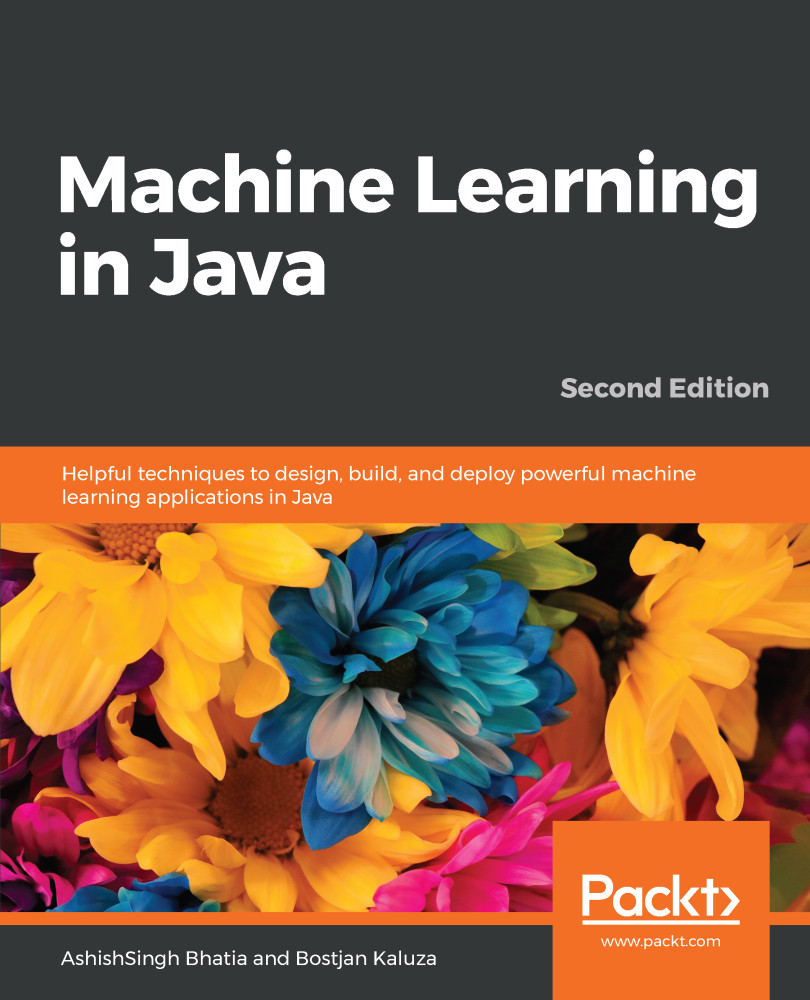
Machine Learning in Java

Machine Learning in Java - Second Edition

By : AshishSingh Bhatia, Bostjan Kaluza
5 (1)
close
close
Machine Learning in Java

Machine Learning in Java

5 (1)
By: AshishSingh Bhatia, Bostjan Kaluza

Overview of this book

As the amount of data in the world continues to grow at an almost incomprehensible rate, being able to understand and process data is becoming a key differentiator for competitive organizations. Machine learning applications are everywhere, from self-driving cars, spam detection, document search, and trading strategies, to speech recognition. This makes machine learning well-suited to the present-day era of big data and Data Science. The main challenge is how to transform data into actionable knowledge. Machine Learning in Java will provide you with the techniques and tools you need. You will start by learning how to apply machine learning methods to a variety of common tasks including classification, prediction, forecasting, market basket analysis, and clustering. The code in this book works for JDK 8 and above, the code is tested on JDK 11. Moving on, you will discover how to detect anomalies and fraud, and ways to perform activity recognition, image recognition, and text analysis. By the end of the book, you will have explored related web resources and technologies that will help you take your learning to the next level. By applying the most effective machine learning methods to real-world problems, you will gain hands-on experience that will transform the way you think about data.
Table of Contents (13 chapters)
close
close

Building a machine learning application

Machine learning applications, especially those focused on classification, usually follow the same high-level workflow that's shown in the following diagram. The workflow is comprised of two phases—training the classifier and the classification of new instances. Both phases share common steps, as shown here:

First, we use a set of training data, select a representative subset as the training set, preprocess the missing data, and extract its features. A selected supervised learning algorithm is used to train a model, which is deployed in the second phase. The second phase puts a new data instance through the same preprocessing and feature extraction procedure and applies the learned model to obtain the instance label. If you are able to collect new labelled data, periodically rerun the learning phase to retrain the model and...

CONTINUE READING
83
Tech Concepts
36
Programming languages
73
Tech Tools
Icon Unlimited access to the largest independent learning library in tech of over 8,000 expert-authored tech books and videos.
Icon Innovative learning tools, including AI book assistants, code context explainers, and text-to-speech.
Icon 50+ new titles added per month and exclusive early access to books as they are being written.
Machine Learning in Java
notes
bookmark Notes and Bookmarks search Search in title playlist Add to playlist download Download options font-size Font size

Change the font size

margin-width Margin width

Change margin width

day-mode Day/Sepia/Night Modes

Change background colour

Close icon Search
Country selected

Close icon Your notes and bookmarks

Confirmation

Modal Close icon
claim successful

Buy this book with your credits?

Modal Close icon
Are you sure you want to buy this book with one of your credits?
Close
YES, BUY

Submit Your Feedback

Modal Close icon
Modal Close icon
Modal Close icon