
Sign In Start Free Trial
Account

Add to playlist

Create a Playlist

Modal Close icon
You need to login to use this feature.
  • Book Overview & Buying Hands-On Time Series Analysis with R
  • Table Of Contents Toc
  • Feedback & Rating feedback
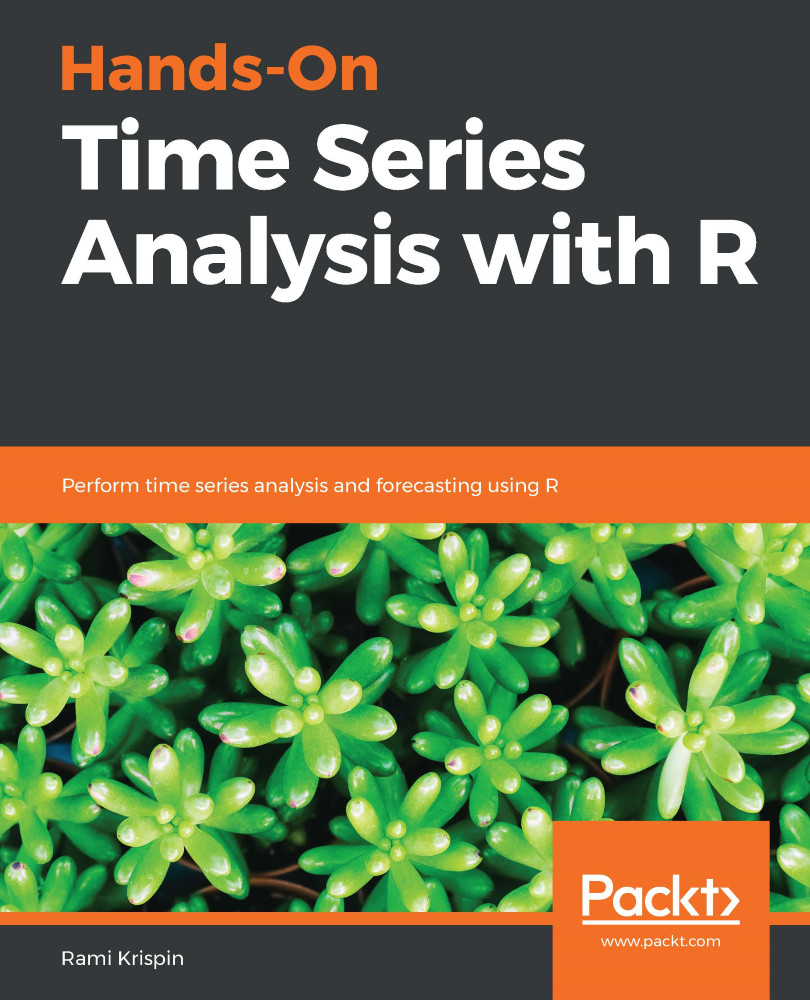
Hands-On Time Series Analysis with R

Hands-On Time Series Analysis with R

By : Rami Krispin
3.9 (10)
close
close
Hands-On Time Series Analysis with R

Hands-On Time Series Analysis with R

3.9 (10)
By: Rami Krispin

Overview of this book

Time-series analysis is the art of extracting meaningful insights from, and revealing patterns in, time-series data using statistical and data visualization approaches. These insights and patterns can then be utilized to explore past events and forecast future values in the series. This book explores the basics of time-series analysis with R and lays the foundation you need to build forecasting models. You will learn how to preprocess raw time-series data and clean and manipulate data with packages such as stats, lubridate, xts, and zoo. You will analyze data using both descriptive statistics and rich data visualization tools in R including the TSstudio, plotly, and ggplot2 packages. The book then delves into traditional forecasting models such as time-series linear regression, exponential smoothing (Holt, Holt-Winter, and more) and Auto-Regressive Integrated Moving Average (ARIMA) models with the stats and forecast packages. You'll also work on advanced time-series regression models with machine learning algorithms such as random forest and Gradient Boosting Machine using the h2o package. By the end of this book, you will have developed the skills necessary for exploring your data, identifying patterns, and building a forecasting model using various traditional and machine learning methods.
Table of Contents (14 chapters)
close
close

Summary

Correlation analysis of time series data is one of the main steps of the analysis process. Throughout this chapter, we introduced different approaches for identifying the correlation between a series and its lags and causality between two time series. Those approaches include the use of both statistical methods, such as the ACF and PACF, and data visualization methods. The application of the correlation analysis plays a pivotal role in many time series applications, from the descriptive analysis of a series, as we saw in this chapter, to tuning time series forecasting models, such as the ARIMA model.

In the next chapter, we will introduce strategies for training, testing, benchmarking, and evaluating forecasting models.

Visually different images
CONTINUE READING
83
Tech Concepts
36
Programming languages
73
Tech Tools
Icon Unlimited access to the largest independent learning library in tech of over 8,000 expert-authored tech books and videos.
Icon Innovative learning tools, including AI book assistants, code context explainers, and text-to-speech.
Icon 50+ new titles added per month and exclusive early access to books as they are being written.
Hands-On Time Series Analysis with R
notes
bookmark Notes and Bookmarks search Search in title playlist Add to playlist download Download options font-size Font size

Change the font size

margin-width Margin width

Change margin width

day-mode Day/Sepia/Night Modes

Change background colour

Close icon Search
Country selected

Close icon Your notes and bookmarks

Confirmation

Modal Close icon
claim successful

Buy this book with your credits?

Modal Close icon
Are you sure you want to buy this book with one of your credits?
Close
YES, BUY

Submit Your Feedback

Modal Close icon
Modal Close icon
Modal Close icon