
Sign In Start Free Trial
Account

Add to playlist

Create a Playlist

Modal Close icon
You need to login to use this feature.
  • Book Overview & Buying Machine Learning Quick Reference
  • Table Of Contents Toc
Machine Learning Quick Reference

Machine Learning Quick Reference

By : Kumar
close
close
Machine Learning Quick Reference

Machine Learning Quick Reference

By: Kumar

Overview of this book

Machine learning makes it possible to learn about the unknowns and gain hidden insights into your datasets by mastering many tools and techniques. This book guides you to do just that in a very compact manner. After giving a quick overview of what machine learning is all about, Machine Learning Quick Reference jumps right into its core algorithms and demonstrates how they can be applied to real-world scenarios. From model evaluation to optimizing their performance, this book will introduce you to the best practices in machine learning. Furthermore, you will also look at the more advanced aspects such as training neural networks and work with different kinds of data, such as text, time-series, and sequential data. Advanced methods and techniques such as causal inference, deep Gaussian processes, and more are also covered. By the end of this book, you will be able to train fast, accurate machine learning models at your fingertips, which you can easily use as a point of reference.
Table of Contents (13 chapters)
close
close

Random forest algorithm

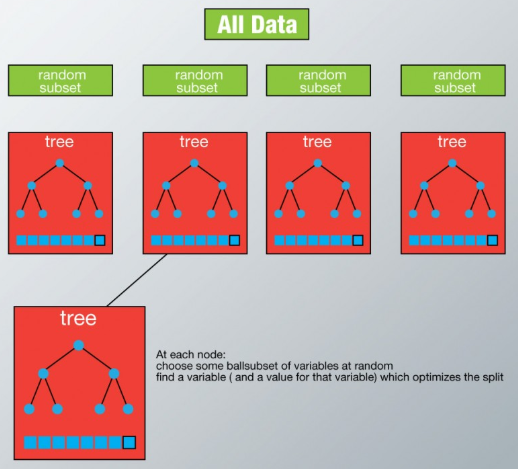
The random forest algorithm works with the bagging technique. The number of trees are planted and grown in the following manner:

  • There are observations in the training set. Samples out of N observations are taken at random and with replacement. These samples will act as a training set for different trees.
  • If there are M input features (variables), m features are drawn as a subset out of M and of course m < M. What this does is select m features at random at each node of the tree.
  • Every tree is grown to the largest extent possible.

  • Prediction takes place based on the aggregation of the results coming out of all the trees. In the case of classification, the method of aggregation is voting, whereas it is an average of all the results in the case of regression:
Let's work on a case study, since that will help us understand...

CONTINUE READING
83
Tech Concepts
36
Programming languages
73
Tech Tools
Icon Unlimited access to the largest independent learning library in tech of over 8,000 expert-authored tech books and videos.
Icon Innovative learning tools, including AI book assistants, code context explainers, and text-to-speech.
Icon 50+ new titles added per month and exclusive early access to books as they are being written.
Machine Learning Quick Reference
notes
bookmark Notes and Bookmarks search Search in title playlist Add to playlist download Download options font-size Font size

Change the font size

margin-width Margin width

Change margin width

day-mode Day/Sepia/Night Modes

Change background colour

Close icon Search
Country selected

Close icon Your notes and bookmarks

Confirmation

Modal Close icon
claim successful

Buy this book with your credits?

Modal Close icon
Are you sure you want to buy this book with one of your credits?
Close
YES, BUY

Submit Your Feedback

Modal Close icon
Modal Close icon
Modal Close icon