
Sign In Start Free Trial
Account

Add to playlist

Create a Playlist

Modal Close icon
You need to login to use this feature.
  • Book Overview & Buying R Deep Learning Essentials
  • Table Of Contents Toc
R Deep Learning Essentials

R Deep Learning Essentials - Second Edition

By : Mark Hodnett, Joshua F. Wiley
3.7 (3)
close
close
R Deep Learning Essentials

R Deep Learning Essentials

3.7 (3)
By: Mark Hodnett, Joshua F. Wiley

Overview of this book

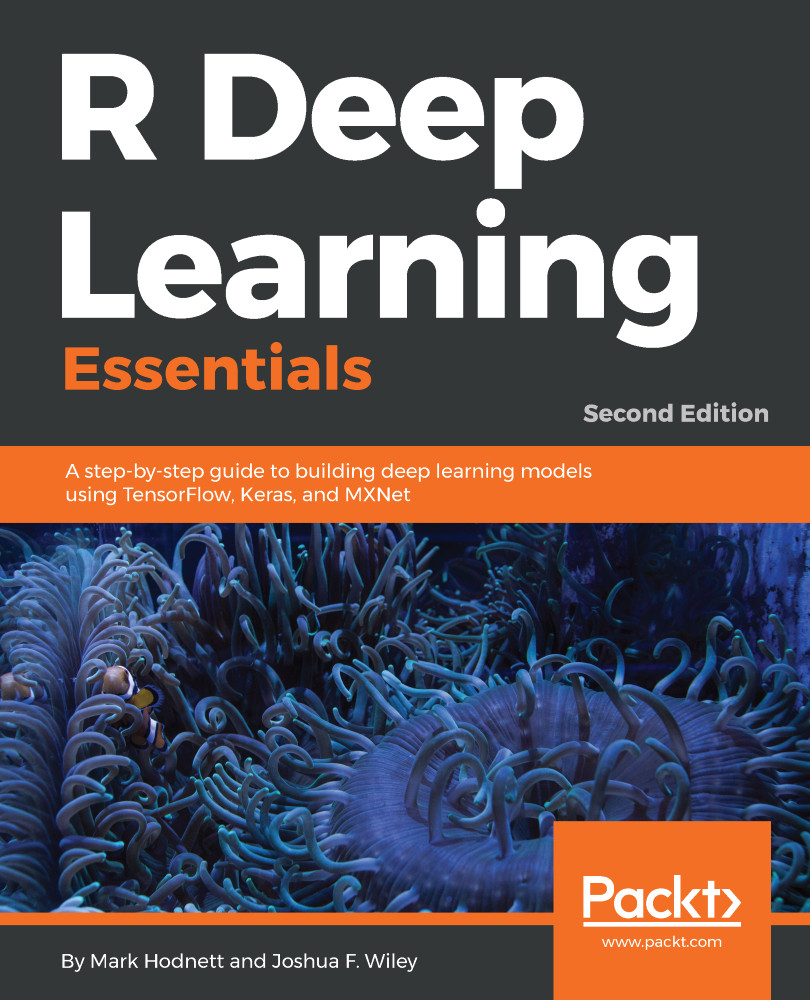
Deep learning is a powerful subset of machine learning that is very successful in domains such as computer vision and natural language processing (NLP). This second edition of R Deep Learning Essentials will open the gates for you to enter the world of neural networks by building powerful deep learning models using the R ecosystem. This book will introduce you to the basic principles of deep learning and teach you to build a neural network model from scratch. As you make your way through the book, you will explore deep learning libraries, such as Keras, MXNet, and TensorFlow, and create interesting deep learning models for a variety of tasks and problems, including structured data, computer vision, text data, anomaly detection, and recommendation systems. You’ll cover advanced topics, such as generative adversarial networks (GANs), transfer learning, and large-scale deep learning in the cloud. In the concluding chapters, you will learn about the theoretical concepts of deep learning projects, such as model optimization, overfitting, and data augmentation, together with other advanced topics. By the end of this book, you will be fully prepared and able to implement deep learning concepts in your research work or projects.
Table of Contents (13 chapters)
close
close

Summary

In this chapter, we used deep learning for image classification. We discussed the different layer types that are used in image classification: convolutional layers, pooling layers, dropout, dense layers, and the softmax activation function. We saw an R-Shiny application that shows how convolutional layers perform feature engineering on image data.

We used the MXNet deep learning library in R to create a base deep learning model which got 97.1% accuracy. We then developed a CNN deep learning model based on the LeNet architecture, which achieved over 98.3% accuracy on test data. We also used a slightly harder dataset (Fashion MNIST) and created a new model that achieved over 91% accuracy. This accuracy score was better than all of the other scores that used non-deep learning algorithms. In the next chapter, we will build on what we have covered and show you how we can take...

CONTINUE READING
83
Tech Concepts
36
Programming languages
73
Tech Tools
Icon Unlimited access to the largest independent learning library in tech of over 8,000 expert-authored tech books and videos.
Icon Innovative learning tools, including AI book assistants, code context explainers, and text-to-speech.
Icon 50+ new titles added per month and exclusive early access to books as they are being written.
R Deep Learning Essentials
notes
bookmark Notes and Bookmarks search Search in title playlist Add to playlist download Download options font-size Font size

Change the font size

margin-width Margin width

Change margin width

day-mode Day/Sepia/Night Modes

Change background colour

Close icon Search
Country selected

Close icon Your notes and bookmarks

Confirmation

Modal Close icon
claim successful

Buy this book with your credits?

Modal Close icon
Are you sure you want to buy this book with one of your credits?
Close
YES, BUY

Submit Your Feedback

Modal Close icon
Modal Close icon
Modal Close icon