
Sign In Start Free Trial
Account

Add to playlist

Create a Playlist

Modal Close icon
You need to login to use this feature.
  • Book Overview & Buying Learning Jupyter 5
  • Table Of Contents Toc
  • Feedback & Rating feedback
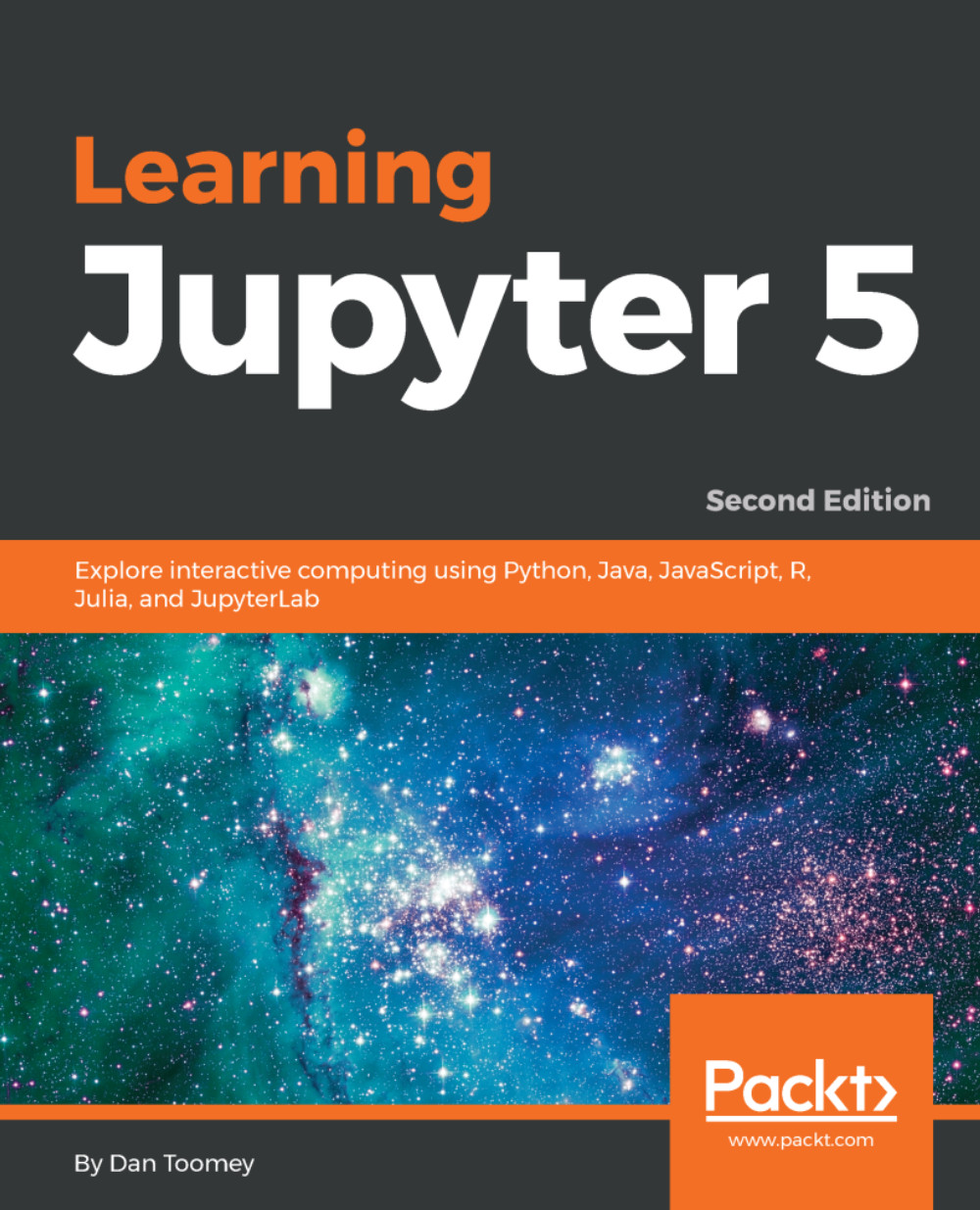
Learning Jupyter 5

Learning Jupyter 5 - Second Edition

2.5 (2)
close
close
Learning Jupyter 5

Learning Jupyter 5

2.5 (2)

Overview of this book

The Jupyter Notebook allows you to create and share documents that contain live code, equations, visualizations, and explanatory text. The Jupyter Notebook system is extensively used in domains such as data cleaning and transformation, numerical simulation, statistical modeling, and machine learning. Learning Jupyter 5 will help you get to grips with interactive computing using real-world examples. The book starts with a detailed overview of the Jupyter Notebook system and its installation in different environments. Next, you will learn to integrate the Jupyter system with different programming languages such as R, Python, Java, JavaScript, and Julia, and explore various versions and packages that are compatible with the Notebook system. Moving ahead, you will master interactive widgets and namespaces and work with Jupyter in a multi-user mode. By the end of this book, you will have used Jupyter with a big dataset and be able to apply all the functionalities you’ve explored throughout the book. You will also have learned all about the Jupyter Notebook and be able to start performing data transformation, numerical simulation, and data visualization.
Table of Contents (14 chapters)
close
close

Jupyter JavaScript Coding

JavaScript is a high-level, dynamic, untyped, and interpreted programming language. There are several outgrowth languages that are based on JavaScript. In the case of Jupyter, the underlying JavaScript is really Node.js. Node.js is an event-based framework that uses JavaScript, which can be used to develop large, scalable applications. Note that this is in contrast to the earlier languages covered in this book which are primarily used for data analysis (Python is a general language as well, but has clear aspects that deal with its capabilities of performing data analysis).

In this chapter, we will cover the following topics:

  •  Adding JavaScript packages to Jupyter
  •  JavaScript Jupyter Notebook
  •  Basic JavaScript in Jupyter
  •  Node.js d3 package
  •  Node.js stats-analysis package
  •  Node.js JSON handling
  •  Node.js canvas package...

Subscribe to access the full title

Advance your knowledge in tech

A Packt subscription gives you instant online access to our library of over 8,000 practical eBooks and videos, constantly updated with the latest in tech
notes
bookmark Notes and Bookmarks search Search in title playlist Add to playlist font-size Font size

Change the font size

margin-width Margin width

Change margin width

day-mode Day/Sepia/Night Modes

Change background colour

Close icon Search
Country selected

Close icon Your notes and bookmarks

Confirmation

Modal Close icon
claim successful

Buy this book with your credits?

Modal Close icon
Are you sure you want to buy this book with one of your credits?
Close
YES, BUY

Submit Your Feedback

Modal Close icon
Modal Close icon
Modal Close icon