Sign In Start Free Trial
Account

Add to playlist

Create a Playlist

Modal Close icon
You need to login to use this feature.
  • Book Overview & Buying Learning Jupyter 5
  • Table Of Contents Toc
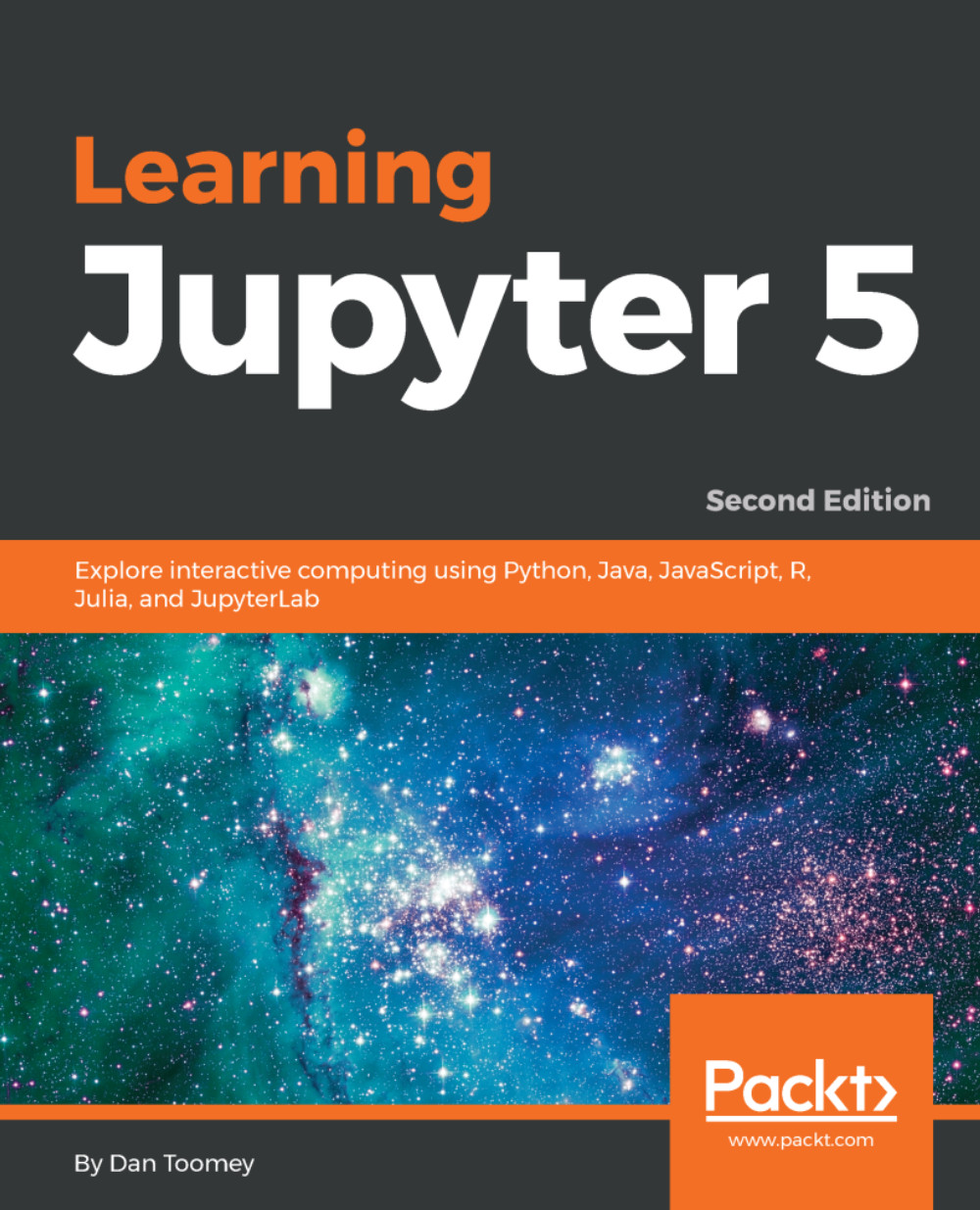
Learning Jupyter 5

Learning Jupyter 5 - Second Edition

By : Toomey
2.5 (2)
close
close
Learning Jupyter 5

Learning Jupyter 5

2.5 (2)
By: Toomey

Overview of this book

The Jupyter Notebook allows you to create and share documents that contain live code, equations, visualizations, and explanatory text. The Jupyter Notebook system is extensively used in domains such as data cleaning and transformation, numerical simulation, statistical modeling, and machine learning. Learning Jupyter 5 will help you get to grips with interactive computing using real-world examples. The book starts with a detailed overview of the Jupyter Notebook system and its installation in different environments. Next, you will learn to integrate the Jupyter system with different programming languages such as R, Python, Java, JavaScript, and Julia, and explore various versions and packages that are compatible with the Notebook system. Moving ahead, you will master interactive widgets and namespaces and work with Jupyter in a multi-user mode. By the end of this book, you will have used Jupyter with a big dataset and be able to apply all the functionalities you’ve explored throughout the book. You will also have learned all about the Jupyter Notebook and be able to start performing data transformation, numerical simulation, and data visualization.
Table of Contents (14 chapters)
close
close

Spark evaluating history data


In this example, we combine the previous sections to look at some historical data and determine a number of useful attributes.

The historical data we are using is the guest list for the Jon Stewart television show. A typical record from the data looks as follows:

1999,actor,1/11/99,Acting,Michael J. Fox 

This contains the year, the occupation of the guest, the date of appearance, a logical grouping of the occupations, and the name of the guest.

For our analysis, we will be looking at the number of appearances per year, the occupation that appears most frequently, and the personality who appears most frequently.

We will be using this script:

#Spark Daily Show Guests
import pyspark
import csv
import operator
import itertools
import collections

if not 'sc' in globals():
 sc = pyspark.SparkContext()

years = {}
occupations = {}
guests = {}

#file header contains column descriptors:
#YEAR, GoogleKnowledge_Occupation, Show, Group, Raw_Guest_List

with open('daily_show_guests...
CONTINUE READING
83
Tech Concepts
36
Programming languages
73
Tech Tools
Icon Unlimited access to the largest independent learning library in tech of over 8,000 expert-authored tech books and videos.
Icon Innovative learning tools, including AI book assistants, code context explainers, and text-to-speech.
Icon 50+ new titles added per month and exclusive early access to books as they are being written.
Learning Jupyter 5
notes
bookmark Notes and Bookmarks search Search in title playlist Add to playlist font-size Font size

Change the font size

margin-width Margin width

Change margin width

day-mode Day/Sepia/Night Modes

Change background colour

Close icon Search
Country selected

Close icon Your notes and bookmarks

Confirmation

Modal Close icon
claim successful

Buy this book with your credits?

Modal Close icon
Are you sure you want to buy this book with one of your credits?
Close
YES, BUY

Submit Your Feedback

Modal Close icon
Modal Close icon
Modal Close icon