
Sign In Start Free Trial
Account

Add to playlist

Create a Playlist

Modal Close icon
You need to login to use this feature.
  • Book Overview & Buying Splunk 7.x Quick Start Guide
  • Table Of Contents Toc
  • Feedback & Rating feedback
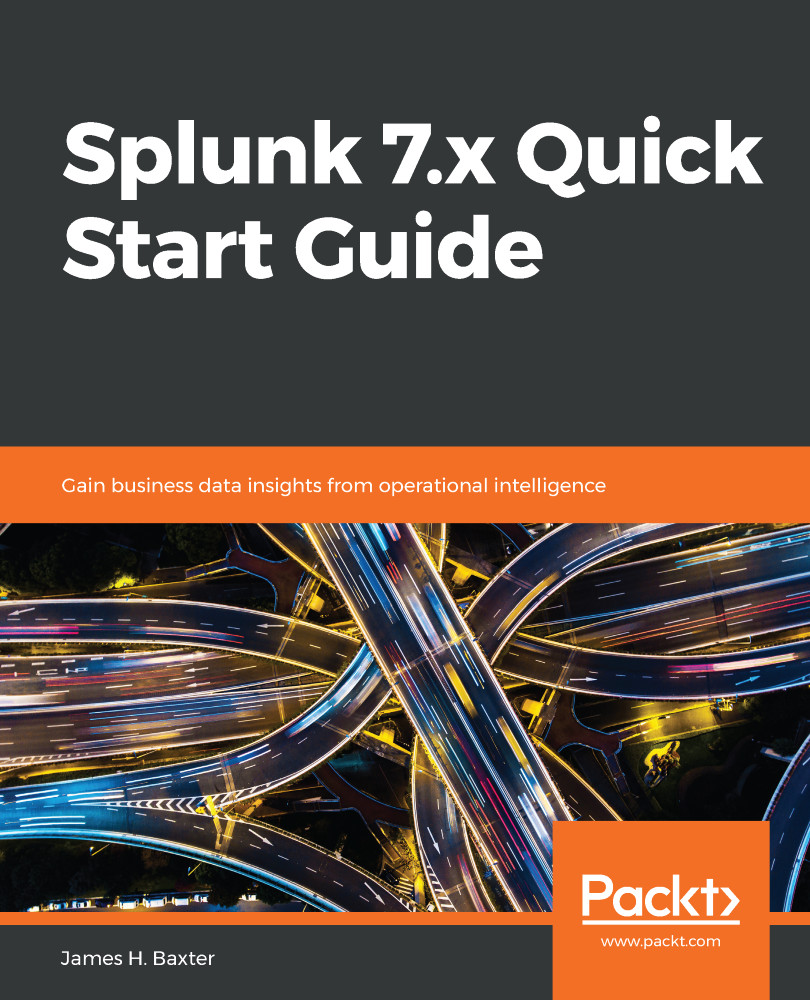
Splunk 7.x Quick Start Guide

Splunk 7.x Quick Start Guide

By : James H. Baxter
5 (1)
close
close
Splunk 7.x Quick Start Guide

Splunk 7.x Quick Start Guide

5 (1)
By: James H. Baxter

Overview of this book

Splunk is a leading platform and solution for collecting, searching, and extracting value from ever increasing amounts of big data - and big data is eating the world! This book covers all the crucial Splunk topics and gives you the information and examples to get the immediate job done. You will find enough insights to support further research and use Splunk to suit any business environment or situation. Splunk 7.x Quick Start Guide gives you a thorough understanding of how Splunk works. You will learn about all the critical tasks for architecting, implementing, administering, and utilizing Splunk Enterprise to collect, store, retrieve, format, analyze, and visualize machine data. You will find step-by-step examples based on real-world experience and practical use cases that are applicable to all Splunk environments. There is a careful balance between adequate coverage of all the critical topics with short but relevant deep-dives into the configuration options and steps to carry out the day-to-day tasks that matter. By the end of the book, you will be a confident and proficient Splunk architect and administrator.
Table of Contents (12 chapters)
close
close

Using the cluster master

Now that you have defined your indexes in indexes.conf file(s), and where needed, defined your custom source types in props.conf and perhaps a transforms.conf file, you need to get these files distributed to all the indexers in the cluster so that they can use them to parse the incoming data properly from forwarders and/or other data sources that reference those indexes and sourcetypes in their inputs.conf files, and store the parsed data in the appropriate index. Each indexer in the cluster must be working with identical configuration files – this configuration file distribution is accomplished by using the cluster master.

In similar fashion as is done to distribute apps from a deployment server, you distribute apps containing indexes.conf and any other configuration files by creating apps directories in a $SPLUNK_HOME/etc/master-apps folder on...

Visually different images
CONTINUE READING
83
Tech Concepts
36
Programming languages
73
Tech Tools
Icon Unlimited access to the largest independent learning library in tech of over 8,000 expert-authored tech books and videos.
Icon Innovative learning tools, including AI book assistants, code context explainers, and text-to-speech.
Icon 50+ new titles added per month and exclusive early access to books as they are being written.
Splunk 7.x Quick Start Guide
notes
bookmark Notes and Bookmarks search Search in title playlist Add to playlist download Download options font-size Font size

Change the font size

margin-width Margin width

Change margin width

day-mode Day/Sepia/Night Modes

Change background colour

Close icon Search
Country selected

Close icon Your notes and bookmarks

Confirmation

Modal Close icon
claim successful

Buy this book with your credits?

Modal Close icon
Are you sure you want to buy this book with one of your credits?
Close
YES, BUY

Submit Your Feedback

Modal Close icon
Modal Close icon
Modal Close icon