
Sign In Start Free Trial
Account

Add to playlist

Create a Playlist

Modal Close icon
You need to login to use this feature.
  • Book Overview & Buying Learning PostgreSQL 11
  • Table Of Contents Toc
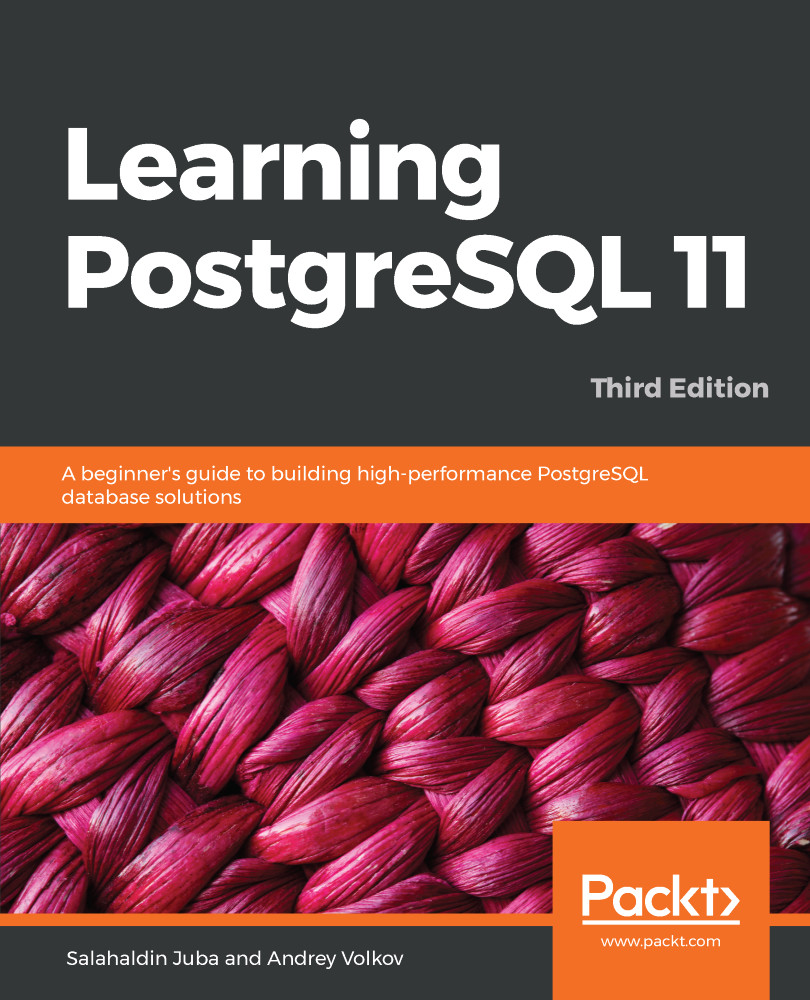
Learning PostgreSQL 11

Learning PostgreSQL 11 - Third Edition

By : Christopher Travers, Volkov
2.7 (6)
close
close
Learning PostgreSQL 11

Learning PostgreSQL 11

2.7 (6)
By: Christopher Travers, Volkov

Overview of this book

PostgreSQL is one of the most popular open source database management systems in the world, and it supports advanced features included in SQL standards. This book will familiarize you with the latest features in PostgreSQL 11, and get you up and running with building efficient PostgreSQL database solutions from scratch. Learning PostgreSQL, 11 begins by covering the concepts of relational databases and their core principles. You’ll explore the Data Definition Language (DDL) and commonly used DDL commands supported by ANSI SQL. You’ll also learn how to create tables, define integrity constraints, build indexes, and set up views and other schema objects. As you advance, you’ll come to understand Data Manipulation Language (DML) and server-side programming capabilities using PL/pgSQL, giving you a robust background to develop, tune, test, and troubleshoot your database application. The book will guide you in exploring NoSQL capabilities and connecting to your database to manipulate data objects. You’ll get to grips with using data warehousing in analytical solutions and reports, and scaling the database for high availability and performance. By the end of this book, you’ll have gained a thorough understanding of PostgreSQL 11 and developed the necessary skills to build efficient database solutions.
Table of Contents (18 chapters)
close
close

Summary

PostgreSQL provides a complete programming language called PL/pgSQL, which is integrated with the PostgreSQL trigger system. The PL/pgSQL and SQL languages can be used to code very complex logic. You should use the SQL functions when possible. With the introduction of advanced query writing techniques, such as window functions and lateral joins, in PostgreSQL, we can write very complex logic using only the standard SQL language.

There are several parameters for controlling function behavior in PostgreSQL; these parameters are applicable to the PL/pgSQL and SQL functions, as well. For example, SECURITY DEFINER and SECURITY INVOKER define the execution security context and privileges. The functions' planner parameters help the planner to generate execution plans. These parameters are COST, LEAKPROOF, and ROWS. Configuration related parameters can also be applied to...

CONTINUE READING
83
Tech Concepts
36
Programming languages
73
Tech Tools
Icon Unlimited access to the largest independent learning library in tech of over 8,000 expert-authored tech books and videos.
Icon Innovative learning tools, including AI book assistants, code context explainers, and text-to-speech.
Icon 50+ new titles added per month and exclusive early access to books as they are being written.
Learning PostgreSQL 11
notes
bookmark Notes and Bookmarks search Search in title playlist Add to playlist font-size Font size

Change the font size

margin-width Margin width

Change margin width

day-mode Day/Sepia/Night Modes

Change background colour

Close icon Search
Country selected

Close icon Your notes and bookmarks

Confirmation

Modal Close icon
claim successful

Buy this book with your credits?

Modal Close icon
Are you sure you want to buy this book with one of your credits?
Close
YES, BUY

Submit Your Feedback

Modal Close icon
Modal Close icon
Modal Close icon