
Sign In Start Free Trial
Account

Add to playlist

Create a Playlist

Modal Close icon
You need to login to use this feature.
  • Book Overview & Buying Hands-On Artificial Intelligence for Search
  • Table Of Contents Toc
  • Feedback & Rating feedback
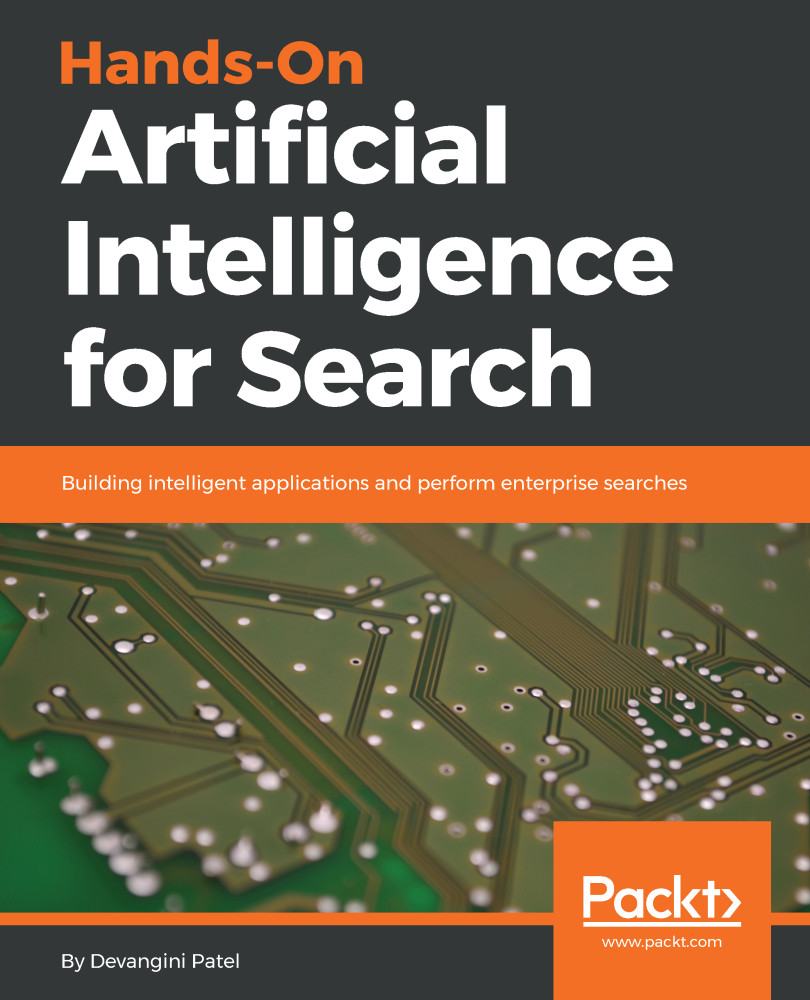
Hands-On Artificial Intelligence for Search

Hands-On Artificial Intelligence for Search

By : Patel
4 (1)
close
close
Hands-On Artificial Intelligence for Search

Hands-On Artificial Intelligence for Search

4 (1)
By: Patel

Overview of this book

With the emergence of big data and modern technologies, AI has acquired a lot of relevance in many domains. The increase in demand for automation has generated many applications for AI in fields such as robotics, predictive analytics, finance, and more. In this book, you will understand what artificial intelligence is. It explains in detail basic search methods: Depth-First Search (DFS), Breadth-First Search (BFS), and A* Search, which can be used to make intelligent decisions when the initial state, end state, and possible actions are known. Random solutions or greedy solutions can be found for such problems. But these are not optimal in either space or time and efficient approaches in time and space will be explored. We will also understand how to formulate a problem, which involves looking at it and identifying its initial state, goal state, and the actions that are possible in each state. We also need to understand the data structures involved while implementing these search algorithms as they form the basis of search exploration. Finally, we will look into what a heuristic is as this decides the quality of one sub-solution over another and helps you decide which step to take.
Table of Contents (5 chapters)
close
close

Understanding the Breadth-First Search Algorithm

The breadth-first search (BFS) algorithm is a traversing algorithm where you start at a selected node (the source or starting node) and traverse the graph layer-wise, exploring the neighboring nodes (nodes that are directly connected to the source node). You then move towards the neighboring nodes in the next level.

In this chapter, you will learn about BFS while developing LinkedIn's connection feature. You will learn how second-degree connections can be computed by using the BFS algorithm.

In this chapter, we will cover the following topics:

  • Understanding the LinkedIn connection feature
  • Graph data structure
  • Queue data structure
  • The BFS algorithm
  • DFS versus BFS
Visually different images
CONTINUE READING
83
Tech Concepts
36
Programming languages
73
Tech Tools
Icon Unlimited access to the largest independent learning library in tech of over 8,000 expert-authored tech books and videos.
Icon Innovative learning tools, including AI book assistants, code context explainers, and text-to-speech.
Icon 50+ new titles added per month and exclusive early access to books as they are being written.
Hands-On Artificial Intelligence for Search
notes
bookmark Notes and Bookmarks search Search in title playlist Add to playlist download Download options font-size Font size

Change the font size

margin-width Margin width

Change margin width

day-mode Day/Sepia/Night Modes

Change background colour

Close icon Search
Country selected

Close icon Your notes and bookmarks

Confirmation

Modal Close icon
claim successful

Buy this book with your credits?

Modal Close icon
Are you sure you want to buy this book with one of your credits?
Close
YES, BUY

Submit Your Feedback

Modal Close icon
Modal Close icon
Modal Close icon