
Sign In Start Free Trial
Account

Add to playlist

Create a Playlist

Modal Close icon
You need to login to use this feature.
  • Book Overview & Buying Machine Learning for Cybersecurity Cookbook
  • Table Of Contents Toc
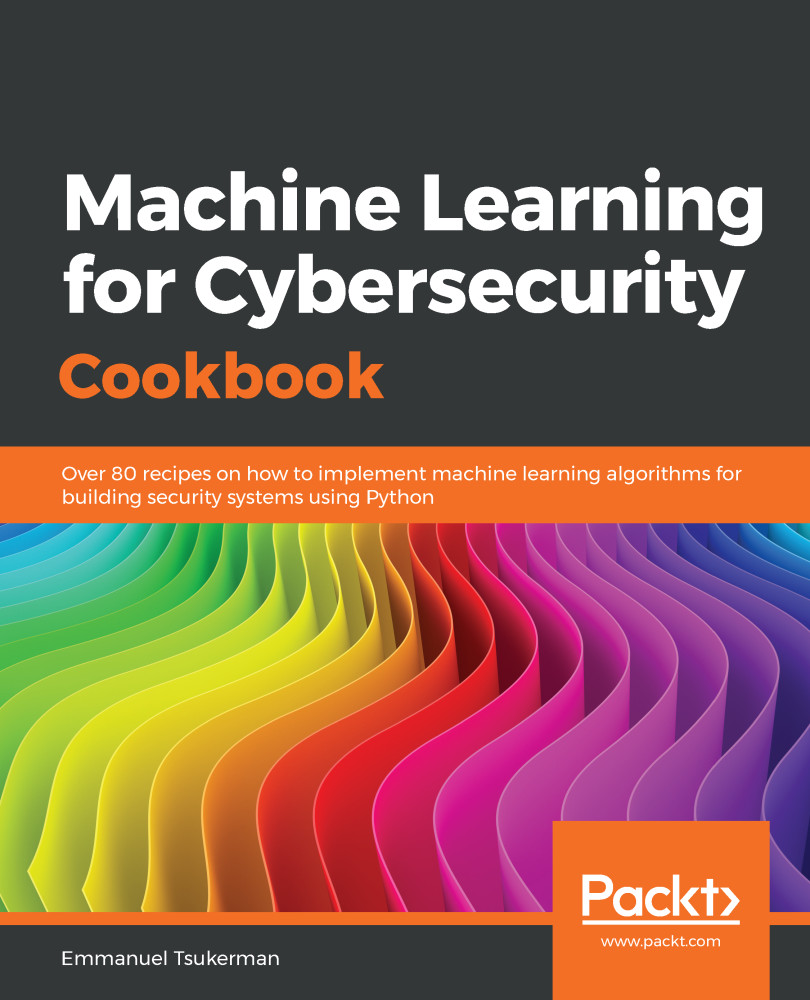
Machine Learning for Cybersecurity Cookbook

Machine Learning for Cybersecurity Cookbook

By : Emmanuel Tsukerman
3 (2)
close
close
Machine Learning for Cybersecurity Cookbook

Machine Learning for Cybersecurity Cookbook

3 (2)
By: Emmanuel Tsukerman

Overview of this book

Organizations today face a major threat in terms of cybersecurity, from malicious URLs to credential reuse, and having robust security systems can make all the difference. With this book, you'll learn how to use Python libraries such as TensorFlow and scikit-learn to implement the latest artificial intelligence (AI) techniques and handle challenges faced by cybersecurity researchers. You'll begin by exploring various machine learning (ML) techniques and tips for setting up a secure lab environment. Next, you'll implement key ML algorithms such as clustering, gradient boosting, random forest, and XGBoost. The book will guide you through constructing classifiers and features for malware, which you'll train and test on real samples. As you progress, you'll build self-learning, reliant systems to handle cybersecurity tasks such as identifying malicious URLs, spam email detection, intrusion detection, network protection, and tracking user and process behavior. Later, you'll apply generative adversarial networks (GANs) and autoencoders to advanced security tasks. Finally, you'll delve into secure and private AI to protect the privacy rights of consumers using your ML models. By the end of this book, you'll have the skills you need to tackle real-world problems faced in the cybersecurity domain using a recipe-based approach.
Table of Contents (11 chapters)
close
close

Deepfake

Deepfake is the technique of using a neural network to take a video or image, superimpose some content onto it, and make the result look realistic. For example, the technique can take a video of Alice saying she supports a movement, and then, replacing Alice with Bob, create a realistic-looking video of Bob saying he supports the movement. Clearly, this technique has deep implications on the trust we can place on videos and images, while also providing a useful tool for social engineers.

In this recipe, we use a Deepfake variant to take the image of the face of one target and realistically superimpose it onto the image of another target's face. The recipe is a refactored and simplified version of the code in the GitHub repository, wuhuikai/FaceSwap.

Getting ready

...
CONTINUE READING
83
Tech Concepts
36
Programming languages
73
Tech Tools
Icon Unlimited access to the largest independent learning library in tech of over 8,000 expert-authored tech books and videos.
Icon Innovative learning tools, including AI book assistants, code context explainers, and text-to-speech.
Icon 50+ new titles added per month and exclusive early access to books as they are being written.
Machine Learning for Cybersecurity Cookbook
notes
bookmark Notes and Bookmarks search Search in title playlist Add to playlist download Download options font-size Font size

Change the font size

margin-width Margin width

Change margin width

day-mode Day/Sepia/Night Modes

Change background colour

Close icon Search
Country selected

Close icon Your notes and bookmarks

Confirmation

Modal Close icon
claim successful

Buy this book with your credits?

Modal Close icon
Are you sure you want to buy this book with one of your credits?
Close
YES, BUY

Submit Your Feedback

Modal Close icon
Modal Close icon
Modal Close icon