
Sign In Start Free Trial
Account

Add to playlist

Create a Playlist

Modal Close icon
You need to login to use this feature.
  • Book Overview & Buying Python for Finance Cookbook
  • Table Of Contents Toc
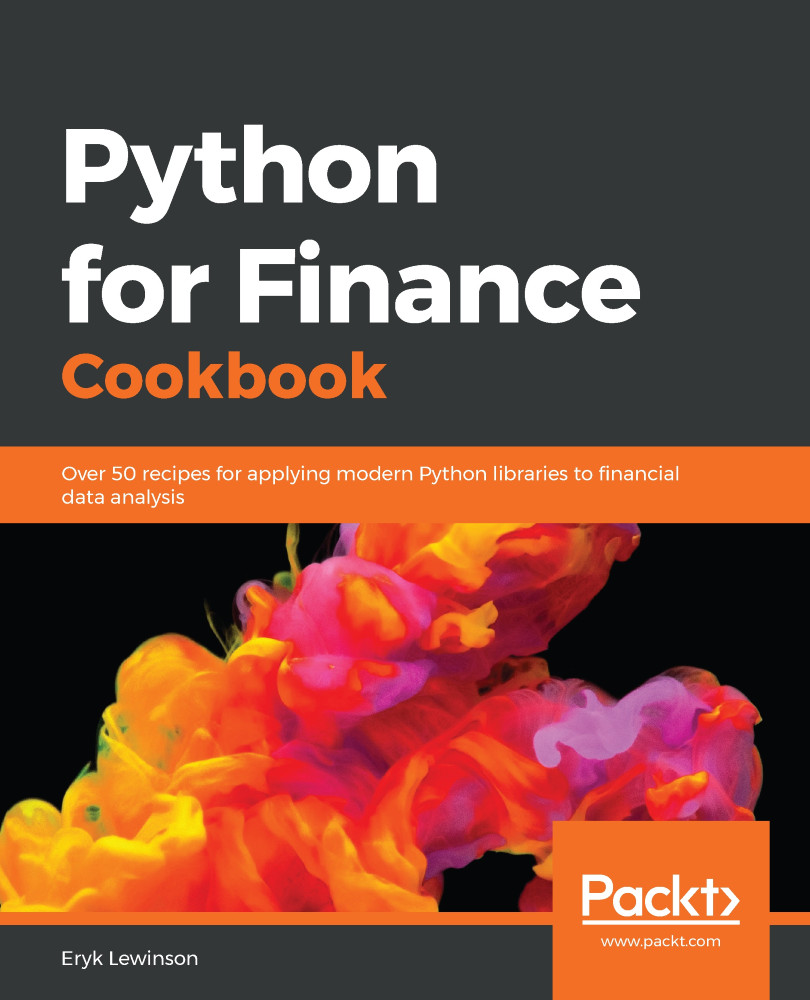
Python for Finance Cookbook

Python for Finance Cookbook

By : Eryk Lewinson
4.2 (6)
close
close
Python for Finance Cookbook

Python for Finance Cookbook

4.2 (6)
By: Eryk Lewinson

Overview of this book

Python is one of the most popular programming languages used in the financial industry, with a huge set of accompanying libraries. In this book, you'll cover different ways of downloading financial data and preparing it for modeling. You'll calculate popular indicators used in technical analysis, such as Bollinger Bands, MACD, RSI, and backtest automatic trading strategies. Next, you'll cover time series analysis and models, such as exponential smoothing, ARIMA, and GARCH (including multivariate specifications), before exploring the popular CAPM and the Fama-French three-factor model. You'll then discover how to optimize asset allocation and use Monte Carlo simulations for tasks such as calculating the price of American options and estimating the Value at Risk (VaR). In later chapters, you'll work through an entire data science project in the financial domain. You'll also learn how to solve the credit card fraud and default problems using advanced classifiers such as random forest, XGBoost, LightGBM, and stacked models. You'll then be able to tune the hyperparameters of the models and handle class imbalance. Finally, you'll focus on learning how to use deep learning (PyTorch) for approaching financial tasks. By the end of this book, you’ll have learned how to effectively analyze financial data using a recipe-based approach.
Table of Contents (12 chapters)
close
close

Identifying Credit Default with Machine Learning

In recent years, we have witnessed machine learning gaining more and more popularity in solving traditional business problems. Every so often, a new algorithm is published, beating the current state of the art. It is only natural for businesses (in all industries) to try to leverage the incredible powers of machine learning in their core functionalities.

Before specifying a problem, we provide a brief introduction to the field of machine learning. Machine learning can be broken down into two main areas: supervised learning and unsupervised learning. In the former, we have a target variable (label), which we try to predict as accurately as possible. In the latter, there is no target, and we try to use different techniques to draw some insights from the data. An example of unsupervised learning might be clustering, which is often...

Visually different images
CONTINUE READING
83
Tech Concepts
36
Programming languages
73
Tech Tools
Icon Unlimited access to the largest independent learning library in tech of over 8,000 expert-authored tech books and videos.
Icon Innovative learning tools, including AI book assistants, code context explainers, and text-to-speech.
Icon 50+ new titles added per month and exclusive early access to books as they are being written.
Python for Finance Cookbook
notes
bookmark Notes and Bookmarks search Search in title playlist Add to playlist download Download options font-size Font size

Change the font size

margin-width Margin width

Change margin width

day-mode Day/Sepia/Night Modes

Change background colour

Close icon Search
Country selected

Close icon Your notes and bookmarks

Confirmation

Modal Close icon
claim successful

Buy this book with your credits?

Modal Close icon
Are you sure you want to buy this book with one of your credits?
Close
YES, BUY

Submit Your Feedback

Modal Close icon
Modal Close icon
Modal Close icon