

Sign In Start Free Trial
Account

Add to playlist

Create a Playlist

Modal Close icon
You need to login to use this feature.
  • Book Overview & Buying Hands-On Python Deep Learning for the Web
  • Table Of Contents Toc
Hands-On Python Deep Learning for the Web

Hands-On Python Deep Learning for the Web

By : Anubhav Singh, Sayak Paul
4.5 (2)
close
close
Hands-On Python Deep Learning for the Web

Hands-On Python Deep Learning for the Web

4.5 (2)
By: Anubhav Singh, Sayak Paul

Overview of this book

When used effectively, deep learning techniques can help you develop intelligent web apps. In this book, you'll cover the latest tools and technological practices that are being used to implement deep learning in web development using Python. Starting with the fundamentals of machine learning, you'll focus on DL and the basics of neural networks, including common variants such as convolutional neural networks (CNNs). You'll learn how to integrate them into websites with the frontends of different standard web tech stacks. The book then helps you gain practical experience of developing a deep learning-enabled web app using Python libraries such as Django and Flask by creating RESTful APIs for custom models. Later, you'll explore how to set up a cloud environment for deep learning-based web deployments on Google Cloud and Amazon Web Services (AWS). Next, you'll learn how to use Microsoft's intelligent Emotion API, which can detect a person's emotions through a picture of their face. You'll also get to grips with deploying real-world websites, in addition to learning how to secure websites using reCAPTCHA and Cloudflare. Finally, you'll use NLP to integrate a voice UX through Dialogflow on your web pages. By the end of this book, you'll have learned how to deploy intelligent web apps and websites with the help of effective tools and practices.
Table of Contents (19 chapters)
close
close
1
Artificial Intelligence on the Web
3
Using Deep Learning for Web Development
7
Getting Started with Different Deep Learning APIs for Web Development
12
Deep Learning in Production (Intelligent Web Apps)
1
Appendix: Success Stories and Emerging Areas in Deep Learning on the Web

A standard ML workflow

Any project starts with a problem in mind and ML projects are no exception. Before starting an ML project, it is very important to have a clear understanding of the problem that you are trying to solve using ML. Therefore, problem formulation and mapping with respect to the standard ML workflow serve as good starting points in an ML project. But what is meant by an ML workflow? This section is all about that. 

Designing ML systems and employing them to solve complex problems requires a set of skills other than just ML. It is good to know that ML requires knowledge of several things such as statistics, domain knowledge, software engineering, feature engineering, and basic high-school mathematics in varying proportions. To be able to design such systems, certain steps are fundamental to almost any ML workflow and each of these steps requires a certain skill set. In this section, we are going to take a look at these steps and discuss them briefly. 
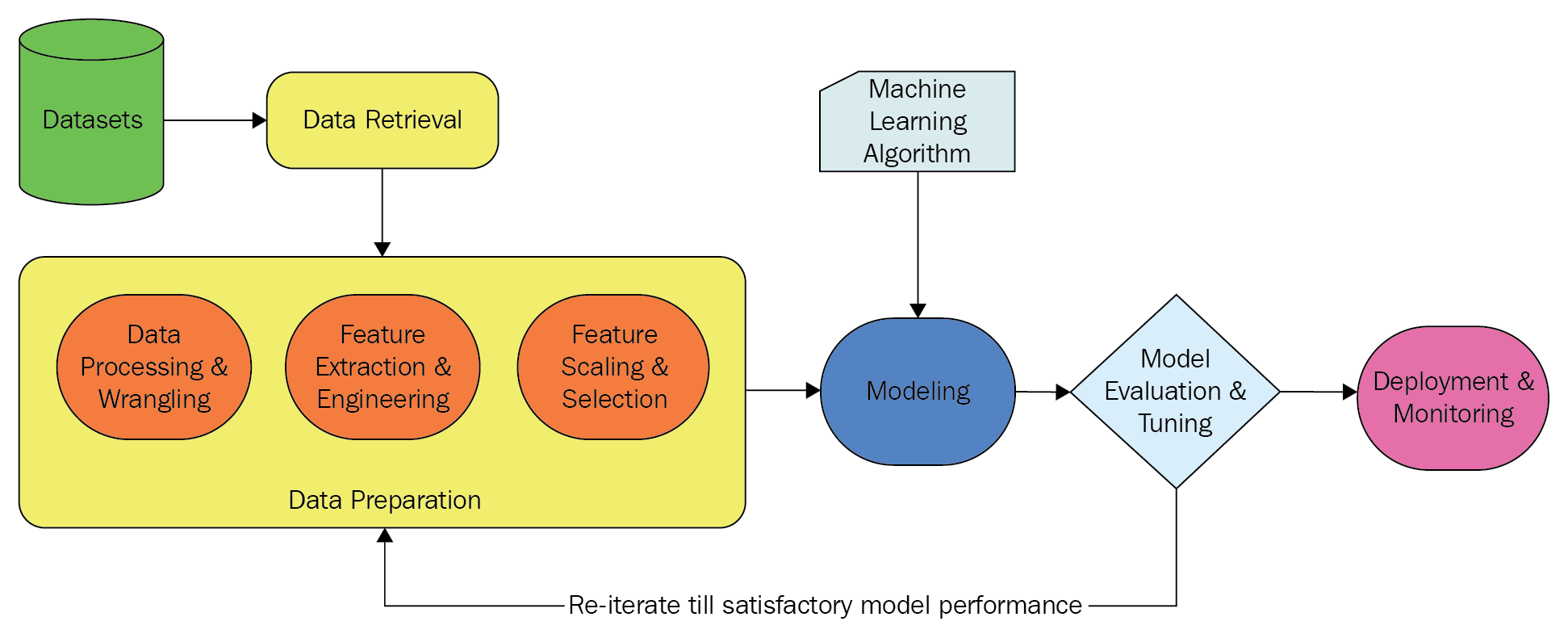
This workflow is inspired by CRISP-DM, which stands for Cross Industry Standard Process for Data Mining and is extremely widely used across many industries pertaining to data mining and analytics. 

Data retrieval

As mentioned earlier in this chapter, ML systems need data for functioning. It is not available all of the time, in fact, most of the time, the data itself is not available in a format with which we can actually start training ML models. But what if there is no standard dataset for a particular problem that we are trying to solve using ML? Welcome to reality! This happens for most real-life ML projects. For example, let's say we are trying to analyze the sentiments of tweets regarding the New Year resolutions of 2018 and trying to estimate the most meaningful ones. This is actually a problem for which there is no standard dataset available. We will have to scrape it from Twitter using its APIs. Another great example is business logs. Business logs are treasures of knowledge. If effectively mined and modeled, they can help in many decision-making processes. But often, logs are not available directly to the ML engineer. So, the ML engineer needs to spend a considerable amount of time figuring out the structure of the logs and they might write a script so that the logs are captured as required. All of these processes are collectively called data retrieval or data collection

Data preparation

After the data collection phase, we tend to prepare the data to feed it to the ML systems and this is known as data preparation. It is worth mentioning that this is the most time-consuming part of an ML workflow/pipeline. Data preparation includes a series of steps and they are as follows:

  • Exploratory data analysis
  • Data processing and wrangling
  • Feature engineering and extraction
  • Feature scaling and selection
This is one of the most time-consuming parts of an ML project. When we take a broader look at the process, we find that data identification and collection are also sometimes really important aspects as the correct format, as mentioned previously, might not always be available.

Exploratory Data Analysis (EDA) 

After the data is collected, the first step in the data preparation stage is Exploratory Data Analysis, which is very popularly known as EDA. EDA techniques allow us to know the data in a detailed manner for better understanding. This is an extremely vital step in the overall ML pipeline because without good knowledge about the data itself, if we blindly fit an ML model to the data, it most likely will not produce good results. EDA gives us a direction in which to proceed and helps us to decide further steps in the pipeline. EDA involves many things such as calculating useful statistics about the data and determining whether the data suffers from any outliers. It also comprises effective data visualization, which helps us to interpret the data graphically and therefore helps us to communicate vital facts about the data in a meaningful way. 

In short, EDA is all about getting to know about the data better.

Data processing and wrangling

We have performed some statistical analyses on the data. Now what? Most of the time, the data that is collected from several data sources is present in its raw form, which cannot be fed to an ML model, hence the need for further data processing. 

But you might ask, why not collect the data in a way so that it gets retrieved with all of the necessary processing done? This is typically not a good practice as it breaks the modularity of the workflow. 

This is why to make the data consumable in the later steps in the workflow, we need to clean, transform, and persist it. This includes several things such as data normalization, data standardization, missing value imputation, encoding from one value to another, and outlier treatment. All of these are collectively named data wrangling.

Feature engineering and extraction/selection

Consider a situation where an employee from an analytics firm is given the company's billing data and is asked by their manager to build a machine learning system with it so the company's overall financial budget could be optimized. Now, this data is not in a format that can be given directly to an ML model since ML models expect data in the form of numeric vectors.

Although the data might be in good shape, the employee will still have to do something to convert that data into a favorable form. Given that the data is already wrangled, they still need to decide what features he is they are going to include in the final dataset. Practically, anything measurable can be a feature here. This is where good domain knowledge comes. This knowledge can help the employee to choose the features that have high predictive power. It may sound a bit light-weight, but it requires a lot of skills and it is definitely a challenging task. This is a classic example of feature engineering

Sometimes, we employ several techniques that help us in the automatic extraction of the most meaningful features from a given dataset. This is particularly useful when the data is very high dimensional and the features are hard to interpret. This is known as feature selection. Feature selection not only helps to develop an ML model with the data that has the most relevant features but it also helps to enhance the model's predictive performance and to reduce its computation time.

Apart from feature selection, we might want to reduce the dimensionality of the data to better visualize it. Besides, dimensionality reduction is also employed to capture a representative set of features from the complete set of data features. Principal Component Analysis (PCA) is one such very popular dimensionality reduction technique. 

It is important to keep in mind that feature selection and dimensionality reduction are not the same. 

Modeling

We have finally come to the step that appears to be the most exciting onethe ML modeling part. But it is worth noting here that a good ML project is not just about this part. All of the previously mentioned parts contribute equally to the standard of the project. In fact, it matters a lot how the data is being collected for the project, and for this, we are helped by powerful data engineers. For now, let's leave that part aside.

We already have the data in pretty good shape by now. In the process of modeling the data, we feed the training data to ML models for training them, we monitor their training progress and tune different hyperparameters so their performance is optimized, and we evaluate the model on the test set. Model comparison is also a part of this phase. It is indeed an iterative process and involves trial and error to some extent.

The main objective here is to come up with an ML model that best represents the data, that is, it generalizes well. Computation time is another factor we must consider here because we want a model that performs well but within a feasible time frame and thereby optimizing a certain business outcome. 

Following are the parts that constitute the core of modeling:

  • Model training
  • Model evaluation 
  • Model tuning

Model training

This is the fundamental part of modeling as we introduce the data to different ML models and train the model so that it can learn the representations of the data holistically. We can see how a model is making progress during its training using training error. We often bring validation error (which means we validate the model training simultaneously) into this picture as well, which is a standard practice. Most of the modern libraries today allow us to do this and we will see it in the upcoming chapters of this book. We will now discuss some of the most commonly used error metrics. 

Model evaluation

We have trained an ML model but how well will the model perform on the data it has never seen before? We answer this question using model evaluation

Different machine learning algorithms call for different evaluation metrics. 

For supervised learning methods, we usually use the following:

  • The confusion matrix, which is a matrix consisting of four values: True Positive, False Positive, True Negative, and False Negative
  • Accuracy, precision, recall, and F1-score (these are all byproducts of the confusion matrix)
  • The Receiver Operator Characteristic (ROC) curve and the Area Under Curve (AUC) metric
  • R-square (coefficient of determination), Root Mean Square Error (RMSE), F-statistic, Akaike Information Criterion (AIC), and p-values specifically for regression models

Throughout this book, we will be incorporating these metrics to evaluate our models. Although these are the most common evaluation metrics, be it for ML or DL, there are more specific evaluation metrics that correspond to different domains. We will get to that as well as we go along. 

It worth mentioning here that we often tend to fall into the trap of the accuracy paradox in the case of classification problems where the data is imbalanced. In these cases, classification accuracy only tells one part of the story, that is, it gives the percentage of correct predictions made out of the total number of predictions made. This system fails miserably in the case of imbalanced datasets because accuracy does not capture how well a model is performing at predicting the negative instances of the dataset (which is originally the problem—predicting the uncommon class(es)).

Following are the most commonly used metrics for evaluating unsupervised methods such as clustering:

  • Silhouette coefficients
  • Sum of squared errors
  • Homogeneity, completeness, and the V-measure
  • The Calinski-Harabasz index
The evaluation metrics/error metrics remain the same for a train set, a test set, or a validation set. We cannot just jump to a conclusion just by looking at the performance of a model on the train set. 

Model tuning 

By this phase, we should have a baseline model with which we can go further for tuning the model to make it perform even better. Model tuning corresponds to hyperparameter tuning/optimization.

ML models come with different hyperparameters that cannot be learned from model training. Their values are set by the practitioners. You can compare the hyperparameter values to the knobs of an audio equalizer where we manually adjust the knobs to have the perfect aural experience. We will see how hyperparameter tuning can drastically enhance the performance of a model in later chapters.

There are several techniques for tuning hyperparameters and the most popularly incorporated are the following:

  • Grid searching
  • Random searching
  • Bayesian optimization
  • Gradient-based optimization
  • Evolutionary optimization

Model comparison and selection

After we are done with the model tuning part, we would definitely want to repeat the whole modeling part for models other than the current one in the hope that we might get better results. As ML practitioners, it is our job to ensure that the model we have finally come up with is better than the other ones (obviously in various aspects). Naturally, comparing different ML models is a time-consuming task and we may not be able to always afford to do this when we need to meet short deadlines. In cases like this, we incorporate the following aspects of an ML model: 

  • Explainability, which answers a given question (how interpretable is the model and how easily it can be explained and communicated?)
  • In-memory versus out-of-memory modeling
  • The number of features and instances in the dataset
  • Categorical versus numerical features
  • The nonlinearity of the data
  • Training speed
  • Prediction speed
These metrics are the most popular ones but it hugely depends on the problem at hand. When these metrics do not apply, a good rule of thumb is to see how a model is performing on the validation set. 

Deployment and monitoring

After a machine learning model is built, it is merged with the other components of an application and is taken into production. This phase is referred to as model deployment. The true performance of the developed ML model is evaluated after it is deployed into real systems. This phase also involves thorough monitoring of the model to figure out the areas where the model is not performing well and which aspects of the model can be improved further. Monitoring is extremely crucial as it provides the means to enhance the model's performance and thereby enhance the performance of the overall application. 

So, that was a kind of a primer of the most important terminologies/concepts required for an ML project.

For a more rigorous study of the basics of ML, you are encouraged to go through these resources: Machine Learning Crash Course by Google (https://developers.google.com/machine-learning/crash-course/) and Python Machine Learning by Sebastian Raschka (https://india.packtpub.com/in/big-data-and-business-intelligence/python-machine-learning).

For easy reference, you may refer to the following diagram as given in the book, Hands-on Transfer Learning with Python (by Dipanjan et. al), which depicts all of the preceding steps pictorially:

Practically, ML has brought about a lot of enhancements across a wide range of sectors and almost none are left to be impacted by it. This book is focused on building intelligent web applications. Therefore, we will start the next section by discussing the web in general and how it has changed since the advent of AI from a before-and-after perspective. Eventually, we will study some big names and how they are facilitating AI for building world-class web applications that are not only intelligent but also solve some real problems. 

CONTINUE READING
83
Tech Concepts
36
Programming languages
73
Tech Tools
Icon Unlimited access to the largest independent learning library in tech of over 8,000 expert-authored tech books and videos.
Icon Innovative learning tools, including AI book assistants, code context explainers, and text-to-speech.
Icon 50+ new titles added per month and exclusive early access to books as they are being written.
Hands-On Python Deep Learning for the Web
notes
bookmark Notes and Bookmarks search Search in title playlist Add to playlist download Download options font-size Font size

Change the font size

margin-width Margin width

Change margin width

day-mode Day/Sepia/Night Modes

Change background colour

Close icon Search
Country selected

Close icon Your notes and bookmarks

Confirmation

Modal Close icon
claim successful

Buy this book with your credits?

Modal Close icon
Are you sure you want to buy this book with one of your credits?
Close
YES, BUY

Submit Your Feedback

Modal Close icon
Modal Close icon
Modal Close icon