
Sign In Start Free Trial
Account

Add to playlist

Create a Playlist

Modal Close icon
You need to login to use this feature.
  • Book Overview & Buying Mastering PostgreSQL 13
  • Table Of Contents Toc
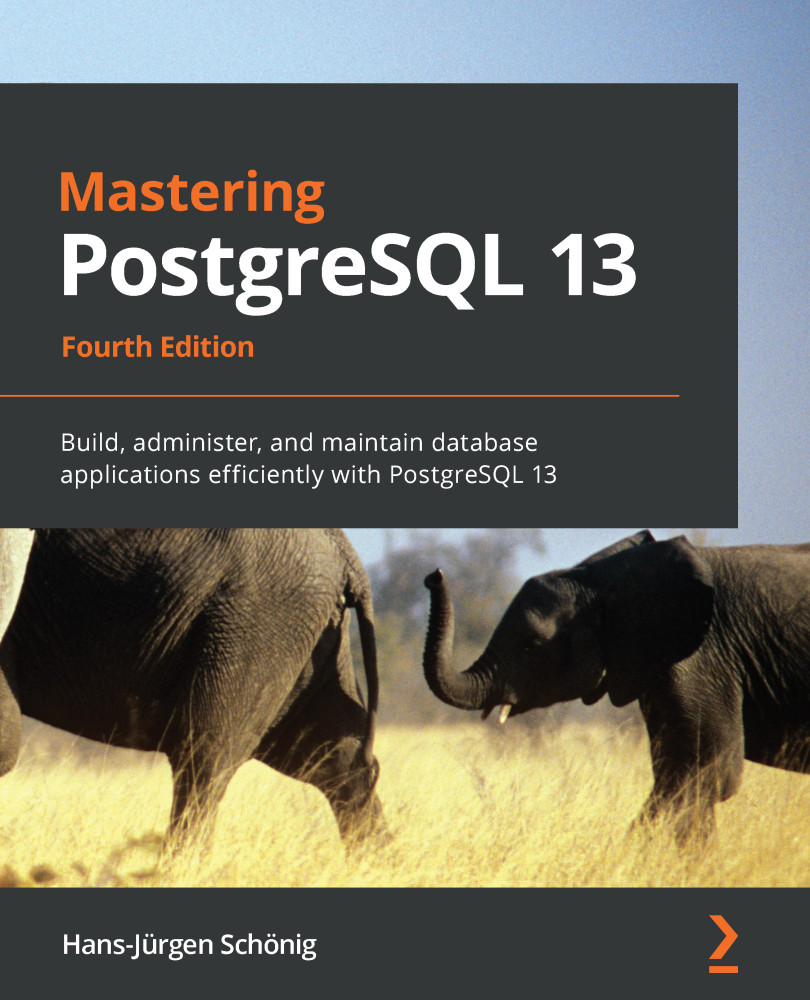
Mastering PostgreSQL 13

Mastering PostgreSQL 13 - Fourth Edition

By : Hans-Jürgen Schönig
3.6 (5)
close
close
Mastering PostgreSQL 13

Mastering PostgreSQL 13

3.6 (5)
By: Hans-Jürgen Schönig

Overview of this book

Thanks to its reliability, robustness, and high performance, PostgreSQL has become one of the most advanced open source databases on the market. This updated fourth edition will help you understand PostgreSQL administration and how to build dynamic database solutions for enterprise apps with the latest release of PostgreSQL, including designing both physical and technical aspects of the system architecture with ease. Starting with an introduction to the new features in PostgreSQL 13, this book will guide you in building efficient and fault-tolerant PostgreSQL apps. You’ll explore advanced PostgreSQL features, such as logical replication, database clusters, performance tuning, advanced indexing, monitoring, and user management, to manage and maintain your database. You’ll then work with the PostgreSQL optimizer, configure PostgreSQL for high speed, and move from Oracle to PostgreSQL. The book also covers transactions, locking, and indexes, and shows you how to improve performance with query optimization. You’ll also focus on how to manage network security and work with backups and replication while exploring useful PostgreSQL extensions that optimize the performance of large databases. By the end of this PostgreSQL book, you’ll be able to get the most out of your database by executing advanced administrative tasks.
Table of Contents (15 chapters)
close
close

Setting up asynchronous replication

The idea behind streaming replication is simple. After an initial base backup, the secondary can connect to the master and fetch a transaction log in real time and apply it. Transaction log replay is not a single operation anymore, but rather a continuous process that is supposed to keep running for as long as the cluster exists.

Performing a basic setup

In this section, we will learn how to set up asynchronous replication quickly and easily. The goal is to set up a system that consists of two nodes.

Basically, most of the work has already been done for WAL archiving. However, to make it easy to understand, we will look at the entire process of setting up streaming because we cannot assume that WAL shipping is really already set up as needed.

The first thing to do is to go to the postgresql.conf file and adjust the following parameters:

wal_level = replica
max_wal_senders = 10 # or whatever value >= 2
# this is...
CONTINUE READING
83
Tech Concepts
36
Programming languages
73
Tech Tools
Icon Unlimited access to the largest independent learning library in tech of over 8,000 expert-authored tech books and videos.
Icon Innovative learning tools, including AI book assistants, code context explainers, and text-to-speech.
Icon 50+ new titles added per month and exclusive early access to books as they are being written.
Mastering PostgreSQL 13
notes
bookmark Notes and Bookmarks search Search in title playlist Add to playlist download Download options font-size Font size

Change the font size

margin-width Margin width

Change margin width

day-mode Day/Sepia/Night Modes

Change background colour

Close icon Search
Country selected

Close icon Your notes and bookmarks

Confirmation

Modal Close icon
claim successful

Buy this book with your credits?

Modal Close icon
Are you sure you want to buy this book with one of your credits?
Close
YES, BUY

Submit Your Feedback

Modal Close icon
Modal Close icon
Modal Close icon