
Sign In Start Free Trial
Account

Add to playlist

Create a Playlist

Modal Close icon
You need to login to use this feature.
  • Book Overview & Buying Mastering PostgreSQL 13
  • Table Of Contents Toc
Mastering PostgreSQL 13

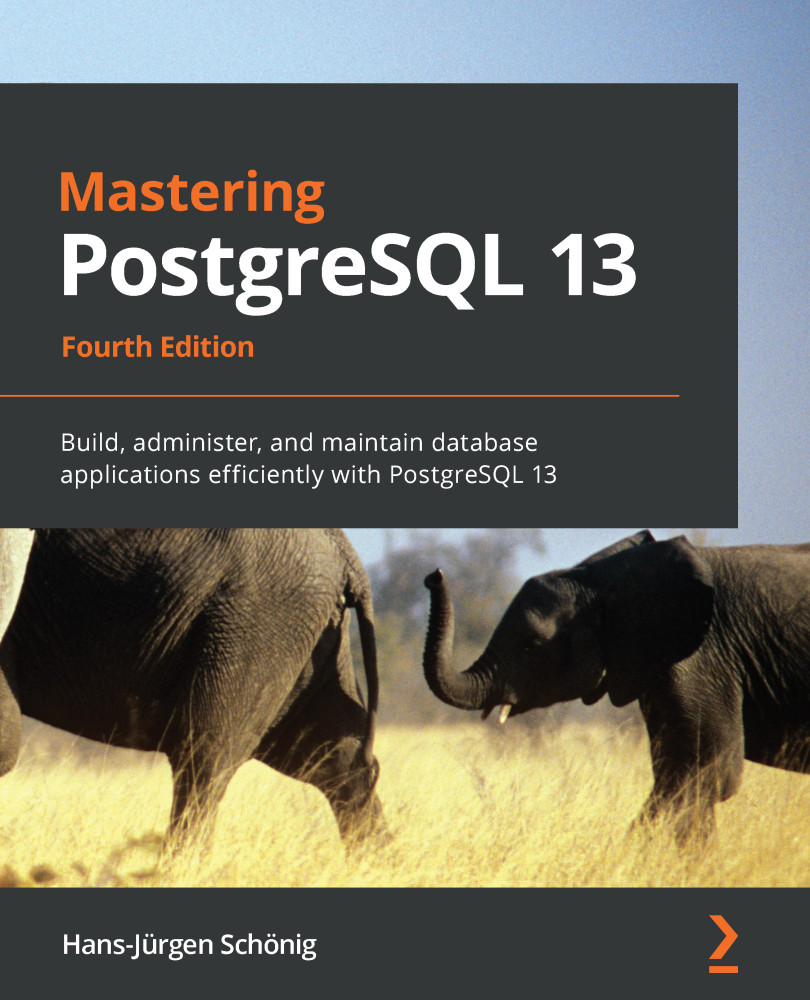
Mastering PostgreSQL 13 - Fourth Edition

By : Hans-Jürgen Schönig
3.6 (5)
close
close
Mastering PostgreSQL 13

Mastering PostgreSQL 13

3.6 (5)
By: Hans-Jürgen Schönig

Overview of this book

Thanks to its reliability, robustness, and high performance, PostgreSQL has become one of the most advanced open source databases on the market. This updated fourth edition will help you understand PostgreSQL administration and how to build dynamic database solutions for enterprise apps with the latest release of PostgreSQL, including designing both physical and technical aspects of the system architecture with ease. Starting with an introduction to the new features in PostgreSQL 13, this book will guide you in building efficient and fault-tolerant PostgreSQL apps. You’ll explore advanced PostgreSQL features, such as logical replication, database clusters, performance tuning, advanced indexing, monitoring, and user management, to manage and maintain your database. You’ll then work with the PostgreSQL optimizer, configure PostgreSQL for high speed, and move from Oracle to PostgreSQL. The book also covers transactions, locking, and indexes, and shows you how to improve performance with query optimization. You’ll also focus on how to manage network security and work with backups and replication while exploring useful PostgreSQL extensions that optimize the performance of large databases. By the end of this PostgreSQL book, you’ll be able to get the most out of your database by executing advanced administrative tasks.
Table of Contents (15 chapters)
close
close

Checking for missing indexes

Once we are done with the first three steps, it is important to take a look at performance in general. As I have kept stating throughout this book, missing indexes are fully responsible for super bad performance. So, whenever we face a slow system, it is recommended that we check for missing indexes and deploy whatever is needed.

Usually, customers ask us to optimize the RAID level, tune the kernel, or some other fancy stuff. In reality, these complicated requests often boil down to a handful of missing indexes. By my judgement, it always makes sense to spend some extra time just checking whether all of the desired indexes are there. Checking for missing indexes is neither hard nor time-consuming, so it should be done all of the time, regardless of the kind of performance problem that you are facing.

Here is my favorite query to get an impression of where an index may be missing:

SELECT schemaname, relname, seq_scan, seq_tup_read, 
idx_scan, seq_tup_read...
CONTINUE READING
83
Tech Concepts
36
Programming languages
73
Tech Tools
Icon Unlimited access to the largest independent learning library in tech of over 8,000 expert-authored tech books and videos.
Icon Innovative learning tools, including AI book assistants, code context explainers, and text-to-speech.
Icon 50+ new titles added per month and exclusive early access to books as they are being written.
Mastering PostgreSQL 13
notes
bookmark Notes and Bookmarks search Search in title playlist Add to playlist download Download options font-size Font size

Change the font size

margin-width Margin width

Change margin width

day-mode Day/Sepia/Night Modes

Change background colour

Close icon Search
Country selected

Close icon Your notes and bookmarks

Confirmation

Modal Close icon
claim successful

Buy this book with your credits?

Modal Close icon
Are you sure you want to buy this book with one of your credits?
Close
YES, BUY

Submit Your Feedback

Modal Close icon
Modal Close icon
Modal Close icon