Sign In Start Free Trial
Account

Add to playlist

Create a Playlist

Modal Close icon
You need to login to use this feature.
  • Book Overview & Buying Machine Learning for Imbalanced Data
  • Table Of Contents Toc
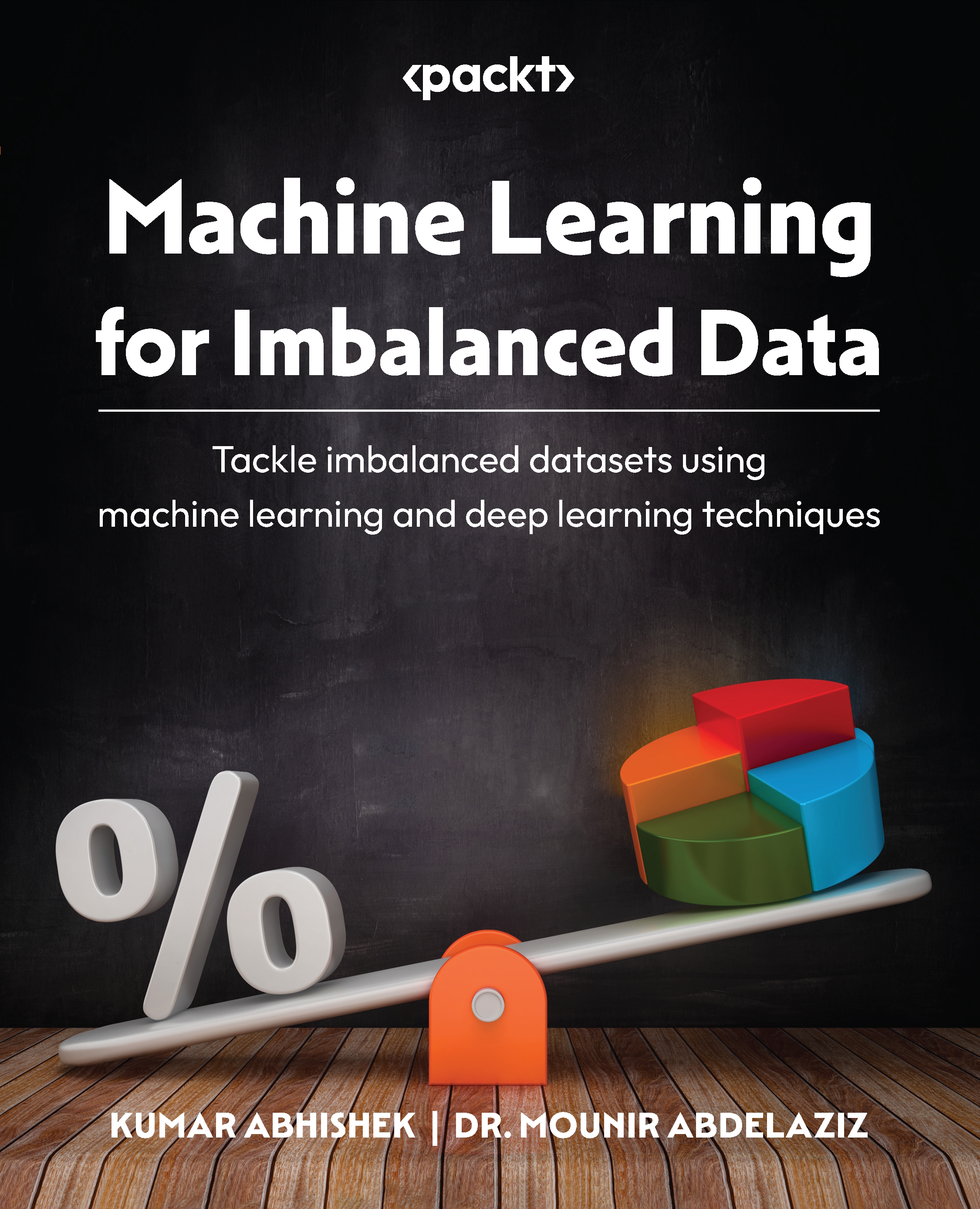
Machine Learning for Imbalanced Data

Machine Learning for Imbalanced Data

By : Kumar Abhishek, Dr. Mounir Abdelaziz
5 (17)
close
close
Machine Learning for Imbalanced Data

Machine Learning for Imbalanced Data

5 (17)
By: Kumar Abhishek, Dr. Mounir Abdelaziz

Overview of this book

As machine learning practitioners, we often encounter imbalanced datasets in which one class has considerably fewer instances than the other. Many machine learning algorithms assume an equilibrium between majority and minority classes, leading to suboptimal performance on imbalanced data. This comprehensive guide helps you address this class imbalance to significantly improve model performance. Machine Learning for Imbalanced Data begins by introducing you to the challenges posed by imbalanced datasets and the importance of addressing these issues. It then guides you through techniques that enhance the performance of classical machine learning models when using imbalanced data, including various sampling and cost-sensitive learning methods. As you progress, you’ll delve into similar and more advanced techniques for deep learning models, employing PyTorch as the primary framework. Throughout the book, hands-on examples will provide working and reproducible code that’ll demonstrate the practical implementation of each technique. By the end of this book, you’ll be adept at identifying and addressing class imbalances and confidently applying various techniques, including sampling, cost-sensitive techniques, and threshold adjustment, while using traditional machine learning or deep learning models.
Table of Contents (15 chapters)
close
close

Machine learning 101

Let’s do a quick overview of machine learning and its related fields:

  • Artificial intelligence is the superset of all intelligence-related problems. Classical machine learning encompasses problems that can be solved by training traditional classical models (such as decision trees or logistic regression) and predicting the target values. They typically work on tabular data, require extensive feature engineering (manual development of features), and are less effective on text and image data. Deep learning tends to do far better on image, text, speech, and video data, wherein, typically, no manual feature engineering is needed, and various layers in the neural network automatically do feature engineering for us.
  • In supervised learning, we have both inputs and outputs (labels) in the dataset, and the model learns to predict the output during the training. Each input can be represented as a list of features. The output or labels can be a finite set of classes (classification), a real number (regression), or something more complex. A classic example of supervised learning in classification is the Iris flowers classification. In this case, the dataset includes features such as petal length, petal width, sepal length, and sepal width, and the labels are the species of the Iris flowers (setosa, versicolor, or virginica). A model can be trained on this dataset and then be used to classify new, unseen Iris flowers as one of these species.
  • In unsupervised learning, models either don’t have access to the labels or don’t use the labels and then try to make some predictions – for example, clustering the examples in the dataset into different groups.
  • In reinforcement learning, the model tries to learn by making mistakes and optimizing a goal or profit variable. An example would be training a model to play chess and adjusting its strategy based on feedback received through rewards and penalties.

In supervised learning (which is the focus of this book), there are two main types of problems: classification and regression. Classification problems involve categorizing data into predefined classes or labels, such as “fraud” or “non-fraud” and “spam” or “non-spam.” On the other hand, regression problems aim to predict a continuous variable, such as the price of a house.

While data imbalance can also affect regression problems, this book will concentrate solely on classification problems. This focus is due to several factors, such as the limited scope of this book and the well-established techniques available for classification. In some cases, you might even be able to reframe a regression problem as a classification problem, making the methods discussed in this book still relevant.

When it comes to various kinds of models that are popular for classification problems, we have quite a few categories of classical supervised machine learning models:

  • Logistic regression: This is a supervised machine learning algorithm that’s used for binary classification problems. It predicts the probability of a binary target variable based on a set of predictor variables (features) by fitting a logistic function to the data, which outputs a value between 0 and 1.
  • Support Vector Machines (SVMs): These are supervised machine learning algorithms that are mainly used for classification and can be extended to regression problems. SVMs classify data by finding the optimal hyperplane that maximally separates the different classes in the input data, thus making it a powerful tool for binary and multiclass classification tasks.
  • K-Nearest Neighbors (KNN): This is a supervised machine learning algorithm that’s used for classification and regression analysis. It predicts the target variable based on the k-nearest neighbors in the training dataset. The value of k determines the number of neighbors to consider when making a prediction, and it can be tuned to optimize the model’s performance.
  • Tree models: These are a type of supervised machine learning algorithm that’s used for classification and regression analysis. They recursively split the data into smaller subsets based on the most important features to create a decision tree that predicts the target variable based on the input features.
  • Ensemble models: These combine multiple individual models to improve predictive accuracy and reduce overfitting (explained later in this chapter). Ensemble techniques include bagging (for example, random forest), boosting (for example, XGBoost), and stacking. They are commonly used for classification as well as regression analysis.
  • Neural networks: These models are inspired by the human brain, consist of multiple layers with numerous neurons in each, and are capable of learning complex functions. We will discuss these in more detail in Chapter 6, Data Imbalance in Deep Learning.

Figure 1.4 displays the decision boundaries of various classifiers we have reviewed so far. It shows that logistic regression has a linear decision boundary, while tree-based models such as decision trees, random forests, and XGBoost work by dividing examples into axis-parallel rectangles to form their decision boundary. SVM, on the other hand, transforms the data to a different space so that it can plot its non-linear decision boundary. Neural networks have a non-linear decision boundary:

Figure 1.4 – The decision boundaries of popular machine learning algorithms on an imbalanced dataset

Next, we’ll delve into the principles underlying the process of model training.

What happens during model training?

In the training phase of a machine learning model, we provide a dataset consisting of examples, each with input features and a corresponding label, to the model. Let <math xmlns="http://www.w3.org/1998/Math/MathML"><mrow><mi>X</mi></mrow></math> represent the list of features used for training, and <math xmlns="http://www.w3.org/1998/Math/MathML"><mrow><mi>y</mi></mrow></math> be the list of labels in the training dataset. The goal of the model is to learn a function, <math xmlns="http://www.w3.org/1998/Math/MathML"><mrow><mi>f</mi></mrow></math>, such that <math xmlns="http://www.w3.org/1998/Math/MathML"><mrow><mrow><mi>f</mi><mo>(</mo><mi>X</mi><mo>)</mo><mo>≈</mo><mi>y</mi></mrow></mrow></math>.

The model has adjustable parameters, denoted as θ, which are fine-tuned during the training process. The error function, commonly referred to as the loss function, is defined as <math xmlns="http://www.w3.org/1998/Math/MathML"><mrow><mrow><mi>L</mi><mo>(</mo><mi>f</mi><mo>(</mo><mi>X</mi><mo>;</mo><mi>θ</mi><mo>)</mo><mo>,</mo><mi>y</mi><mo>)</mo></mrow></mrow></math>. This error function needs to be minimized by a learning algorithm, which finds the optimal setting of these parameters, <math xmlns="http://www.w3.org/1998/Math/MathML"><mrow><mi>θ</mi></mrow></math>.

In classification problems, our typical loss functions are cross-entropy loss (also called the log loss):

<math xmlns="http://www.w3.org/1998/Math/MathML"><mrow><mrow><mi>C</mi><mi>r</mi><mi>o</mi><mi>s</mi><mi>s</mi><mi>E</mi><mi>n</mi><mi>t</mi><mi>r</mi><mi>o</mi><mi>p</mi><mi>y</mi><mi>L</mi><mi>o</mi><mi>s</mi><mi>s</mi><mo>(</mo><mi>p</mi><mo>)</mo><mo>=</mo><mo>{</mo><mo>−</mo><mo mathvariant="italic">log</mo><mo>(</mo><mi>p</mi><mo>)</mo><mi>i</mi><mi>f</mi><mi>y</mi><mo>=</mo><mn>1</mn><mo>−</mo><mo mathvariant="italic">log</mo><mo>(</mo><mn>1</mn><mo>−</mo><mi>p</mi><mo>)</mo><mi>o</mi><mi>t</mi><mi>h</mi><mi>e</mi><mi>r</mi><mi>w</mi><mi>i</mi><mi>s</mi></mrow></mrow></math>

Here, p is the predicted probability from the model when <math xmlns="http://www.w3.org/1998/Math/MathML"><mrow><mrow><mi>y</mi><mo>=</mo><mn>1</mn></mrow></mrow></math>.

When the model’s prediction closely agrees with the target label, the loss function will approach zero. However, when the prediction deviates significantly from the target, the loss can become arbitrarily large, indicating a poor model fit.

As training progresses, the training loss keeps going down (Figure 1.5):

Figure 1.5 – Rate of change of the loss function as training progresses

This brings us to the concept of the fit of a model:

  • A model is said to underfit if it is too simple and can’t capture the data’s complexity. It performs poorly on both training and new data.
  • A model is of right fit if it accurately captures data patterns without learning noise. It performs well on both training and new data.
  • An overfit model is too complex and learns noise along with data patterns. It performs well on training data but poorly on new data (Figure 1.6):

Figure 1.6 – Underfit, right fit, and overfit models for classification task

Next, let’s briefly try to learn about two important concepts in machine learning:

  • Regularization is a set of techniques that are used to prevent the overfitting of a model to the training data. One type of regularization (namely L1 or L2) adds a penalty term to the loss function, which encourages the model to have smaller weights and reduces its complexity. This helps prevent the model from fitting too closely to the training data and generalizes better to unseen data.
  • Feature engineering is the process of selecting and transforming the input features of a model to improve its performance. Feature engineering involves selecting the most relevant features for the problem, transforming them to make them more informative, and creating new features from the existing ones. Good feature engineering can make a huge difference in the performance of a model and can often be more important than the choice of algorithm or hyperparameters.
CONTINUE READING
83
Tech Concepts
36
Programming languages
73
Tech Tools
Icon Unlimited access to the largest independent learning library in tech of over 8,000 expert-authored tech books and videos.
Icon Innovative learning tools, including AI book assistants, code context explainers, and text-to-speech.
Icon 50+ new titles added per month and exclusive early access to books as they are being written.
Machine Learning for Imbalanced Data
notes
bookmark Notes and Bookmarks search Search in title playlist Add to playlist download Download options font-size Font size

Change the font size

margin-width Margin width

Change margin width

day-mode Day/Sepia/Night Modes

Change background colour

Close icon Search
Country selected

Close icon Your notes and bookmarks

Confirmation

Modal Close icon
claim successful

Buy this book with your credits?

Modal Close icon
Are you sure you want to buy this book with one of your credits?
Close
YES, BUY

Submit Your Feedback

Modal Close icon
Modal Close icon
Modal Close icon