


-
Book Overview & Buying
-
Table Of Contents

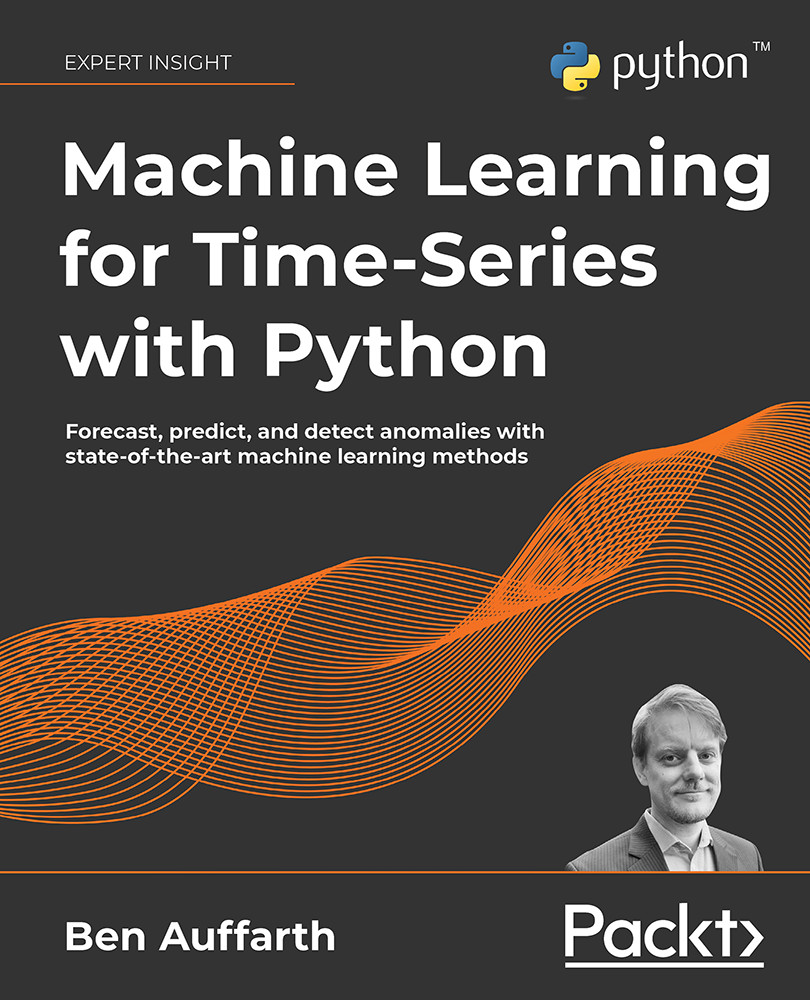
Machine Learning for Time-Series with Python
By :


Machine Learning for Time-Series with Python
By:
Overview of this book
The Python time-series ecosystem is huge and often quite hard to get a good grasp on, especially for time-series since there are so many new libraries and new models. This book aims to deepen your understanding of time series by providing a comprehensive overview of popular Python time-series packages and help you build better predictive systems.
Machine Learning for Time-Series with Python starts by re-introducing the basics of time series and then builds your understanding of traditional autoregressive models as well as modern non-parametric models. By observing practical examples and the theory behind them, you will become confident with loading time-series datasets from any source, deep learning models like recurrent neural networks and causal convolutional network models, and gradient boosting with feature engineering.
This book will also guide you in matching the right model to the right problem by explaining the theory behind several useful models. You’ll also have a look at real-world case studies covering weather, traffic, biking, and stock market data.
By the end of this book, you should feel at home with effectively analyzing and applying machine learning methods to time-series.
Table of Contents (15 chapters)
Preface


Introduction to Time-Series with Python
 Free Chapter
Time-Series Analysis with Python

Preprocessing Time-Series
Introduction to Machine Learning for Time-Series
Forecasting with Moving Averages and Autoregressive Models
Unsupervised Methods for Time-Series
Machine Learning Models for Time-Series
Online Learning for Time-Series
Probabilistic Models for Time-Series
Deep Learning for Time-Series
Reinforcement Learning for Time-Series
Multivariate Forecasting
Other Books You May Enjoy
Index


