Sign In Start Free Trial
Account

Add to playlist

Create a Playlist

Modal Close icon
You need to login to use this feature.
  • Book Overview & Buying A Handbook of Mathematical Models with Python
  • Table Of Contents Toc
A Handbook of Mathematical Models with Python

A Handbook of Mathematical Models with Python

By : Ranja Sarkar
4.1 (7)
close
close
A Handbook of Mathematical Models with Python

A Handbook of Mathematical Models with Python

4.1 (7)
By: Ranja Sarkar

Overview of this book

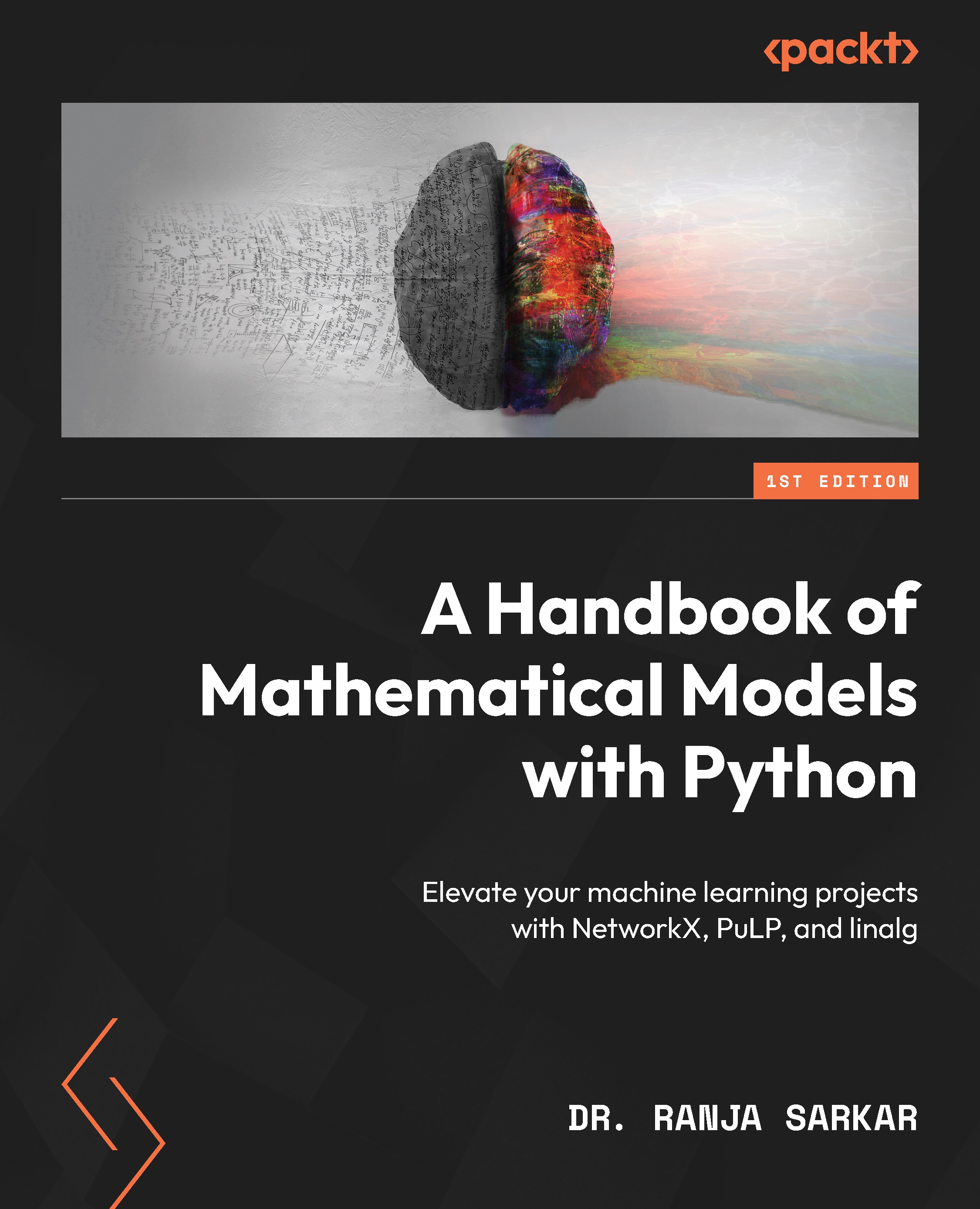
Mathematical modeling is the art of transforming a business problem into a well-defined mathematical formulation. Its emphasis on interpretability is particularly crucial when deploying a model to support high-stake decisions in sensitive sectors like pharmaceuticals and healthcare. Through this book, you’ll gain a firm grasp of the foundational mathematics underpinning various machine learning algorithms. Equipped with this knowledge, you can modify algorithms to suit your business problem. Starting with the basic theory and concepts of mathematical modeling, you’ll explore an array of mathematical tools that will empower you to extract insights and understand the data better, which in turn will aid in making optimal, data-driven decisions. The book allows you to explore mathematical optimization and its wide range of applications, and concludes by highlighting the synergetic value derived from blending mathematical models with machine learning. Ultimately, you’ll be able to apply everything you’ve learned to choose the most fitting methodologies for the business problems you encounter.
Table of Contents (16 chapters)
close
close
1
Part 1:Mathematical Modeling
4
Part 2:Mathematical Tools
11
Part 3:Mathematical Optimization

Exploring Optimization Techniques

This chapter primarily aims to address the question, “Why is optimization necessary while solving problems?” Mathematical optimization, or mathematical programming, is a powerful decision-making tool that has been talked about in depth in the chapters of Part I. What is important is to recall the simple fact that optimization yields the best result to a problem by reducing errors that are, essentially, the gaps between predicted and real data. Optimization comes at a cost; almost all optimization problems are described in terms of costs such as money, time, and resources. This cost function is the error function. If a business problem has clear goals and constraints, such as in the airline and logistics industries, mathematical optimization is applied for efficient decision-making.

In machine learning (ML) problems, the cost is often called the loss function. ML models make predictions about trends or classify data wherein training...

CONTINUE READING
83
Tech Concepts
36
Programming languages
73
Tech Tools
Icon Unlimited access to the largest independent learning library in tech of over 8,000 expert-authored tech books and videos.
Icon Innovative learning tools, including AI book assistants, code context explainers, and text-to-speech.
Icon 50+ new titles added per month and exclusive early access to books as they are being written.
A Handbook of Mathematical Models with Python
notes
bookmark Notes and Bookmarks search Search in title playlist Add to playlist download Download options font-size Font size

Change the font size

margin-width Margin width

Change margin width

day-mode Day/Sepia/Night Modes

Change background colour

Close icon Search
Country selected

Close icon Your notes and bookmarks

Confirmation

Modal Close icon
claim successful

Buy this book with your credits?

Modal Close icon
Are you sure you want to buy this book with one of your credits?
Close
YES, BUY

Submit Your Feedback

Modal Close icon
Modal Close icon
Modal Close icon