Sign In Start Free Trial
Account

Add to playlist

Create a Playlist

Modal Close icon
You need to login to use this feature.
  • Book Overview & Buying Bayesian Analysis with Python
  • Table Of Contents Toc
Bayesian Analysis with Python

Bayesian Analysis with Python - Third Edition

By : Osvaldo Martin
4.6 (21)
close
close
Bayesian Analysis with Python

Bayesian Analysis with Python

4.6 (21)
By: Osvaldo Martin

Overview of this book

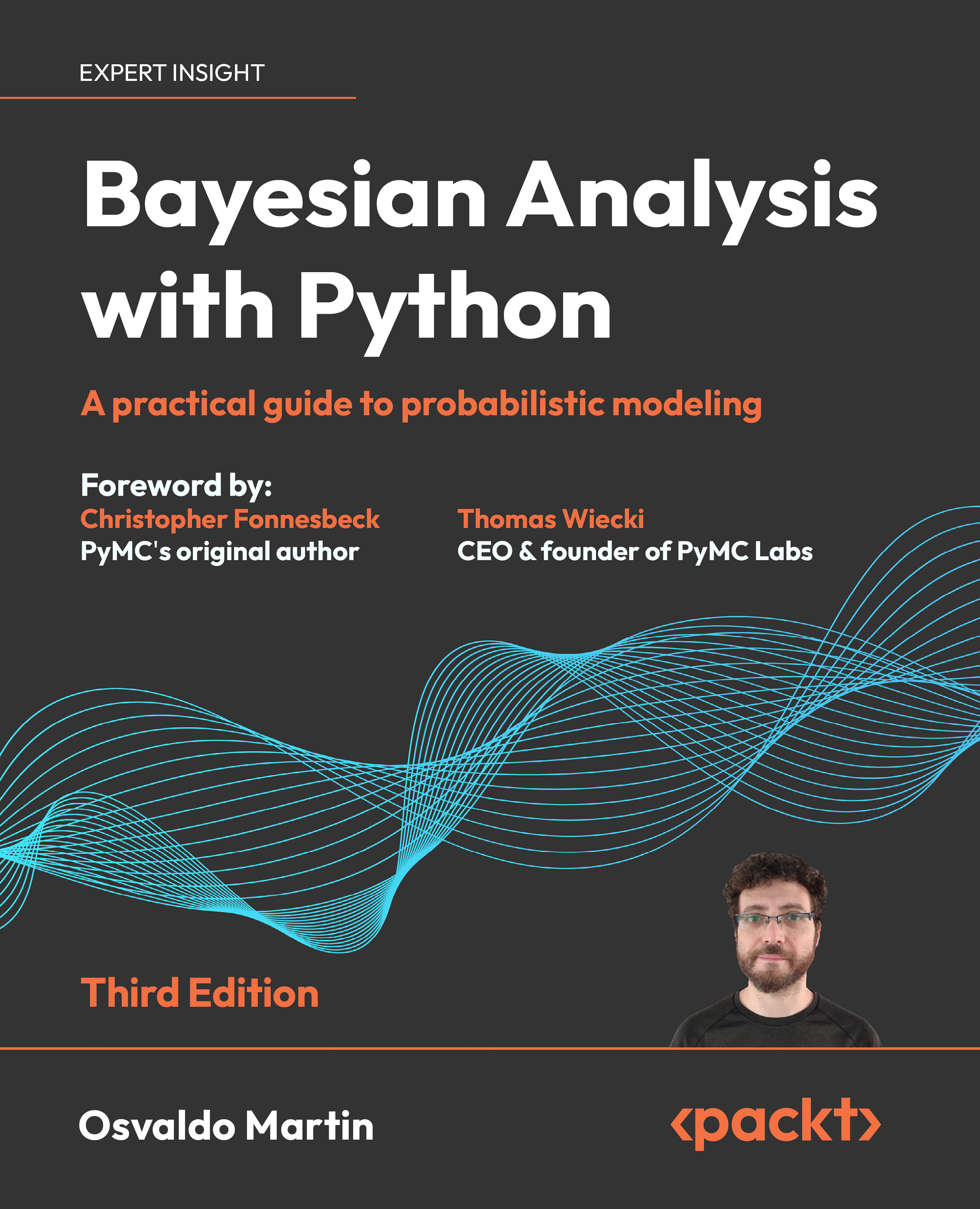
The third edition of Bayesian Analysis with Python serves as an introduction to the main concepts of applied Bayesian modeling using PyMC, a state-of-the-art probabilistic programming library, and other libraries that support and facilitate modeling like ArviZ, for exploratory analysis of Bayesian models; Bambi, for flexible and easy hierarchical linear modeling; PreliZ, for prior elicitation; PyMC-BART, for flexible non-parametric regression; and Kulprit, for variable selection. In this updated edition, a brief and conceptual introduction to probability theory enhances your learning journey by introducing new topics like Bayesian additive regression trees (BART), featuring updated examples. Refined explanations, informed by feedback and experience from previous editions, underscore the book's emphasis on Bayesian statistics. You will explore various models, including hierarchical models, generalized linear models for regression and classification, mixture models, Gaussian processes, and BART, using synthetic and real datasets. By the end of this book, you’ll understand probabilistic modeling and be able to design and implement Bayesian models for data science, with a strong foundation for more advanced study. *Email sign-up and proof of purchase required
Table of Contents (15 chapters)
close
close
Preface
12
Bibliography
13
Other Books You May Enjoy
14
Index

4.7 Variable variance

We have been using the linear motif to model the mean of a distribution and, in the previous section, we used it to model interactions. In statistics, it is said that a linear regression model presents heteroskedasticity when the variance of the errors is not constant in all the observations made. For those cases, we may want to consider the variance (or standard deviation) as a (linear) function of the dependent variable.

The World Health Organization and other health institutions around the world collect data for newborns and toddlers and design growth chart standards. These charts are an essential component of the pediatric toolkit and also a measure of the general well-being of populations to formulate health-related policies, plan interventions, and monitor their effectiveness. An example of such data is the lengths (heights) of newborn/toddler girls as a function of their age (in months):

Code 4.9

data = pd.read_csv("data/babies.csv") ...
CONTINUE READING
83
Tech Concepts
36
Programming languages
73
Tech Tools
Icon Unlimited access to the largest independent learning library in tech of over 8,000 expert-authored tech books and videos.
Icon Innovative learning tools, including AI book assistants, code context explainers, and text-to-speech.
Icon 50+ new titles added per month and exclusive early access to books as they are being written.
Bayesian Analysis with Python
notes
bookmark Notes and Bookmarks search Search in title playlist Add to playlist download Download options font-size Font size

Change the font size

margin-width Margin width

Change margin width

day-mode Day/Sepia/Night Modes

Change background colour

Close icon Search
Country selected

Close icon Your notes and bookmarks

Confirmation

Modal Close icon
claim successful

Buy this book with your credits?

Modal Close icon
Are you sure you want to buy this book with one of your credits?
Close
YES, BUY

Submit Your Feedback

Modal Close icon
Modal Close icon
Modal Close icon