Sign In Start Free Trial
Account

Add to playlist

Create a Playlist

Modal Close icon
You need to login to use this feature.
  • Book Overview & Buying Bayesian Analysis with Python
  • Table Of Contents Toc
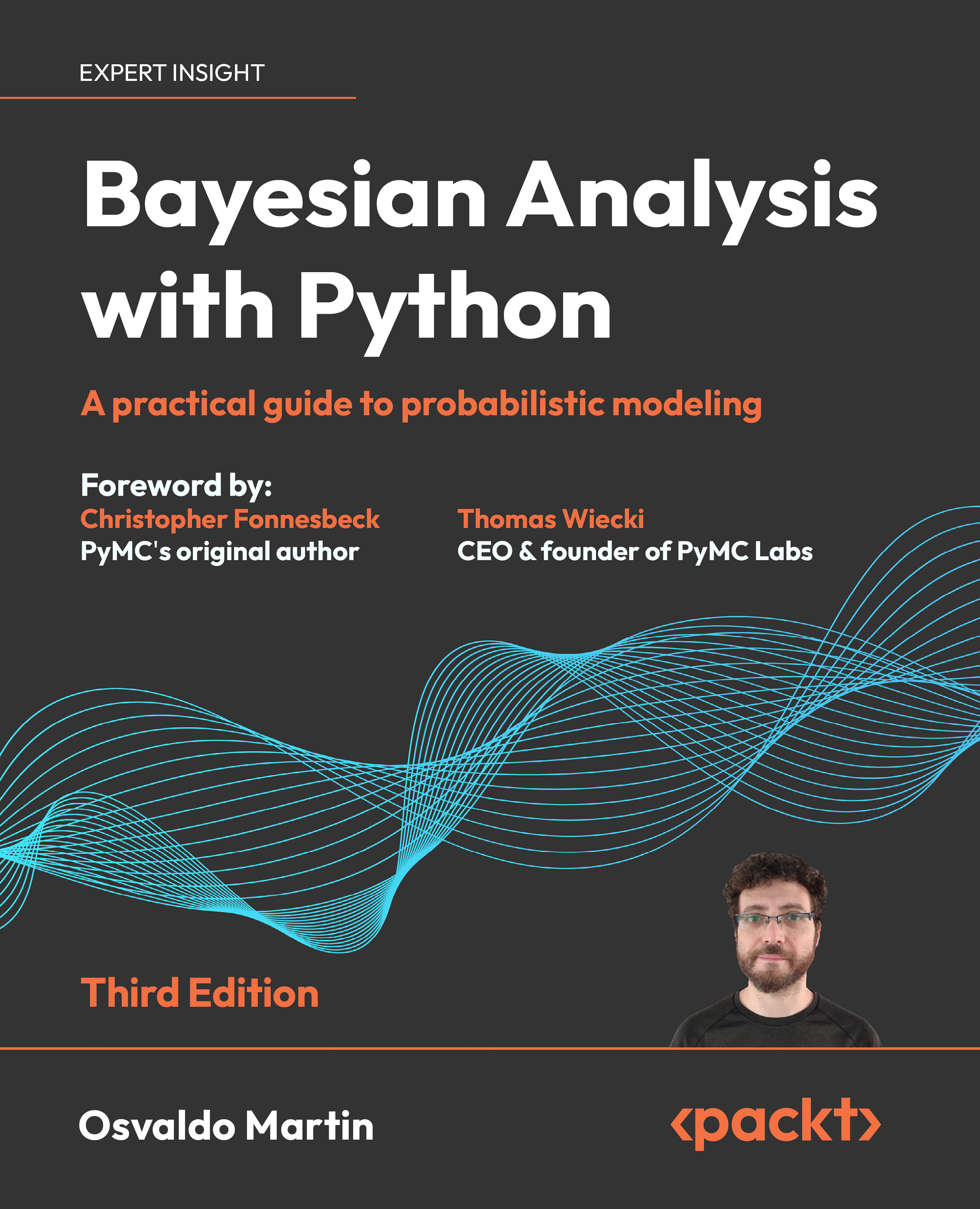
Bayesian Analysis with Python

Bayesian Analysis with Python - Third Edition

By : Osvaldo Martin
4.6 (21)
close
close
Bayesian Analysis with Python

Bayesian Analysis with Python

4.6 (21)
By: Osvaldo Martin

Overview of this book

The third edition of Bayesian Analysis with Python serves as an introduction to the main concepts of applied Bayesian modeling using PyMC, a state-of-the-art probabilistic programming library, and other libraries that support and facilitate modeling like ArviZ, for exploratory analysis of Bayesian models; Bambi, for flexible and easy hierarchical linear modeling; PreliZ, for prior elicitation; PyMC-BART, for flexible non-parametric regression; and Kulprit, for variable selection. In this updated edition, a brief and conceptual introduction to probability theory enhances your learning journey by introducing new topics like Bayesian additive regression trees (BART), featuring updated examples. Refined explanations, informed by feedback and experience from previous editions, underscore the book's emphasis on Bayesian statistics. You will explore various models, including hierarchical models, generalized linear models for regression and classification, mixture models, Gaussian processes, and BART, using synthetic and real datasets. By the end of this book, you’ll understand probabilistic modeling and be able to design and implement Bayesian models for data science, with a strong foundation for more advanced study. *Email sign-up and proof of purchase required
Table of Contents (15 chapters)
close
close
Preface
12
Bibliography
13
Other Books You May Enjoy
14
Index

6.9 Variable selection

Variable selection refers to the process of identifying the most relevant variables in a model from a larger set of potential predictors. We perform variable selection under the assumption that only a subset of variables have a considerable impact on the outcome of interest, while others contribute little or no additional value.

Arguably the ”most Bayesian thing to do” when building a model is to include all the variables that we may think of in a single model and then use the posterior from that model to make predictions or gain an understanding of the relationships of the variables. This is the ”most Bayesian” approach because we are using as much data as possible and incorporating in the posterior the uncertainty about the importance of the variables. However, being more Bayesian than Bayes is not always the best idea. We already saw in Chapter 5 that Bayes factors can be problematic, even when they are a direct consequence of Bayes...

CONTINUE READING
83
Tech Concepts
36
Programming languages
73
Tech Tools
Icon Unlimited access to the largest independent learning library in tech of over 8,000 expert-authored tech books and videos.
Icon Innovative learning tools, including AI book assistants, code context explainers, and text-to-speech.
Icon 50+ new titles added per month and exclusive early access to books as they are being written.
Bayesian Analysis with Python
notes
bookmark Notes and Bookmarks search Search in title playlist Add to playlist download Download options font-size Font size

Change the font size

margin-width Margin width

Change margin width

day-mode Day/Sepia/Night Modes

Change background colour

Close icon Search
Country selected

Close icon Your notes and bookmarks

Confirmation

Modal Close icon
claim successful

Buy this book with your credits?

Modal Close icon
Are you sure you want to buy this book with one of your credits?
Close
YES, BUY

Submit Your Feedback

Modal Close icon
Modal Close icon
Modal Close icon