Sign In Start Free Trial
Account

Add to playlist

Create a Playlist

Modal Close icon
You need to login to use this feature.
  • Book Overview & Buying 30 Agents Every AI Engineer Must Build
  • Table Of Contents Toc
30 Agents Every AI Engineer Must Build

30 Agents Every AI Engineer Must Build

By : Imran Ahmad
4.5 (2)
close
close
30 Agents Every AI Engineer Must Build

30 Agents Every AI Engineer Must Build

4.5 (2)
By: Imran Ahmad

Overview of this book

As AI evolves from passive tools into proactive collaborators, intelligent agents are leading a fundamental shift in computing. This guide provides the critical knowledge of agent architectures, practical tools, and industry approaches needed to build robust, autonomous AI systems that do more than just generate text—they act. You will begin by mastering foundational capabilities: perception, memory, reasoning, planning, and learning. You’ll gain deep insight into the cognitive loops that drive autonomous behavior and build sophisticated architectures using frameworks such as LangChain and LangGraph. The book explores high-impact applications across diverse sectors, including software development, finance, manufacturing, legal and education, to show how agents optimize workflows, automate quality control, and enhance advisory systems. Through real-world case studies, you will create agents capable of contextual reasoning, effective tool use, and seamless human collaboration. Finally, you’ll learn essential strategies for deployment, management, and ethical alignment, ensuring your AI solutions are both scalable and responsible in production environments. Whether you're building your first intelligent agent or improving business systems, this book provides clear, actionable guidance for creating scalable and responsible AI solutions. *Email sign-up and proof of purchase required
Table of Contents (19 chapters)
close
close
18
Index

The Agent Development Lifecycle

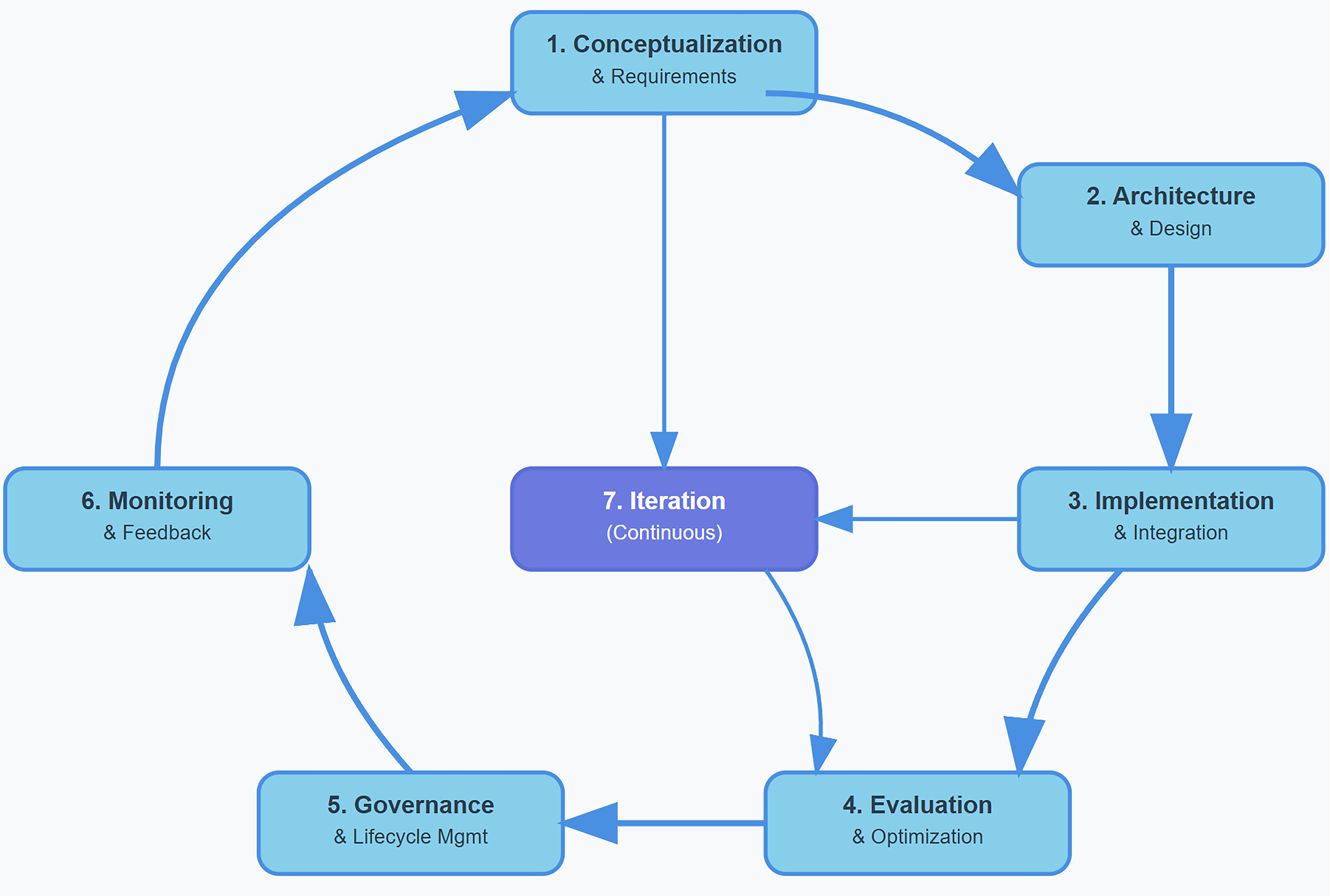
The development of autonomous agents follows a structured, iterative lifecycle that serves as a roadmap, but one that fundamentally diverges from traditional software engineering practices. Unlike procedural systems that rely on static logic and predefined behavior, intelligent agents must operate within dynamic, uncertain environments. They interpret ambiguous inputs, make decisions under uncertainty, invoke external tools, and continuously refine their behavior through feedback. These evolving, goal-directed behaviors require a lifecycle model that is not just iterative, but also deeply adaptive, supporting reasoning, learning, memory, and orchestration. The Agent Development Lifecycle (ADL) was designed to meet this need, providing a flexible framework that mirrors the operational complexity of modern agent-based systems.

This section outlines the ADL, a practical framework that spans from early conceptualization to post-deployment refinement. It provides developers and organizations with a roadmap for building robust, goal-aligned agentic systems that continuously improve over time.

Image 8

Figure 1.8 – Agent Development Lifecycle

The following subsections explore each phase of this lifecycle in detail, examining the unique considerations and best practices that distinguish agent development from conventional software engineering approaches.

Conceptualization and requirements analysis

Agent development begins with defining the problem space and articulating the agent's goals in context. This is more than requirements gathering; it's an exercise in modeling a cognitive workload, meaning the mental processes the agent must simulate or manage in order to operate intelligently. This includes tracking user intent, interpreting environmental signals, selecting appropriate strategies, and updating plans based on feedback, functions traditionally associated with human cognition. Developers must analyze the domain, understand the user's intent, and assess the capabilities the agent will require to operate effectively. Unlike static applications, agent goals may evolve and must be formulated with sufficient flexibility to accommodate environmental changes and emerging requirements.

In this stage, developers identify the operating environment, map objectives into achievable sub-goals, and determine the ethical, technical, and operational boundaries. For instance, an agent assisting in regulatory compliance may require explicit constraints on behavior that are both encoded into rules and monitored during execution. Importantly, this phase includes evaluating success metrics (performance, alignment, and user trust) all of which guide future decisions in architecture and implementation.

To summarize, key activities in this conceptualization phase include the following:

  • Defining clear, high-level agent goals
  • Mapping these goals into achievable sub-goals or tasks
  • Setting measurable success metrics (e.g., performance, alignment, user trust) to guide development and evaluation

Architecture and design

Once the objectives are well-scoped, the agent's internal architecture is designed to support them. As discussed in Architecture of agents section , this includes choosing between cognitive models, such as ReAct, plan-and-execute, or BDI, and specifying components responsible for sensing, planning, acting, and learning. The architecture must balance modularity, autonomy, and extensibility.

In this stage, agent designers define memory strategies (short-term, long-term, episodic), internal communication flows, and interaction points with external systems. Just as importantly, they ensure the agent can interoperate via established protocols and persist state across sessions. Security and safety mechanisms are integrated from the start, not as afterthoughts. This design phase forms the conceptual and technical backbone of the entire system.

To ensure traceability and informed iteration, many teams adopt Architecture Decision Records (ADRs) to document key design decisions, such as why a particular memory model, orchestration strategy, or protocol framework was selected. This helps future contributors understand tradeoffs, revisit past assumptions, and evolve agent architectures without losing institutional knowledge.

Implementation and integration

Implementation brings the architecture to life using development frameworks such as LangChain, CrewAI, or LangGraph. Developers construct modules for reasoning, perception, planning, and memory, and bind them through workflow graphs or event-driven engines. Function calling APIs, memory databases, and orchestration layers are stitched together using open toolchains.

The focus here is on cohesion and correctness. Modules must interact predictably, and the agent's behavior must match its defined goals. Developers run local simulations or stage deployments to test the interaction of cognitive components under load. It's at this point that real-world constraints emerge (latency, context limits, token usage, etc.) and require engineering trade-offs to balance capability with cost.

To support robust iteration, teams often integrate agent behavior testing into CI/CD pipelines. These pipelines validate cognitive workflows (e.g., reasoning chains, tool calls, memory usage) using automated test harnesses, synthetic prompts, and simulated failure cases, ensuring stability across deployments and catching regressions early.

Evaluation and optimization

After deployment in a testing or controlled environment, agents must be rigorously evaluated. Unlike conventional systems, success is not always binary. Performance metrics include task completion rates, decision quality, and robustness under ambiguity. Evaluation may involve synthetic environments or production shadows, with extensive logging and telemetry pipelines in place.

Feedback from internal reflection mechanisms, such as confidence scoring or critique loops, is coupled with external signals like user satisfaction and tool performance. These insights feed back into the architecture, enabling adaptive changes. Optimization in this phase may include refining planning depth, adjusting context window strategies, or improving memory relevance scoring.

Typical optimization metrics include task success rate, average response time, user satisfaction scores, tool invocation latency, and fallback frequency (how often the agent defers or fails). Tracking these metrics enables teams to iteratively improve agent quality based on both performance and user trust signals.

Governance and lifecycle management

Deploying an agent is not the end of its development but the beginning of a continuous improvement loop. Lifecycle management includes proactive monitoring, log auditing, model updating, and failure recovery. Governance also encompasses security patching, compliance auditing, and ethical oversight, ensuring the agent remains reliable, transparent, and aligned with human intent.

This phase encompasses both the monitoring and iterative improvement processes. Agents deployed at scale must support observability and incident response. Tools such as LangSmith or Prometheus provide real-time insights into agent performance and health. Furthermore, policies for model retraining, versioning, and rollback ensure that system changes are deliberate and recoverable. Continuous iteration based on performance data, user feedback, and changing requirements ensures that agents evolve and improve over their operational lifetime. This is critical in mission-critical domains like finance, legal, or healthcare, where unexpected behavior can have significant consequences.

For example, logs from LangSmith or Prometheus might reveal a drop in tool invocation success rates or an increase in hallucinated outputs. This can trigger alerts, initiate human review, and lead to adjustments in prompt design, fine-tuning, or even retraining the underlying model. Incorporating this loop—from observability to auditing to retraining—is essential for building resilient agents in production.

CONTINUE READING
83
Tech Concepts
36
Programming languages
73
Tech Tools
Icon Unlimited access to the largest independent learning library in tech of over 8,000 expert-authored tech books and videos.
Icon Innovative learning tools, including AI book assistants, code context explainers, and text-to-speech.
Icon 50+ new titles added per month and exclusive early access to books as they are being written.
30 Agents Every AI Engineer Must Build
notes
bookmark Notes and Bookmarks search Search in title playlist Add to playlist download Download options font-size Font size

Change the font size

margin-width Margin width

Change margin width

day-mode Day/Sepia/Night Modes

Change background colour

Close icon Search
Country selected

Close icon Your notes and bookmarks

Confirmation

Modal Close icon
claim successful

Buy this book with your credits?

Modal Close icon
Are you sure you want to buy this book with one of your credits?
Close
YES, BUY

Submit Your Feedback

Modal Close icon
Modal Close icon
Modal Close icon