


-
Book Overview & Buying
-
Table Of Contents

30 Agents Every AI Engineer Must Build
By :


30 Agents Every AI Engineer Must Build
By:
Overview of this book
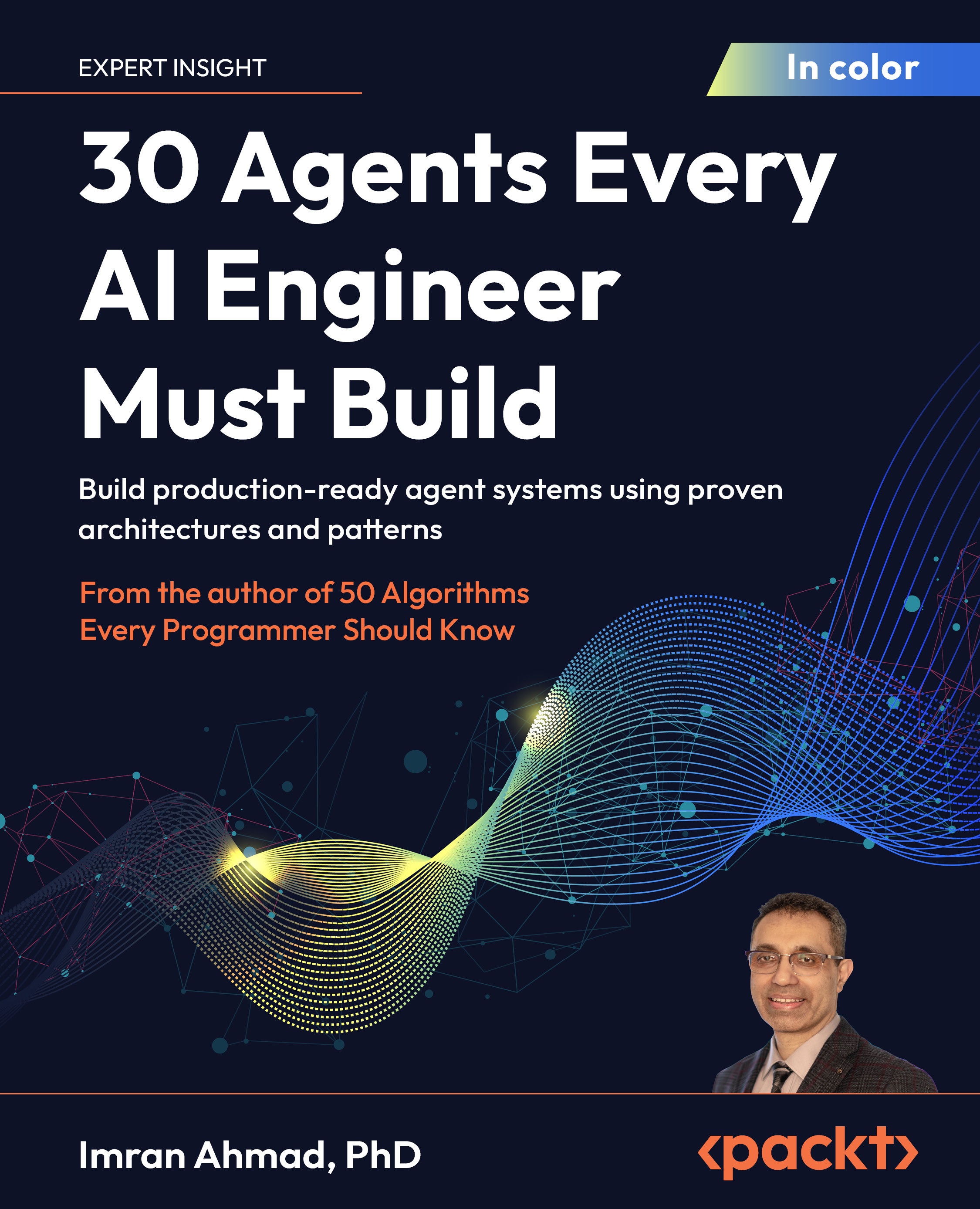
As AI evolves from passive tools into proactive collaborators, intelligent agents are leading a fundamental shift in computing. This guide provides the critical knowledge of agent architectures, practical tools, and industry approaches needed to build robust, autonomous AI systems that do more than just generate text—they act.
You will begin by mastering foundational capabilities: perception, memory, reasoning, planning, and learning. You’ll gain deep insight into the cognitive loops that drive autonomous behavior and build sophisticated architectures using frameworks such as LangChain and LangGraph.
The book explores high-impact applications across diverse sectors, including software development, finance, manufacturing, legal and education, to show how agents optimize workflows, automate quality control, and enhance advisory systems. Through real-world case studies, you will create agents capable of contextual reasoning, effective tool use, and seamless human collaboration. Finally, you’ll learn essential strategies for deployment, management, and ethical alignment, ensuring your AI solutions are both scalable and responsible in production environments.
Whether you're building your first intelligent agent or improving business systems, this book provides clear, actionable guidance for creating scalable and responsible AI solutions.
*Email sign-up and proof of purchase required
Table of Contents (19 chapters)
Preface


 Free Chapter
Chapter 1: Foundations of Agent Engineering

Chapter 2: The Agent Engineer's Toolkit
Chapter 3: The Art of Agent Prompting
Chapter 4: Agent Deployment and Responsible Development
Chapter 5: Foundational Cognitive Architectures
Chapter 6: Information Retrieval and Knowledge Agents
Chapter 7: Tool Manipulation and Orchestration Agents
Chapter 8: Data Analysis and Reasoning Agents
Chapter 9: Software Development Agents
Chapter 10: Conversational and Content Creation Agents
Chapter 11: Multi-Modal Perception Agents
Chapter 12: Ethical and Explainable Agents
Chapter 13: Healthcare and Scientific Agents
Chapter 14: Financial and Legal Domain Agents
Chapter 15: Education and Knowledge Agents
Chapter 16: Embodied and Physical World Agents
Chapter 17: Epilogue: The Future of Intelligent Agents
Index


