-
Book Overview & Buying
-
Table Of Contents
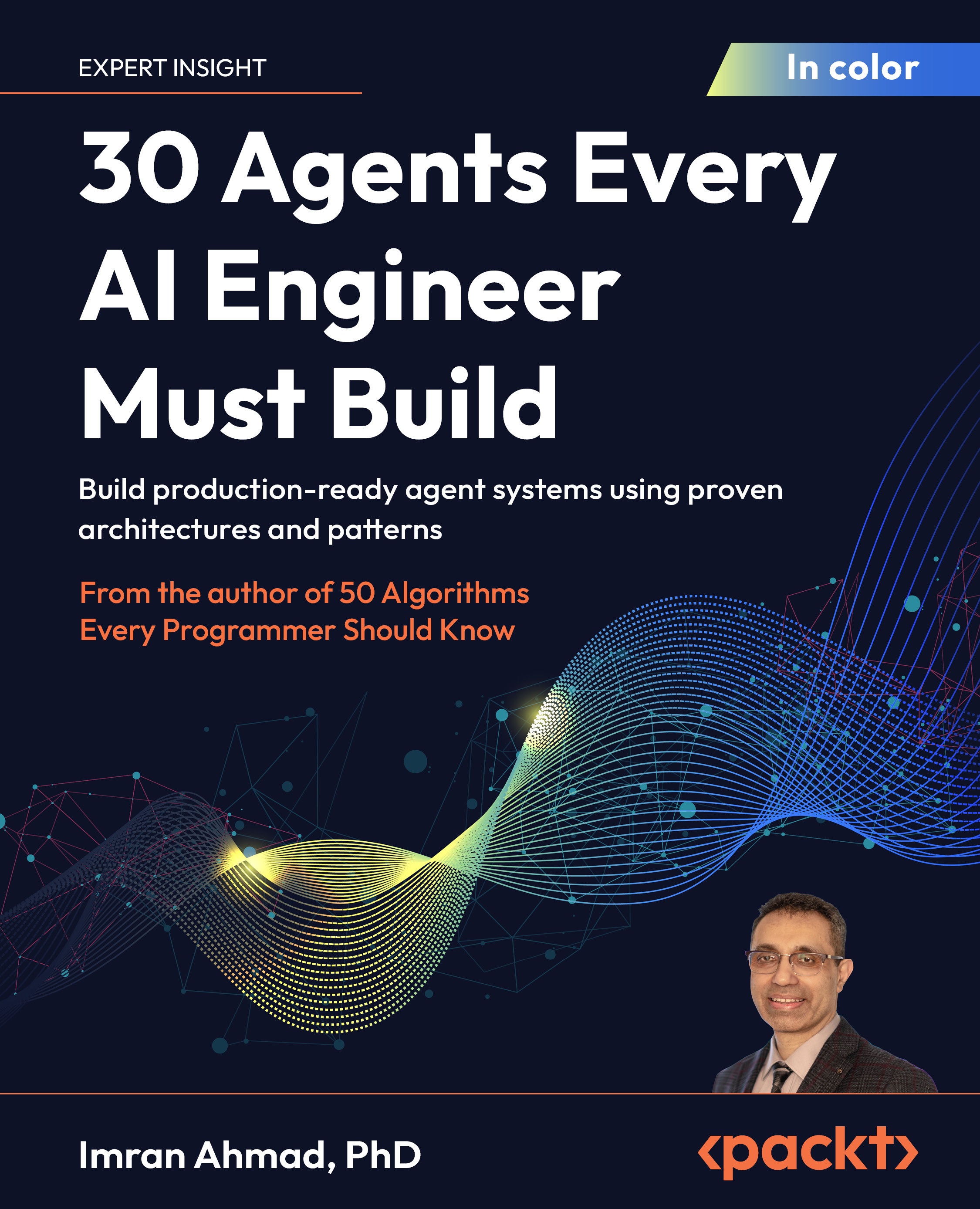
30 Agents Every AI Engineer Must Build
By :
The AI landscape is undergoing a profound transformation. We are moving from an era of passive, reactive AI systems to one dominated by autonomous, goal-directed intelligent agents: systems that can perceive their environment, make decisions, and take actions to achieve objectives with minimal human intervention. This shift is not incremental. It represents a fundamental change in how we conceive of, design, and deploy computational systems.
As the author of 50 Algorithms Every Programmer Should Know, I have observed how understanding the fundamental building blocks of computer science provides engineers with the capabilities to build increasingly sophisticated systems. Just as algorithms form the foundation of traditional software engineering, intelligent agents represent the next evolutionary step in AI development. Understanding these agent architectures gives you the power to create systems that can solve problems of unprecedented complexity.
This transformation is architectural, not merely incremental. The distinction between a system that generates text in response to a prompt and a system that maintains persistent goals, reasons about its environment, selects and invokes tools, and adapts its strategy based on feedback is not a matter of degree. It is a qualitative shift in the kind of computational entity we are building. The closest historical analogue is the transition from procedural to object-oriented programming in the 1980s, which did not simply change how code was written but fundamentally altered how engineers conceptualized the relationship between data and behavior. The shift to agent-based systems carries similar implications for how we conceptualize the relationship between human intent and computational action.
The core thesis of this book is straightforward: mastering a carefully selected set of intelligent agent architectures will give you the capabilities to build transformative AI systems across virtually any domain. These are not theoretical constructs alone. They are practical, implementable patterns that solve real-world problems. The emergence of powerful LLMs has provided the cognitive engine that makes these agent architectures possible at scale for the first time. However, raw LLMs alone are not enough. The key to building effective systems lies in understanding how to architect agents that decompose complex tasks into manageable steps, connect to external tools and data sources, maintain context and memory across interactions, collaborate with humans and other agents, learn from experience, and make ethical decisions aligned with human values.
Consider a concrete example of what this shift means in practice. A traditional software system that processes insurance claims follows a fixed pipeline: validate the form, check the policy, compute the payout, and generate the letter. An agent-based system performing the same task operates differently. It reads the claim, identifies ambiguities, consults the policy database, cross-references historical claims for fraud indicators, escalates edge cases to a human adjuster, and generates a summary that explains its reasoning. It adapts to exceptions it has never encountered before by reasoning from first principles rather than following hardcoded branches. This book teaches you how to build systems like this.
This book bridges the gap between theoretical agent concepts and practical implementation. We will not merely describe what these agents can do. We will show you exactly how to build them. Every chapter includes working code, formal architectural patterns, real-world case studies, and guidance on avoiding common implementation pitfalls.
This book is written for practitioners who need to implement working systems, and not merely understand concepts. It is ideal for AI and ML engineers looking to move beyond model training to building complete intelligent systems, software engineers expanding their toolkit to include agent-based AI solutions, technical leaders responsible for AI strategy and implementation, product managers who need to understand what is possible with modern agent architectures, and domain specialists looking to apply AI agents in their field.
While some familiarity with ML concepts and Python programming is assumed, the book focuses on architectural patterns rather than low-level implementation details, making it accessible to readers with various technical backgrounds. Each chapter is self-contained enough to be read independently, though reading them in sequence provides the most comprehensive foundation.
This book does not require a background in formal logic, control theory, or cognitive science, though readers with such backgrounds will recognize the theoretical traditions that inform many of the architectural patterns presented. The emphasis throughout is on building working systems informed by sound principles, rather than on proofs or formal verification.
Chapter 1, Foundations of Agent Engineering, introduces the core concepts, terminology, and architectural patterns that underpin all intelligent agent systems. It traces the evolution from simple rule-based systems to modern LLM-powered agents and establishes the cognitive architecture, development lifecycle, and evaluation frameworks used throughout the book.
Chapter 2, The Agent Engineer's Toolkit, surveys the essential frameworks, tools, and development environments for building agent systems. It provides a comprehensive analysis of LangChain, LlamaIndex, AutoGPT, and other frameworks, along with guidance on LLM selection, fine-tuning strategies, and foundational infrastructure including vector databases and observability solutions.
Chapter 3, The Art of Agent Prompting, explores advanced prompt engineering techniques specifically tailored for agent systems. It covers system prompt design for shaping agent cognition, agent-to-agent communication protocols, and iterative prompt development methodologies for testing and refinement.
Chapter 4, Agent Deployment and Responsible Development, addresses the practical considerations of scaling, securing, and ensuring ethical behavior in production agent systems. It covers infrastructure requirements, prompt injection defenses, user data protection, and responsible AI frameworks including bias detection, transparency requirements, and regulatory compliance.
Chapter 5, Foundational Cognitive Architectures, presents the core agents that form the building blocks of all intelligent systems. It covers the autonomous decision-making agent, the planning agent with tree-of-thought reasoning, and the memory-augmented agent with working, episodic, and semantic memory implementations. These patterns provide the cognitive substrate upon which all subsequent domain-specific agents are constructed.
Chapter 6, Information Retrieval and Knowledge Agents, examines how agents connect LLMs to external information sources. It covers advanced retrieval-augmented generation techniques, document intelligence architectures, and scientific research agents for literature review automation and hypothesis generation.
Chapter 7, Tool Manipulation and Orchestration Agents, explores systems that coordinate tools, functions, and other agents. It covers function-calling architecture patterns, chain-of-agents orchestration with task routing and delegation, and agentic workflow systems with human-in-the-loop coordination.
Chapter 8, Data Analysis and Reasoning Agents, focuses on agents specialized in analyzing information and drawing insights. It covers data exploration and visualization recommendation systems, verification and validation agents for factual consistency checking, and general problem solvers with domain-agnostic reasoning frameworks.
Chapter 9, Software Development Agents, covers agents that assist in code creation, testing, and maintenance. It presents program synthesis techniques with LLMs, security-hardened agent patterns for prompt injection defense, and self-improving agents that learn from user feedback.
Chapter 10, Conversational and Content Creation Agents, explores agents that generate, modify, and manage different forms of content. It covers natural dialog management, personality modeling, multi-modal content generation, and recommendation agents with hybrid recommender architectures.
Chapter 11, Multi-Modal Perception Agents, examines agents that process and understand various forms of input data. It covers vision-language agents for image understanding, audio processing agents for speech recognition and sentiment analysis, and physical world sensing agents for IoT data integration.
Chapter 12, Ethical and Explainable Agents, focuses on agents designed with transparency, accountability, and values alignment. It covers value alignment frameworks, ethical decision-making models, reasoning transparency techniques, and decision explanation frameworks for safety-critical applications. The ethical and explainability frameworks established here serve as prerequisites for the regulated-domain agents in Chapters 13 through 16.
Chapter 13, Healthcare and Scientific Agents, explores agents transforming biomedical research and patient care. It covers medical knowledge integration, patient data analysis patterns, clinical decision support frameworks, and scientific discovery agents for literature synthesis and hypothesis generation.
Chapter 14, Financial and Legal Domain Agents, examines agents specialized for regulated industries with complex requirements. It covers market data analysis architectures, risk assessment frameworks, personalized financial planning, legal knowledge base integration, case analysis, and contract analysis frameworks.
Chapter 15, Education and Knowledge Agents, covers agents that facilitate learning, teaching, and knowledge transfer. It presents personalized curriculum planning, adaptive learning techniques, collective intelligence architectures with multi-agent collaboration, and consensus mechanisms for emergent intelligence.
Chapter 16, Embodied and Physical World Agents, focuses on agents that bridge digital intelligence with physical environments. It covers robotics control interfaces, physical world reasoning frameworks, perception-action loops, and cross-domain knowledge synthesis for complex systems modeling.
Epilogue, The Future of Intelligent Agents, examines emerging paradigms including autonomous agent evolution and adaptation, agent societies and emergent behaviors, brain-inspired cognitive architectures, and strategic considerations for building agent capability roadmaps within organizations.
This book is designed to accommodate three distinct reading approaches:
Every chapter follows a consistent six-part structure: conceptual foundation, implementation guide with working code, real-world case studies, design patterns and variations, integration considerations for combining agents into larger systems, and common pitfalls that capture lessons from production deployments.
To follow the examples in this book, you will need a computer running macOS, Windows, or Linux (8 GB RAM minimum; 16 GB recommended), Python 3.10 or later, git, and a terminal. A Python virtual environment tool such as venv, conda, or uv is recommended. An NVIDIA GPU with CUDA 12+ is optional but useful for experimenting with local models. The code examples in the book run on CPU by default.
Familiarity with Python programming and basic machine learning concepts will help you get the most from the implementation sections. Experience with frameworks such as LangChain or LlamaIndex is helpful but not required, as the book introduces these tools progressively.
|
Software/hardware covered in the book |
|---|
|
Python 3.10+ |
|
LangChain/LangGraph 0.2+ |
|
CrewAI/AutoGen (Chapters 2, 7, and 9) |
|
LlamaIndex (Chapters 2 and 6) |
|
OpenAI API (GPT-4o/GPT-4o-mini) |
|
Anthropic API (Claude 3.5+) |
|
ChromaDB/FAISS |
|
Pinecone/Weaviate/Milvus (Chapters 2, 4, 5, and 6) |
|
sentence-transformers/scikit-learn (Chapters 6 and 8) |
|
pandas/NumPy/statsmodels (Chapter 8) |
|
Matplotlib/Plotly (Chapter 8) |
|
Hugging Face Transformers/PyTorch (Chapters 8 and 11) |
|
pytest (Chapters 5 and 9) |
|
Flask/Pydantic (Chapter 9) |
|
Tesseract OCR (Chapter 6) |
|
Neo4j (Chapter 6) |
|
SHAP/LIME (Chapter 12) |
|
FHIR Resources (Chapter 13) |
|
Finnhub API/Tavily API (Chapter 14) |
|
yfinance/NetworkX (Chapters 14 and 15) |
|
ROS2 Humble+ (Chapter 16, optional) |
|
Docker/Kubernetes (Chapters 4 and 9, optional) |
|
Grafana/LangSmith (Chapter 4, optional) |
|
Apache Kafka (Chapter 4, optional) |
|
NVIDIA GPU with CUDA 12+, 16 GB VRAM (Chapter 11, optional) |
Before starting with Chapter 5, which introduces the first hands-on code implementations, we recommend setting up a dedicated development environment. Create a Python virtual environment, install the core dependencies (langchain, openai, chromadb), and configure your API keys as environment variables. The README file in the GitHub repository provides step-by-step setup instructions for all major operating systems.
The code bundle for the book is hosted on GitHub athttps://github.com/PacktPublishing/30-Agents-Every-AI-Engineer-Must-Build/. We also have other code bundles from our rich catalog of books and videos available at https://github.com/PacktPublishing. Check them out!
There are a number of text conventions used throughout this book.
CodeInText: Indicates code words in text, database table names, folder names, filenames, file extensions, pathnames, dummy URLs, user input, and Twitter handles. For example: "Initialize the agent by calling AgentExecutor.from_tools() with your configured tool list."
A block of code is set as follows:
class AutonomousAgent:
def __init__(self, llm, tools, memory):
self.llm = llm
self.tools = tools
self.memory = memory
Bold: Indicates a new term, an important word, or words that you see on the screen. For instance, words in menus or dialog boxes appear in the text like this. For example: " Navigate to the Settings panel and select API Keys."
Warnings or important notes appear like this.
Tips and tricks appear like this.
Feedback from our readers is always welcome.
General feedback: If you have questions about any aspect of this book or have any general feedback, please email us at customercare@packt.com and mention the book's title in the subject of your message.
Errata: Although we have taken every care to ensure the accuracy of our content, mistakes do happen. If you have found a mistake in this book, we would be grateful if you reported this to us. Please visit http://www.packt.com/submit-errata, click Submit Errata, and fill in the form.
Piracy: If you come across any illegal copies of our works in any form on the internet, we would be grateful if you would provide us with the location address or website name. Please contact us at [email protected] with a link to the material.
If you are interested in becoming an author: If there is a topic that you have expertise in and you are interested in either writing or contributing to a book, please visit http://authors.packt.com/.
Change the font size
Change margin width
Change background colour