Sign In Start Free Trial
Account

Add to playlist

Create a Playlist

Modal Close icon
You need to login to use this feature.
  • Book Overview & Buying DAX for Humans
  • Table Of Contents Toc
DAX for Humans

DAX for Humans

By : Greg Deckler
5 (2)
close
close
DAX for Humans

DAX for Humans

5 (2)
By: Greg Deckler

Overview of this book

Although DAX has been around for over a decade, many struggle to master the language primarily because DAX is often taught through the CALCULATE function, which is the most complex and unintuitive function in all of DAX. But what if DAX could be taught without CALCULATE? The result would be an incredibly intuitive and easy way to learn DAX. DAX for Humans stands the traditional approach to learning DAX on its head, foregoing the traditional, legacy methods of learning DAX for a more modern approach that focuses on core DAX concepts and not any specific function. Even if you know nothing about DAX, from the very first chapter you will learn the essentials of the DAX language, as well as a single pattern to solve the majority of DAX problems. From that point forward, you’ll explore how to work with the basic building blocks of the DAX language and apply what you learn to real-world business scenarios across customers, human resources, projects, finance, operations, and more. By the end of this book, you’ll be able to apply your DAX skills to simple, complex, and advanced scenarios; understand how to optimize and debug your DAX code; and even know how to efficiently apply artificial intelligence to help you write and debug your DAX code.
Table of Contents (18 chapters)
close
close
2
Foreword

General Example

We have covered enough theory and introduced enough tools, so let’s take a closer look at an example scenario based on a real-world question that appeared in the Power BI Community forums.

To explore this scenario, import the DateTimeTable, Dim_Department, and Tracking_History sheets from the Excel spreadsheet, Chapter15_Data.xlsx which can be found in the GitHub repository for this book: https://github.com/gdeckler/DAX-For-Humans/tree/main/book.

It is worth noting that the DateTimeTable consists of 1,776 rows of data containing a single column called Date with datetime values for each hour of the day between the dates of January 1st, 2020 and March 14th. The Tracking_History table is the main fact table and contains just over 59,000 rows.

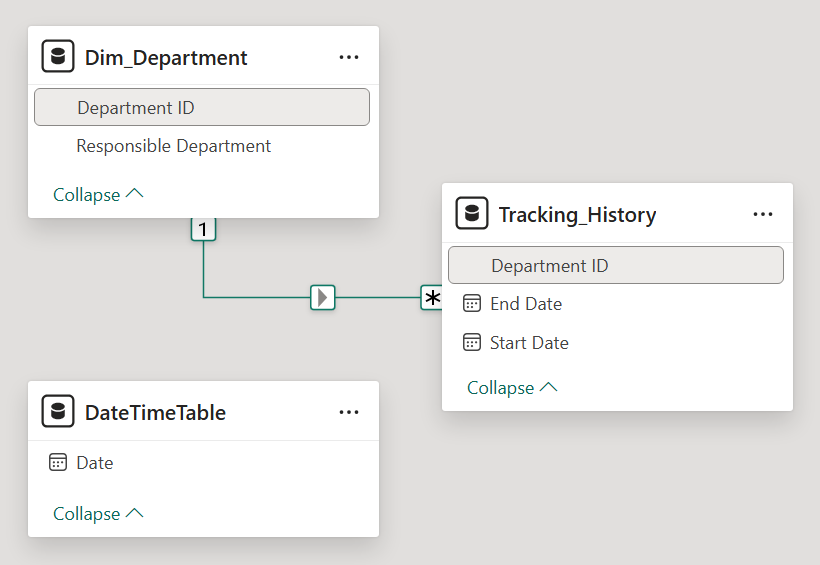
Create a relationship between the Dim_Department and Tracking_History tables using the common Department ID columns in both tables. Your semantic model should look like the following:

A screenshot of a computer AI-generated content may be incorrect.

Figure 15.6: Scenario semantic model

Now...

CONTINUE READING
83
Tech Concepts
36
Programming languages
73
Tech Tools
Icon Unlimited access to the largest independent learning library in tech of over 8,000 expert-authored tech books and videos.
Icon Innovative learning tools, including AI book assistants, code context explainers, and text-to-speech.
Icon 50+ new titles added per month and exclusive early access to books as they are being written.
DAX for Humans
notes
bookmark Notes and Bookmarks search Search in title playlist Add to playlist download Download options font-size Font size

Change the font size

margin-width Margin width

Change margin width

day-mode Day/Sepia/Night Modes

Change background colour

Close icon Search
Country selected

Close icon Your notes and bookmarks

Confirmation

Modal Close icon
claim successful

Buy this book with your credits?

Modal Close icon
Are you sure you want to buy this book with one of your credits?
Close
YES, BUY

Submit Your Feedback

Modal Close icon
Modal Close icon
Modal Close icon