Sign In Start Free Trial
Account

Add to playlist

Create a Playlist

Modal Close icon
You need to login to use this feature.
  • Book Overview & Buying Python Feature Engineering Cookbook
  • Table Of Contents Toc
Python Feature Engineering Cookbook

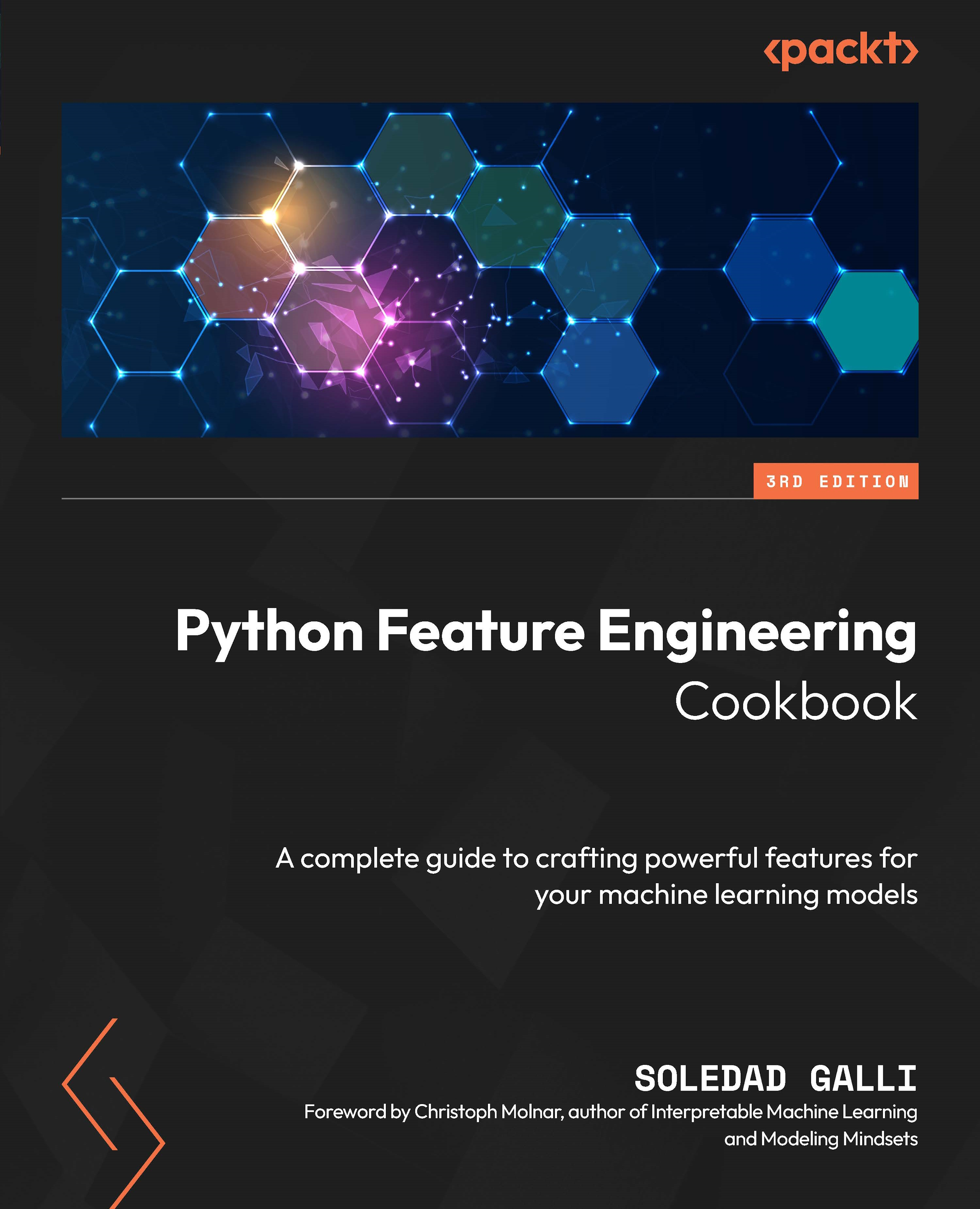
Python Feature Engineering Cookbook - Third Edition

By : Galli
close
close
Python Feature Engineering Cookbook

Python Feature Engineering Cookbook

By: Galli

Overview of this book

Streamline data preprocessing and feature engineering in your machine learning project with this third edition of the Python Feature Engineering Cookbook to make your data preparation more efficient. This guide addresses common challenges, such as imputing missing values and encoding categorical variables using practical solutions and open source Python libraries. You’ll learn advanced techniques for transforming numerical variables, discretizing variables, and dealing with outliers. Each chapter offers step-by-step instructions and real-world examples, helping you understand when and how to apply various transformations for well-prepared data. The book explores feature extraction from complex data types such as dates, times, and text. You’ll see how to create new features through mathematical operations and decision trees and use advanced tools like Featuretools and tsfresh to extract features from relational data and time series. By the end, you’ll be ready to build reproducible feature engineering pipelines that can be easily deployed into production, optimizing data preprocessing workflows and enhancing machine learning model performance.
Table of Contents (14 chapters)
close
close

Imputing Missing Data

Missing data—meaning the absence of values for certain observations—is an unavoidable problem in most data sources. Some machine learning model implementations can handle missing data out of the box. To train other models, we must remove observations with missing data or transform them into permitted values.

The act of replacing missing data with their statistical estimates is called imputation. The goal of any imputation technique is to produce a complete dataset. There are multiple imputation methods. We select which one to use, depending on whether the data is missing at random, the proportion of missing values, and the machine learning model we intend to use. In this chapter, we will discuss several imputation methods.

This chapter will cover the following recipes:

  • Removing observations with missing data
  • Performing mean or median imputation
  • Imputing categorical variables
  • Replacing missing values with an arbitrary number
  • Finding extreme values for imputation
  • Marking imputed values
  • Implementing forward and backward fill
  • Carrying out interpolation
  • Performing multivariate imputation by chained equations
  • Estimating missing data with nearest neighbors
CONTINUE READING
83
Tech Concepts
36
Programming languages
73
Tech Tools
Icon Unlimited access to the largest independent learning library in tech of over 8,000 expert-authored tech books and videos.
Icon Innovative learning tools, including AI book assistants, code context explainers, and text-to-speech.
Icon 50+ new titles added per month and exclusive early access to books as they are being written.
Python Feature Engineering Cookbook
notes
bookmark Notes and Bookmarks search Search in title playlist Add to playlist download Download options font-size Font size

Change the font size

margin-width Margin width

Change margin width

day-mode Day/Sepia/Night Modes

Change background colour

Close icon Search
Country selected

Close icon Your notes and bookmarks

Confirmation

Modal Close icon
claim successful

Buy this book with your credits?

Modal Close icon
Are you sure you want to buy this book with one of your credits?
Close
YES, BUY

Submit Your Feedback

Modal Close icon
Modal Close icon
Modal Close icon